Showing posts with label Seafood. Show all posts
,


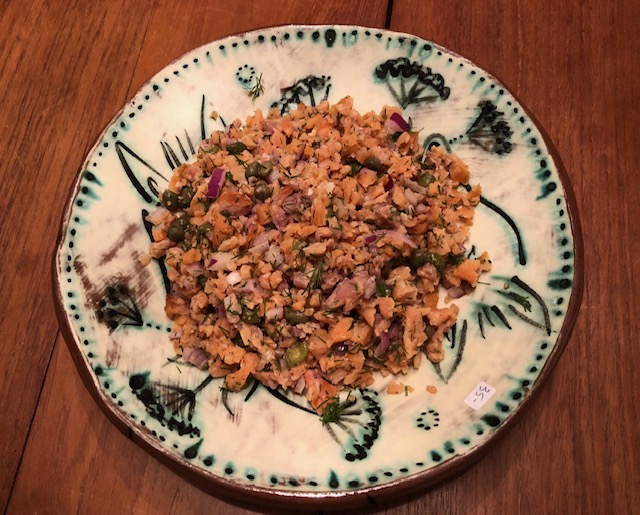
Smoked Salmon Tartare for Holiday Entertaining


Tartare (“à la tartare," in culinary French) means “in the Tatar (or Tartar) manner.” The original Tartare was finely chopped raw beef, typically mixed with raw egg, onion, and capers. Serving raw chopped beef was picked up by the Russians in past centuries from their nomadic Mongol-Turkic Tatar neighbors. “Steak tartare” is now a well-established European, especially French, dish.


My “tartare” leaves out the beef but, rather, contains quasi-raw smoked salmon. But like the beef original it includes capers and onion. Hard-boiled egg, optionally, can be used as a toping.


I’m noticing at the stores that smoked salmon is increasingly showing up with special flavorings, like black pepper, “Cajun,” “Pastrami,” or even Siracha. This recipe is for the simple smoked salmon that was, and to me still is, special enough.


The dish makes an elegant appetizer for a holiday buffet or a fancy appetizer for dinner. The recipe serves six or more as an appetizer with crackers or melba toast.


1/2 pound smoked salmon (cold-smoked, from Scotland or Norway, or hot-smoked, as from Alaska)

2 tablespoons finely minced red onion

1 tablespoon drained capers, coarsely chopped if larger than peppercorns

1 tablespoon snipped or coarsely chopped fresh dill, plus dill sprigs for garnish

6 hearty grinds of black pepper

1 tablespoon fresh lemon juice

1 hardboiled egg, white party only, finely minced, for garnish (optional)


On a cutting board, using a chef’s knife, finely chop the salmon (minus any skin). Mix well in a bowl with minced onion, seasonings and capers. Taste, and add salt only if needed (smoked salmon is salted). Refrigerate, covered, at least half an hour -- preferably overnight.


Serve in a decorative bowl or heaped up on an attractive small platter. Garnish, if desired, by sprinkling with minced hard-cooked egg whites. Top with dill sprigs.


Accompany with crackers, a plain, low salt variety, like water crackers, preferred,


,


Pasta with Smoked Salmon and Peas -- Easy


Smoked salmon is not common in Italy, while in Northern Europe, especially Scandinavia, it is extremely popular. But in Italy this special fish has one principal use: tossed in with pasta. Here is an attractive and super-easy pasta dish with smoked salmon and peas.


Like other pasta with seafood dishes, this one does not contain cheese. Cheese can be used in the antipasto, or strips of cheese, like Parmesan sliced off the block with a vegetable peeler, can be served on the salad.


The dish is made fresh and served hot. The recipe serves six. A salad is a nice accompaniment.


A hearty, chilled white wine, such as an un-oaked Chardonnay or a Viognier, or a somewhat cooled Pinot noir or Chianti (20 minutes in the refrigerator before serving) would be my pairing with this dish.


1 medium-large clove garlic

2 tablespoons olive oil

3/4 cup heavy cream

3/4 teaspoon salt, plus more if needed

1/2 teaspoon paprika

1/8 teaspoon black pepper

A pinch of cayenne

1 cup frozen peas

4 ounces smoked salmon, cold-smoked preferred

1/2 pound short pasta, such as penne or farfale (“bow ties”)

A little of the hot water from boiling the pasta, saved


Heat a large quantity of water for cooking the pasta. Keep it hot until time to cook the pasta.


Put garlic through a garlic press or mince it finely. Place in a large microwaveable bowl, from which the pasta will be served. Add olive oil, mix with the garlic, then microwave for 1 minute.


Add cream, salt and spices, and microwave 1 minute. Mix in frozen peas and hold until pasta is nearly cooked.


Cut salmon into 1/2-inch squares and keep ready for tossing with the pasta.


Add a teaspoon salt to the pasta water and boil the pasta, stirring constantly for the first 30 seconds so pasta does not stick together, then often during the cooking. After 7-8 minutes, depending on the pasta, cool then bite into a piece of pasta to test for tenderness. As soon as all crunch is gone from the pasta and it starts to become tender, drain it, saving a little of the cooking water in a cup.


Put the bowl with the cream and pea mixture back in the microwave and heat for 2 minutes, or until peas are hot. Stir, add the cut salmon and the drained, cooked pasta and toss well. If the sauce is dry, add a little of the hot pasta-cooking water. Taste, and if under-salted, add a little (the salmon may be salty, so be cautious).


Serve immediately.

,


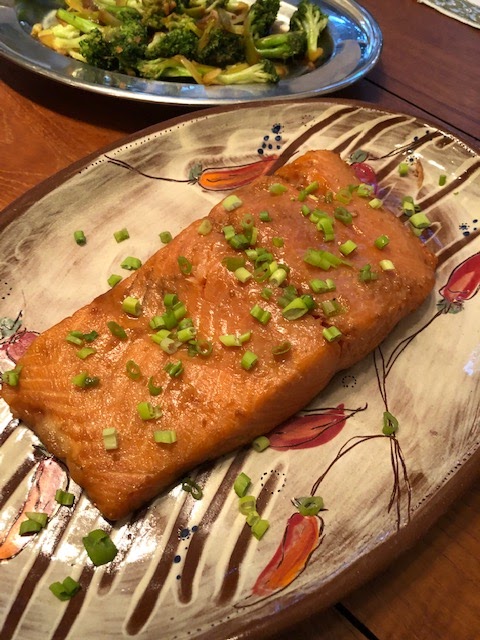
Teriyaki Salmon -- with Gluten-Free Option


Teriyaki, a traditional Japanese cooking method primarily used for fish, literally means shiny and grilled or broiled. In other Asian countries, similar methods, though with other names, are also used and are applied to chicken and pork in addition to fish.


Here’s the way I have been making teriyaki, primarily with salmon and roasting it in the oven, for some years at our restaurant. We’ve prepared it mostly for catering, using one or more whole salmon fillets, which makes an attractive party dish. (The same marinade can be used for boneless, skinless chicken thighs, which can be cooked on the grill or griddle.)


Soy sauce is essential for the teriyaki seasoning. A Japanese soy (such as Kikkoman, which is readily available in the US) or Korean soy have the appropriate flavor. Most soy sauces include wheat, and therefore gluten, in their fermentation process. People who must avoid gluten can get a gluten-free equivalent sauce, such as a Japanese “tamari,” which also gives the right flavor.


The recipe serves four, accompanied by rice and a stir-fried vegetable. The fish can be served hot for dinner, or at room temperature as part of an appetizer buffet.


1 pound piece of salmon fillet

2 tablespoons soy sauce, preferably Japanese or Korean, or gluten-free tamari

1-1/2 teaspoons sweet rice wine or “Mirin” (substitute is dry Sherry)

1 teaspoon rice vinegar or white vinegar

1 tablespoon sugar

1/2 teaspoon cornstarch

3/8 teaspoon salt

3/4 teaspoon grated fresh ginger

1/4 teaspoon Asian sesame oil

1 teaspoon canola or sunflower oil

Some thinly sliced green onion tops or chives for garnish


Wipe the salmon piece with paper towel. If the salmon still has skin on it, remove it by placing the salmon skin side down on a cutting board and with a sharp knife cutting a quarter inch into one end of the fish between the skin and the flesh. Then holding the skin down with your fingertips, slice along the skin to free the flesh from the skin.


Combine the remaining ingredients, aside from the green onion or chives for the garnish, and stir well. Marinate the fish in a flat-bottomed container for several hours, occasionally lifting the fish a little to get marinade under it and spooning marinade over the top.


Heat the oven to 375 degrees. Place the salmon on a baking sheet. Drizzle a little of the marinade over the salmon and discard remaining marinade. Roast 14 minutes on an upper rack. If the surface is looking cooked, test by sticking the tip of a small sharp knife into the fish with the “grain” and twist the knife gently to see if the raw color is almost gone. If not, roast another 2 minutes and test again. Do not overcook.


Teriyaki salmon can be eaten hot or cold. Platter the fish and sprinkle lightly with sliced green onion top or chives.


,


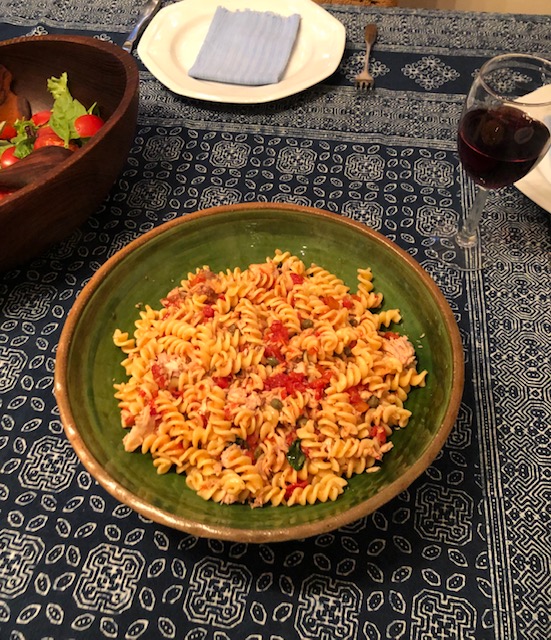
Pasta al Tonno, Pasta with Tuna and Tomato


In the United States, we are familiar with a limited number of pasta dishes. By contrast, in Italy, where pasta is ubiquitous, there are dozens if not hundreds of different, named, pasta dishes. Many of those are lighter, or simpler, than what we are used to. But in Italy, pasta typically serves as an early course in the dinner, or sometimes as a snack or light lunch, and not as the main dinner dish.


I first encountered pasta with tuna in Sicily, in Syracusa specifically. As I recall it was made with a “long” pasta, spaghetti or possibly linguine. But the dish can also be made with “short” pasta.


I’ve since learned that most of the tuna fishing by Italian fishermen is based out of coastal villages in Sicily. And while pasta with tuna and tomato is made elsewhere in Italy, it is a specialty in Sicily, particularly when made with fresh tuna. I’m pretty sure, though, that the pasta al tonno I first ate had canned tuna, as the dish typically does in Italy.


Here’s a delightful, fairly light, Pasta al Tonno, that can serve as part of a dinner, or as a light meal in its own right, accompanied by a simple salad. This dish is relatively quick and easy to make, but should be cooked shortly before eating.


In Italian cooking, pasta dishes that feature seafood, rather than meat or vegetables, rarely also contain cheese. Cheese makes a pasta dish heavy, and the point of seafood is lightness.


The best canned tuna for this dish is imported from Italy and is solid and packed in olive oil. At our local supermarket the closest I can get is Yellow Fin tuna canned in olive oil with the brand name “Genova.” which though not actually from Italy works satisfactorily for the dish.


The Italian trick of gently frying the garlic, somewhat crushed, in olive oil till golden then removing it keeps the floral essence of garlic without any of the bitterness or coarseness.


The recipe serves 6 people as the pasta course of a bigger dinner or as a light lunch or supper meal. In Italy, salad is served after the main course, but here we’d typically have the salad along with the pasta or dinner.


1 (4 to 5 ounce) can solid-meat tuna packed in oil, preferably olive oil

3 large cloves of garlic, peeled and partially crushed (with the bottom of a tumbler)

2 tablespoons capers, drained (optional)

1/4 teaspoon dry crushed red pepper flakes

1 (14-ounce) can petite diced tomatoes

1/2 teaspoon salt

6 medium-sized fresh basil leaves, or leaves from 4 sprigs flat (“Italian”) parsley

3 tablespoons olive oil

8 ounces (1/2 pound) spaghetti, or short pasta, such as Rotini or Ziti


Have all the ingredients ready, cans opened, etc. Keep the juices in the tuna can, since they are used in the recipe. Bring a large pot of water to a boil and add a teaspoon of salt, ready to boil the pasta.


Heat a heavy, shallow pan to medium-low, and gently fry the crushed garlic in the olive oil, stirring very frequently, until the garlic is golden colored. Lift garlic out of the pan, keeping the now-flavored oil in the pan. Add the drained capers, if used, and stir and fry about 10 seconds. Add the crushed dry pepper and stir and fry 5 seconds. Add the tomatoes and their juices to the pan. Press the lid of the tuna can gently into the tuna and add the juices to the pan. Stir and fry the tomatoes over medium heat a few minutes until the liquid is reduced somewhat. Stir in the salt and basil or parsley leaves and turn off the heat.


While the tomatoes are cooking, add the pasta to the boiling, salted water, and stir well for the first minute so the pasta doesn’t stick together. Then stir it less frequently. After 5 minutes or so, begin biting into a bit of the pasta to check for tenderness. When no crunch is present, and the pasta reaches the tenderness you want, drain it in a colander, catching some of the pasta water in a small bowl.


Put drained pasta into a bowl to mix, add the cooked tomato sauce. Using a fork, break up the tuna in its can and add it to the pasta. Toss this all together briefly. If the mixture is dry, add a little of the reserved pasta-boiling water to moisten it. Taste for salt, and if needed add a bit. Transfer mixed pasta to a serving bowl and serve immediately.


,

 Mediterranean-Style Tomatoes with Tuna Stuffing


If these beautiful appetizers aren’t Mediterranean,  French or Spanish, they should be. Tuna-stuffed tomatoes just scream summertime in Provence or Valencia! I believe I actually had something like this with French friends many years ago. But my memory tends to be generous.


American fresh tomatoes stuffed with mayonnaise-heavy chicken salad or tuna salad were an item from my mother's generation, and considered quite genteel. Necessarily seasonal, they were realistic only in summer in those ancient days before trucks and planes brought in nearly vine-ripe produce from Florida and California and Chile.


Now, thanks to agricultural advances we have tomatoes year round that actually taste like something. “Campari” tomatoes are a hybrid (but not the much-vilified GMO) developed in the 1990s for commercial greenhouse and hydroponic growing. These intensely red, small (about 2-inch diameter), round beauties, often sold “on the vine,” are sweet and tasty, and are available in supermarkets most of the time. They seem ideal for this European-style “small dish.”


In the Mediterranean, “light” rather than white or Albacore tuna is preferred, and it’s usually packed in olive or other oil rather than water. My recipe calls for oil-packed light tuna, from Italy if available, for the most Mediterranean taste. Several of the other ingredients are also Mediterranean, including green olives, capers, olive oil and wine vinegar. The round bottoms on Campari tomatoes makes standing them up on a platter a bit difficult. A tiny slice off the bottom of the tomatoes, or a thin bed of finely shredded lettuce under them will help.


The recipe serves 4 as an appetizer or 2-3 as a luncheon. They should be eaten fairly fresh, but can be stored in the refrigerator for an hour or so. If stored too long the tomato softens.


1 pound (usually 1 package) Campari tomatoes, as similar in size as possible

1 (4-ounce) can light or white tuna, packed in oil, Italian if available

1 green onion, green and white parts

1 inch piece of celery stalk

8 small green pimento-stuffed olives

1 teaspoon capers, drained

1/2 teaspoon salt

1/8 teaspoon ground black pepper

A pinch of cayenne

1/2 teaspoon olive oil

1/2 teaspoon wine vinegar

A little minced parsley or green onion top for garnish


Rinse and drain the tomatoes. With a sharp knife, thinly slice off their tops. Save the tops. (Optionally, in addition, cut a very thin slice off the bottoms of the tomatoes so eventually they will stand up easier on a serving dish.) With a small spoon (a teaspoon-sized measuring spoon is useful) scoop out the juicy middles of the tomatoes, and put those middles in a colander or sieve to drain. Turn the hollowed-out tomatoes upside down on a paper towel to drain.


On a cutting board, using a chef’s knife, cut the flesh off the tomato tops, discarding the stem-attachment area. With the knife, finely chop both these pieces of top and the middles of the tomatoes. Return the chopped tomato flesh to the colander or sieve and press it down firmly to get rid of the juices. Put the pressed tomato flesh into a mixing bowl.


On the cutting board, finely mince the green onion and piece of celery, along with the drained olives and capers. Add this mixture to the chopped tomato flesh


Open the can of tuna and press the can lid firmly into the fish to squeeze out the liquid. Add the pressed tuna to the mixing bowl. Add the salt, pepper, cayenne, olive oil and vinegar. With a spoon or fork break up any pieces of tuna, and combine the mixture well. Taste for salt, and mix in a little if desired.


Spoon tuna mixture into the hollowed-out tomatoes, filling them evenly and mounding the filling on top as necessary. On the cutting board finely mince a small amount of parsley or green onion top and place a small amount on the center of the filled tomatoes.


Serve now or refrigerate up to an hour. If too long the tomato loses its firmness.
,


Shrimp and Grits, or Smoked Salmon and Grits


Shrimp and Grits, that “classical” Southern favorite, the dish that was declared the “Official State Food” of South Carolina, dates way back to …...1950. That’s when it first appeared in a cookbook, “Charleston Receipts,” as a breakfast dish. It became a regional rage by the 1970s. Though associated with the Carolina Low Country, and Charleston in particular, it is now common in coastal regions throughout the South. There are many variations, even some with Louisiana Cajun touches. The dish makes a very elegant light dinner, the sort of thing you cook for company.


I was introduced to Shrimp and Grits by a friend originally from South Carolina, and have subsequently enjoyed it (though occasionally – it tends to be pricey!) at a number of restaurants. The biggest influence on how I myself prepare the dish came from the “Wahoo! Grill” in Decatur, GA, back when we lived in Atlanta. I learned somewhat accidentally what the subtle but unusual seasonings were that they used in their especially delicious sauce. Those are in my recipe but I won’t point them out. The Grill is still open and still features “Charleston Shrimp and Grits” on their website. Thus my recipe contains their secrets masked among the seasonings that I came up with on my own.


I’ve also used this same sauce that the shrimp are cooked in to make my special variant, Smoked Salmon and Grits, which you won’t even find on Google. Smoked salmon is more readily available than fresh coastal shrimp. And it’s easier to work with than shrimp, with no peeling or de-veining. I find I like the salmon version even more than the shrimp original.  But for the shrimp version, good-quality frozen shrimp will work, though they’re not quite as fine, or as elegant, as fresh-caught Georgia or South Carolina shrimp.


The shrimp and their sauce, or the smoked salmon and its sauce, are designed to go over seasoned “dinner” grits. I have a recipe for such grits in the blog post published just before this one. The seafood over grits is fairly complicated to make. I recommend trying it for family at least once before offering it to invited guests. 


The recipe serves four to six people. A simple vegetable and a green salad are good accompaniments as are warm dinner rolls or baguette. Since it’s a “company” dish, I’ll mention that my wine paring for either the shrimp or smoked salmon version would be a slightly chilled (yes, chilled) Pinot Noir, or a well-chilled French rosé, California Viognier or unoaked Chardonnay.


Shrimp and Grits or Smoked Salmon and Grits


For one batch of seasoned “dinner” grits (see my blog post of 7/30/23), kept hot while finishing the shrimp or smoked salmon topping:


Shrimp Version

1 1/2  pounds fresh or frozen unpeeled large shrimp

            or 1 pound large frozen peeled, de-veined shrimp


Thaw shrimp if frozen, in a colander under cold running water. Let drain. If shrimp are unpeeled, peel and de-vein them and rinse again. Set aside for later use. Refrigerate if holding for more than half an hour before serving time.


Smoked Salmon Version

14-16 ounces smoked salmon, cut coarsely into 1-inch pieces, and set aside till serving time.


Sauce for either version

1 small-medium onion, cut in large pieces

1/2 red bell pepper, seeds removed

2-inch length of celery stick, cut in half

1 medium-large clove of garlic

3 tablespoons butter

5 teaspoons sherry

1/4 cup white wine

1/2 cup canned crushed tomato

3/4 teaspoon Thai Panang curry paste (freeze the remainder of the can for other use), optional

3/4 teaspoon salt if for shrimp, 1/2 teaspoon if using smoked salmon

1/2 teaspoon sugar

Large pinch ground fenugreek, if available, or nutmeg

Large pinch black pepper

Large pinch cayenne

1/2 cup heavy cream

1/2 cup water, plus more as needed

Minced parsley for garnishing


Thoroughly puree the onion, bell pepper, celery and garlic in food processor. Place in heavy pan with the butter and fry gently over low heat, stirring frequently, until softened, 5 minutes or more.


While that mixture is cooking, combine the sherry, white wine, tomato, and the seasonings. When the onion mixture is softened, add the tomato mixture and simmer another five minutes, stirring occasionally. Stir in the cream and water, bring to a boil and simmer 2-3 minutes. The sauce can be made ahead to this point and held until dinner time.


If using shrimp: Ten minutes before serving, reheat the sauce. Add the shrimp and with nearly constant stirring heat them in the sauce until they curl up and get firm, 3-5 minutes. Do not over cook. Remove from the heat. Taste the sauce and add a little salt if needed.


If using salmon: Five minutes before serving, reheat the sauce. Add the salmon pieces and stir and heat just until hot. Add a little water if mixture is dry. Remove from the heat. Taste the sauce and add a little salt if needed.


Serve on dinner plates. Place a bed of hot grits, slightly spread out, and spoon the shrimp or smoked salmon mixture partially over it, leaving some grits exposed. Sprinkle with a little minced parsley for garnish.


Serve accompanied by a simple vegetable, a green salad, plus some warm bread or dinner roll if desired.

,

 Tonnato: My “Triple-Fish” appetizer accidently recreated a classic


There’s nothing new under the sun said the Book of Ecclesiastes over 2200 years ago. Illustrating the point, perhaps accidentally, Shakespeare restated the nothing-is-new idea some 1800 years later in Sonnet 59. I stumbled over that old truth myself several years ago when a dish I created turned out already to exist. I had, in effect, reinvented the wheel.
 
For my daughter Maria’s pottery exhibits I’ve developed several appetizer dishes to pair with her ceramic ones. One such creation was a dip I called then “Double-Fish Cream.”  This appetizer was suggested by, and designed to be served from, a dish of Maria’s inscribed with fish motifs.
 
The double-fish cream was well received at a fancy pottery-related gathering. An older, well-travelled German lady complimented me on my delicious “tonnato.” Hmmm.
 
Tonnato, a name I faintly recognized as an Italian sauce containing its namesake, tuna, was something I had never eaten or even seen, much less knowingly prepared. However, it turns out that, indeed, my double-fish cream resembles the classic sauce. Maria suggested that perhaps it was channeled down through our Italian ancestry.
 
An old-fashioned tuna-enhanced mayonnaise from northern Italy, tonnato also often contains anchovy and cream – as mine does – and typically contains capers – as mine does. While usually a sauce for cold sliced veal in “Vitello Tonnato,” a classy Italian restaurant dish popular in past generations, it can also be paired with sliced boiled potatoes for an elegant potato salad.
 
My dish, varying slightly from classic tonnato, uses cream cheese rather than egg and oil to make a mayonnaise, and contains traces of horseradish and tomato. I now call it “Triple Fish Dip” because I added a little Asian fish sauce as part of the seasoning.
 
So here is. I propose it as an appetizer to spread or dip onto thin bread slices or water crackers, or adding a little more liquid to make it a sauce, try it spooned over cold, sliced and lightly salted boiled potatoes for an elegant potato salad.
 
Wines that would go with this dip are crisp, chilled whites like Sauvignon blanc or Pinot grigio.
 
The recipe makes enough for 6-8 people, depending on what it’s served with.
 
Triple-Fish Cream Appetizer or Sauce
 
8-ounce package of cream cheese (or reduced-fat “Neufchatel” cream cheese)
1 (2-ounce) can anchovy fillets (at supermarket near tuna) or 2 tablespoons anchovy paste
1 (5-ounce) can tuna in olive oil, not drained
2 tablespoons water
1 tablespoon ketchup
1/2 teaspoon prepared horseradish
1 medium scallion (green onion), cut in pieces
1 teaspoon capers, drained and rinsed
1/2 teaspoon Asian fish sauce, plus more to taste, or substitute 1/4 tsp salt
1/8 teaspoon black pepper
Fresh dill or parsley sprigs for garnish
 
In food processor, blend cream cheese, anchovy fillets and their oil (or anchovy paste), and tuna and its juices. Scrape down inside of the food processor bowl periodically with a spatula. Add remaining ingredients, other than dill or parsley, and blend well. If a wetter dip or sauce is desired, add a little more water, a tablespoon at a time.
 
Let sit 10 minutes. Then taste and add a little fish sauce or salt, if needed.
 
Serve in a shallow dish. Garnish with sprigs of dill or parsley.
 
Accompany with thinly sliced baguette, melba toast, bagel crisps, water crackers or other low-salt, unflavored crackers. Alternatively, serve mixed with thinly sliced, peeled, boiled potatoes that have been sprinkled lightly with salt.

,


Thai Chili-Lime Fish (Pla Prik Manau) can be super-hot 

The hottest authentic dish I’ve ever encountered was in Thailand, where fried fish showed up coated thickly with what looked like chopped raw green chilies. 

Called “Prik Manao” [PRIK ma-NOW], the packed-on topping simply means hot pepper and lime. Raw green – or red – chilies and lime juice are two main ingredients, along with plentiful raw garlic, Thai fish sauce, cilantro leaves and a bit of sugar. It’s surprisingly delicious. I’ve toned down the heat in the recipe. 

The traditional fish for this would have been a white-fleshed ocean fish (I love grouper), but nowadays salmon shows up everywhere, and aside from the color seem just like delicious Thai fish. Once, in a hurry, I cheated and put the sauce over baked supermarket crunchy fish fingers -- with relative success. 

The recipe makes enough for six. Accompany this with unsalted white rice, preferably jasmine rice, and a stir-fried vegetable dish. A cold white wine with faint sweetness goes particularly well with the dish. 

Prepare the sauce before cooking the fish:

3 large green or red jalapeño peppers (use fewer, or remove part of seeds for milder sauce)

5 large cloves garlic

1/2 cup cilantro leaves, loosely packed and including a bit of stem

3 tablespoons freshly squeezed lime juice, plus to taste

1 1/2 teaspoons Thai fish sauce, plus to taste

1 teaspoon sugar, plus to taste 

Cut stems off peppers and peel garlic. Mince peppers (including seeds and membranes for authenticity) and garlic finely on cutting board with chef’s knife or pulse them till finely minced, but not pureed, in food processor. (Be careful handling the chilies, or wear a plastic glove.) 

Place minced pepper and garlic in bowl. Chop, but do not mince, cilantro, and add it to mixture. Add remaining ingredients and mix well. 

Taste (it’s hot) and add lime juice, fish sauce (for salt) and/or sugar to taste. Let sauce rest, stirring occasionally, at least half an hour. 

Fish:

6 servings fish, such as grouper or tilapia (thawed just before cooking, if frozen), or salmon

Salt for fish

Flour or rice flour for dusting

Canola or vegetable (not olive) for frying 

Dry fish with paper towel. Sprinkle lightly with salt on both sides. Heat frying pan or griddle to medium hot. Add 1/8 inch of oil. 

Dust fish lightly on both sides with flour or rice flour. Fry half the fish at a time, turning carefully, until just cooked through. Place on platter and fry the remaining fish. 

Spoon most of the sauce over the fish pieces, evening it out to cover the fish. Serve leftover sauce in a side dish. Accompany with unsalted white rice.

,

Easy: Lemon-Dill Roasted Salmon

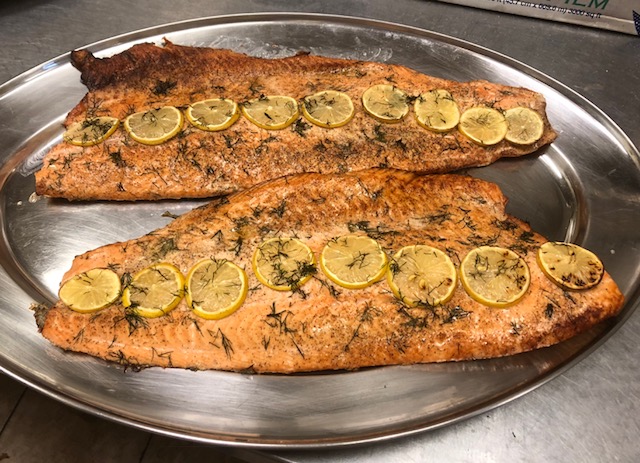
Here is the main course I prepared for family this Christmas. Salmon, at least smoked salmon, is a traditional Christmas dish in the British Isles, Scandinavia and north-central Europe. Roasted salmon also appears, especially in Scandinavia as part of the main course at Christmas dinner. I fix salmon because I like it and, more important, because my family likes it.

A double recipe, served for our family Christmas, 2018
I learned this way of roasting salmon from a Greek Cypriot friend whose mother prepared her fish (though not salmon in those days) this way. Pani, as he was called, was one of the founders of Decatur’s Café Istanbul, along with another friend of mine, a Turkish guy named Kazim. They were at the time both married to women I worked with. The idea of a Greek and a Turk starting a joint venture seemed, well, unlikely. They did part company after a while, but it was over very different views on how to run a restaurant rather than politics or religion. But the establishment they founded has gone on to considerable popularity, though under subsequent – and primarily Turkish – ownership.  

Salmon is not traditional in the Mediterranean, but has become popular now even there as local fish has become more expensive and difficult to find. Lemon and dill are both used extensively in the Eastern Mediterranean, including with fish as a natural partner. But lemon and dill are also used with fish in Scandinavia, where salmon is common.

A crisp Sauvignon Blanc or a not-too-heavy Chardonnay go well with this. Viognier is a wine grape I’m more recently familiar with and love with salmon as well as roasted turkey or pork. Oh yes, and a lemon rice pilaf will be in the spirit of the eastern Mediterranean. (See my pilaf recipe in the 8/24/2019 blog posting, and eliminate the peppers, onions, and fruits, and simply add to the rice-cooking water 2 tablespoons of lemon juice, 1/2 teaspoon grated lemon zest, and a bay leaf, broken in half.) 

The salmon recipe serves six generously.

2 pounds salmon filet in one piece, as fresh as possible, and preferably without skin
1 teaspoon sea salt
1/4 teaspoon black pepper,
1/4 cup freshly chopped dill (a weak substitute is 1-1/2 tablespoons dry dill weed)
3 tablespoons olive oil
3 lemons
Extra lemon and sprigs of dill for garnish

Preheat oven to 500 degrees (very hot), and temporarily turn off the smoke alarm! 

Rinse the salmon and dry it with a paper towel. Liberally sprinkle salt and pepper on both sides and dust both sides with dill. Cut the lemons in half crosswise. Slice a very thin slice off each of the halves and reserve them.

On a large shallow-edged glass or metal pan, such as a cookie sheet with sides, spread 1 tablespoon of the olive oil over an area of the size of the fish, then squeeze two of the lemon halves over this area. Place the seasoned fish on the prepared pan. Drench the surface of the fish with the juice squeezed from the remaining lemon halves. Lay the slices of lemon up the middle of the fish, placed so that when the fish is cut into six pieces, each will have a lemon slice. Drizzle the whole surface with the remaining olive oil and lightly dust a few bits of dill on top of the lemon slices. Let the fish season for 10 to 20 minutes.

When oven is very hot, place the pan on the shelf highest in the oven. Roast the salmon for 11-12 minutes or just until the surface and edges of the fish are beginning to turn crispy and when a knife inserted into the thickest part of the fish and twisted slightly shows a pale opaque pink color. Do not overcook.

Serve hot, accompanied by lemon wedges and sprigs of dill. Alternately, this dish can be cooked ahead and served cold as a buffet dish.


Note:
The fish can be cut into six serving-sized pieces before seasoning and roasting rather than treated as an entire piece.

,


Sweet and Sour Fish, one of the favorite dishes in my family

This is one of the most popular Chinese dishes in Southeast Asia, and has numerous versions. At fancy Chinese restaurants sometimes an entire fish is deep-fried for it.

When I was young, the popular cliché dish at Chinese-American restaurants, a dish I thought was wonderful in my innocence before living in Asia and having real Chinese food, was “Sweet and Sour Pork,” crispy batter-fried pork pieces in a gluey sauce with chunks of pineapple and bell pepper. But it was a cut above the “Chop Suey” and “Chow Mein.” (Nowadays, the non-authentic, popular clichés at Chinese-American restaurants include “General Tao’s Chicken” and “Mongolian Beef” and “Shrimp Rangoon.” See my blog post of 9/2/2019 for a very tasty, if not really Chinese, “Mongolian Beef.”) 

Photo: Maria Dondero. Platter: Marmalade Pottery, Athens GA
In Asia, the only sweet and sour dish I recall encountering was sweet and sour fish. It was a revelation. That dish has become one of the favorites in my family, often requested for birthday dinners.

The version here, with squares of fish fillet, is practical for home cooking. Grouper would be my preferred fish, but tilapia, which many people frown on, makes a surprisingly good dish and is more economical. In fact, the sweet and sour fish I had in Northern Thailand, distant from the sea, was made with local farm-raised tilapia.

The recipe serves six to eight when accompanied by unsalted white rice and a stir-fried vegetable side dish. Preparing sweet and sour fish is a little elaborate, but it’s a party dish and a centerpiece. The effort is worth it.

Fish:
1-1/2 pounds (thawed if frozen) skinless fillet of white fish, such as grouper or tilapia
1/2 teaspoon salt
1 teaspoon finely grated fresh ginger
1 egg
1 tablespoon water
3 tablespoons flour
1 tablespoon rice flour (for crispness), or 1 extra tablespoon flour
Oil for frying (like canola or sunflower oil, not olive oil)
1/2 red bell pepper
1 small-medium carrot*
1 large or 2 smaller green onions
6 sprigs cilantro leaf

Sauce:
1 large clove of garlic
1/2 inch fresh ginger
1 tablespoon oil
3/4 cup water
3 tablespoons soy sauce
5 tablespoons vinegar (white or cider)
1 tablespoon tomato catsup
6 tablespoons sugar
1 tablespoon cornstarch
1/2 teaspoon salt
1 teaspoon Asian sesame oil (available at Asian groceries)

Pat fish dry with paper towel, and cut it into 2-inch squares. Sprinkle with salt and grated ginger and mix to coat. Allow to sit in a bowl at least ten minutes while preparing the other ingredients. Push fish to one side of the bowl and with a fork, beat egg with the water, flour and rice flour. Combine with the seasoned fish, to coat, using your hands to mix evenly. Set aside until ready to cook.

Prepare vegetables and stack in piles on a plate. Remove stem, core, and seeds from bell pepper. Cut into long slices 1/8-inch wide. If more than 3 inches long, cut them in half. Peel carrot* and slice it on a long diagonal 1/8-inch thick. Pile up the slices and cut them lengthwise into 1/8-inch matchsticks. Cut green onion, white and green parts included, into long diagonal slices 1/8-inch thick. Stack a few up at a time and cut in half lengthwise, so as to shred. Pick over and rinse cilantro leaves.

Prepare sauce ingredients: Finely mince garlic and ginger and set aside. Mix water, soy sauce, vinegar, catsup, sugar, cornstarch and salt in a bowl, then add sesame oil. Taste and adjust with sugar or vinegar to make sweet-sour.
Double batch for serving a crowd.

Heat the oven to warm, for storing the fried fish.

Heat several tablespoons of oil in a non-stick frying pan. Fry fish, part at a time, turning once or twice, until golden (do not overcook). Remove fish from pan, placing it on a warm platter and keep it in the warm oven. Finish cooking fish, adding more oil if necessary.

Remove all except 1 tablespoon of oil from pan, or add oil if necessary to obtain about 1 tablespoon. Fry carrot strips about 1-1/2 minutes over medium heat, stirring. Add minced garlic and ginger and stir and fry about 15 seconds or until fragrant but not browned. Add peppers and fry another half minute. Stir sauce mixture to mix the starch around and add to the pan, stirring. Simmer until boiling and thickened. Remove from heat. Taste, and add salt if necessary.

Arrange fish pieces on serving platter. Spoon sauce and vegetables over fish. Garnish with shredded green onion and coriander sprigs.


*Note: Pineapple is sometimes used in this dish. If desired, replace the carrot with 4 to 5 rings of pineapple, either fresh or canned, cut into small pieces. Stir them into the pan when adding the sauce ingredients.

,

Pan-Fried Salmon with Brown Butter and Fried Capers (Saumon Grenobloise)

The traditional French method of making a sauce of “brown butter” for sautéed or pan-seared fish is remarkably easy. Brown butter, in French “Beurre Noisette” (literally hazelnut butter), is simply unsalted butter fried in a pan until the solid bits turn light brown. In its simplest form, with a little lemon juice and parsley, brown butter sauce is “Meunière,” most famous with sole. A slightly darker brown butter sauce with capers is “Grenobloise” (meaning in the style of Grenoble, a city in the Alps), which is a favorite French way of serving pan-fried trout. With the rich flavor of salmon I like a hint of rosemary.

Plate: Maria Dondero, Marmalade Pottery, Athens GA
This dish calls for chilled Chardonnay, my preference is for unoaked Chardonnay. Generally I’m not a fan of Chardonnay, especially if it has lots of buttery and vanilla oak overtones, but the rich fish plus the butter sauce call for Chardonnay. Alternately, a cold Viognier goes well.

The recipe is for four servings. For each diner, allow 4 ounces (1/4 pound) of fish.

1 pound salmon fillet, with or without skin
Salt and pepper
3 tablespoons capers, drained
12 tiny leaves stripped of a sprig of fresh rosemary (optional)
3 tablespoons freshly squeezed lemon juice
4 tablespoons (1/2 stick) unsalted butter, cut into 1-tablespoon chunks
1 tablespoon vegetable oil

If fish is frozen, thaw it quickly in its plastic envelope in slowly running room-temperature water. Remove from envelope and pat fish dry with paper towel.

Sprinkle fish moderately on both sides with salt and pepper.

Prepare remaining ingredients and keep separate. Measure and drain capers. If using rosemary, pick 12 tiny leaves off a sprig. Squeeze lemon juice. Cut butter.

Heat frying pan, preferably non-stick, large enough to hold the fish, to medium high. Add oil and 2 tablespoons of the butter. When butter fully melts, fry fish on both sides, starting with the skinless side, if the skin is still attached. Scrape under it with a sharp spatula so fish doesn’t stick to pan. When fish is nearly cooked in middle (twist point of sharp knife in thickest part and look for changed color in middle), lift out onto a warm platter. (Before you do this, you can often scrape off the skin, if present.)

Remove any bits of skin or fish from the pan, and add the remaining 2 tablespoons of butter. Stir it over gentle heat until bits of solids turn golden brown. Add capers and rosemary and stir and fry for 15 seconds. Stir in lemon juice. Remove from heat. Taste for salt, and add a little if needed.

Spoon sauce and capers over the fish.


Follow Us @donderoskitchen