Showing posts with label Pasta & Rice. Show all posts
,


Ragú Bianco, Italian “White” Meat Sauce for Pasta


I used to think Italian meat sauce for pasta was just what gets called “Bolognese,” more correctly “Ragú alla Bolognese,” after the northern Italian city of Bologna. It’s hearty and red and can be quite satisfying. (A recipe for that dish has long been in this blog.) But when I was in northern Italy several years ago, Cortona, in Tuscany, more specifically, I learned of another hearty meat sauce made with cream or milk rather than tomatoes. It is also called “ragú” (the Italian spelling of the French word for stew, ragoût), but is Ragú Bianco, or white ragú.


Ragú Bianco traditionally contains light-colored ground meat, particularly veal or pork. Here, good veal is hard to find and has ethical complexities plus expense. Pork is my favorite. But ground turkey or chicken can be used instead. The sauce often has a little cured pork cooked into it, like pancetta, bacon or even sausage.


A spice that is common, though used sparingly, in both the better-known red Bolognese meat sauce (Ragú Rosso) and white ragú is fennel. It gives a subtle, warm, faintly licorice-like essence. Both red and white ragú typically have wine cooked into them.


In Italy, the pasta for this ragú is generally an egg-containing flat pasta like taliatelle or fettucine or, wider yet, pappardelle. But, here, an easy-to-get short pasta that the sauce will cling to, like rigatoni or penne rigate, can also work.


With pasta in general I like the hearty sheep’s milk cheese, Pecorino Romano, no doubt due to my culinary exposure to Southern Italians when I was growing up. However, for northern Italian dishes, like ragú, the lighter and more elegant cow’s milk cheese Parmesan (Parmigiano-Reggiano) is preferred.


The recipe makes enough sauce for a pound of pasta, to serve six or more. But leftovers make a great snack.

1 medium-small carrot, finely diced
1 medium stick celery, finely diced
2 shallots or 1 small onion, finely diced
1 strip of bacon or 2 thin slices of pancetta, finely diced
4 tablespoons olive oil (5 if not using bacon or pancetta)

1 pound ground pork, turkey or chicken

1/4 teaspoon crushed red pepper or cayenne
1/8 teaspoon nutmeg

1/8 teaspoon black pepper

1/8 teaspoon whole fennel seeds or ground fennel

1/8 teaspoon dry thyme
1/2 cup white wine
1/2 cup chicken broth, unsalted preferred
1/2 teaspoon salt, plus more to taste

3/4 cup sour cream or heavy cream

1/4 cup milk

1 pound pasta (such as rigatoni or penne rigate)
1/3 cup grated Parmesan cheese for topping

In a heavy pan, gently fry the diced vegetables and bacon or pancetta in the olive oil, stirring occasionally, until carrot is tender but not browning. 


Raise heat and stir in ground meat, breaking it up as it heats. Add herbs and spices, but not the salt When the raw meat color has fully changed, add wine and simmer several minutes. Then add chicken broth and salt and simmer 10 minutes, covered. Add sour cream or cream plus the milk. Simmer 10 more minutes, stirring occasionally.


Taste and add salt if needed (this will depend on whether the bacon and/or the chicken broth were salty). Keep (or reheat) the sauce hot when cooking the pasta.

When sauce is done, cook pasta in a large amount of boiling lightly salted water, stirring frequently at the beginning, so pasta does not stick together. When just tender to the bite, drain pasta well in a colander, but do not rinse.


In large serving bowl, toss most of the heated sauce with the freshly cooked, drained pasta. Top with remaining sauce. Sprinkle generously with grated cheese.


,

Chicken Alfredo Pasta


One of my grandkids’ favorite meals is “Chicken Alfredo,” a pasta dish that has evolved far from its origins. As a style, “alfredo” is an elastic, and much-abused, term in Italian-American cooking. And I am as happily guilty as anyone, making Pasta Alfredo with highlights as varied as lemon zest, sun-dried tomatoes, peas, asparagus or even smoked salmon.


The original dish, a combination of fresh egg pasta, butter and cheese, dates to 1914, when ALFREDO di Lelio served what he called “Fettuccine ALFREDO” at his restaurant in Rome, “ALFREDO alla Scrofa.” Obviously he liked his name.


Cream, not part of the original, is now typical in the dish. Many chefs cook heavy cream down to make the sauce even richer. I use part half-and-half for a lighter version.


The recipe serves six. With both chicken and cream, the classic pairing wine would be a chardonnay.

2 cups 1/4-inch-cubed roasted chicken (can use freshly herb-roasted chicken breast)
1 large clove garlic, minced
2 tablespoons butter
1/2 cup white wine

1 cup (1/2 pint) half-and-half cream

1/2 cup heavy cream
1/2 teaspoon salt
1/8 teaspoon black pepper
1/8 teaspoon grated nutmeg                                                                                    

3/4 pound fettucini, or a short pasta like penne rigate
6 tablespoons grated Romano or Parmesan cheese, plus more for serving                                                                                                                                                                                          

Boil four quarts of water in large pot. Add 1 teaspoon of salt. Keep hot. Prepare meat and other ingredients before cooking pasta. Have a large serving bowl ready for mixing the past and sauce as well as serving it.


In medium-sized pan over gentle heat, fry garlic in butter until softened but not browned. Add wine, half-and-half, cream, salt, pepper, and nutmeg. Bring to simmer (not a boil), and simmer 4 minutes. Add chicken and heat just until it’s are hot. Remove from stove. Taste and add salt, if needed.


Meanwhile raise heat under pasta water. When it boils rapidly, add pasta and stir well for half a minute so it does not stick together. Boil, stirring occasionally, until pasta is just tender when you bite a piece. Drain in colander but do not shake out water. Transfer to large serving bowl.


Add sauce and cheese and toss everything together with two spoons. Taste, and add salt if necessary.

,


Quinoa Pilaf -- Easy


I’m a recent convert to quinoa. I’m not sure quite why it took me so long. Probably because the grain had such a cultish following, and because I loved rice so much in so many forms. 


But trying to get more iron into the diets of several family members who go light on, or without, meat, and cooking occasionally for several people dealing with diabetes or pre-diabetes, have both encouraged me to try more dishes with quinoa. The grain (technically a seed) is highly nutritious and has a relatively low glycemic index.


What I have learned is that quinoa is easy to cook, is fairly flexible in the variety of dishes that can be prepared with it, and (most important to me) I find I like quinoa. I’ll still cook and love rice, potatoes, grits/polenta, and pasta, but now I’ve expanded my repertoire for side dishes.


Raw quinoa has a negative feature that needs to be dealt with for best flavor. The seeds have a light coating of naturally occurring, bitter, soap-like saponins, which apparently give the plant protection from grazing animals and microbial organisms. This should be removed by washing the grains before cooking. (Some quinoa is already washed before it is sold, in which case further washing is not necessary.)


Here’s a pilaf-style dish I made using red quinoa, which is very attractive, to accompany roasted salmon. White, black or tri-colored quinoa would also work. I used a rice cooker, but also suggest how to cook the dish on the stove-top instead. I made the version with chicken broth and rendered chicken fat, but I include a vegetarian option in the recipe, as well.


The recipe serves six as a side dish.


1 1/2 cups quinoa, red or mixed color for attractiveness

1/2 small onion, finely diced

1 small Roma-type tomato, cored and finely diced

3 bay leaves

1/2 teaspoon fresh thyme or a medium pinch of dry thyme

2 tablespoons rendered chicken fat or olive oil

1 teaspoon salt

1/4 teaspoon black pepper

Pinch of cayenne

2 2/3 cups chicken or vegetable broth, or water

Minced parsley for garnish, optional


Place quinoa in the rice cooker container or the pot in which it will be cooked. Add plenty of cool water, then rub the grains between your hands for a minute or so. Drain off the water through a sieve and rinse well with running water. Drain, then return rinsed quinoa to the rice cooker container or cooking pot.


Add all the remaining ingredients and stir well.


Rice cooker method: Cover and turn on rice cooker. Let cook through its full cycle, then rest, unopened, for ten minutes after the light switches from cook to “keep warm.” After 10 minutes, open cooker and fluff quinoa with a rice paddle or fork to mix well. Remove the bay leaves as you see them. Cover and keep warm until served.


Stove-top method: Keeping pot uncovered, bring contents to a boil. Stir, cover pot, and reduce heat to the lowest setting. Set timer for 20 minutes. At 20 minutes, keep pot covered but turn off the heat and let rest 10 minutes. Open and fluff quinoa with a rice paddle or fork to mix well. Remove bay leaves as you see them. Cover again until served.


If quinoa cools off, or there is some left over, it’s easy to reheat in a microwave oven in a covered casserole, fluffing a time or two during reheating.


Serve in a shallow bowl, dusting the top with a little minced parsley, if desired.


,


Chickpea Sauce and Parmesan Cheese for Pasta


I’m always looking for vegetarian counterparts to meat dishes when I’m preparing food for entertaining or feeding the grandkids at our weekly dinners. That way I can offer a vegetarian option when the crowd includes people with different food preferences. This one, which is easy, started as the counterpart to a chicken and pasta dish. The chicken version was relatively good, but not special. The vegetarian version did much better. 


The two dishes were designed to serve with orzo pasta, or with rice if avoiding pasta. Orzo looks like rice, but its name in Italian actually means barley, which cooked it also resembles. This is not an Italian dish, but some of my experience with Italian food influenced it. We had a side of crisp-tender broccoli and a salad with the dinner.


Here’s my chickpea dish. The recipe serves 4 to 6 persons, accompanying 1/2-3/4 pound of orzo pasta, which is cooked separately and lightly oiled after draining so it doesn’t stick together.


1/2 of a medium-small onion, minced

1 medium-large clove garlic, minced

4 tablespoons olive oil

3/4 cup water, plus more as needed

2 (14-ounce) cans chickpeas, drained and rinsed

2 sprigs fresh oregano or 1/2 teaspoon dry oregano

1/2 teaspoon salt, plus more to taste

1/2 teaspoon paprika

1/4 teaspoon ground black pepper

1/4 teaspoon cayenne

6 tablespoons sour cream

1/2 to 3/4 cup grated Parmesan cheese for topping

1/2 to 3/4 pound orzo pasta, freshly cooked for serving


In a medium-sized pot, gently fry the onion and garlic in the olive oil until onion is softened but not turning golden. Add the water and bring to a boil.


Stir in the drained, rinsed chickpeas, oregano, salt, paprika, black pepper and cayenne. Simmer 4-5 minutes, stirring frequently. Stir in the sour cream and bring back just to a boil. Add a little water if sauce is too thick. Taste and add a little salt if needed.


Serve now (or hold and reheat later in a microwave or on the stove top) over orzo pasta. Sprinkle generously with Parmesan cheese.


,


Rice Pilaf with Peaches and Rosemary


With peaches coming in strong here in Georgia, I enjoy cooking savory dishes with them, as well as enjoy them as fruit. Rosemary, which is year-round here, makes a nice foil to the peach flavor,
at least if used sparingly.


“Pilaf” historically applies to rice cooked with a seasoned broth and added meat, seafood, vegetables or fruits and nuts. Here’s a version using seasonal peaches. Rosemary and a few whole spices add delicate flavor highlights.  The dish will go well with grilled food, or pork, duck, smoked sausage or with a savory braised dish.


The recipe serves six.


1 1/2 cups Basmati or other long grained rice

2 large or three medium peaches

2 tablespoons white wine

Water (see instructions below)

1 medium shallot or 1/2 small onion, minced

2 tablespoons olive oil

1 1/4 teaspoons salt

1/2 teaspoon sugar (optional)

18 individual leaves taken off a sprig of rosemary

6 whole peppercorns

2 whole cloves

Minced fresh parsley for garnish


Rinse rice several times and drain well. Set aside to “dry” somewhat.


Peel peaches. Chop flesh coarsely. Place in large (4-cup) measuring cup with the wine. Add enough water to bring the volume up to 2-3/4 cups.


Mince shallot or onion. Heat a heavy pot and fry onion in olive oil, stirring frequently, until onion is limp and beginning to become golden. Add drained (and somewhat dried) rice and stir and fry one minute.


Add peaches and liquid mixture plus salt, sugar if used, rosemary, peppercorns and cloves. Stir.


Bring to a boil, without stirring until after rice is fully cooked. Reduce heat to low, cover pot. Simmer, covered without opening, 20 minutes. Do not lift lid, but turn off heat and let sit 10 minutes.


Remove visible rosemary leaves and whole spices from the surface. Fluff rice with a fork.


Serve, sprinkled with minced parsley.

,


Louisiana-Style “Dirty Rice” made with Mushrooms


 “Dirty Rice” is a Louisiana-Cajun sort of rice pilaf in which the rice was traditionally cooked with finely chopped chicken livers, ground meat or sausage, plus seasonings. I prefer it made with chopped dark mushrooms rather than chicken giblets. That idea came from having the wonderful Riz Djon-Djon in Haiti, a specialty rice dish enriched as well as colored a rich brown by local hill-side black
mushrooms. I use Basmati or other long-grained rice, but in Louisiana cooking medium-grained rice, from Louisiana or Arkansas, is more typical.

Louisiana-Style “Dirty Rice” made with Mushrooms
 

Dirty Rice in Louisiana is frequently served with stewed red beans. It makes a good side for a number of savory braised or stewed dishes.


The recipe serves six to eight as part of dinner.


1 1/2 cups Basmati or other long-grained rice

1 medium-small onion

1/4 large green bell pepper

1/2 stick celery

1/4 pound (4 ounces) baby Bella or Portobello mushrooms

3 tablespoons olive oil

1 tablespoon tomato ketchup

1 1/2 teaspoons Cajun Seasoning (or 1/2 tsp salt, 1/2 tsp paprika, 1/4 tsp black pepper, 1/4 tsp celery salt, 1/4 tsp garlic salt, 1/4 tsp cayenne)

1/8 teaspoon black pepper

2 bay leaves

2 1/4 cups low sodium chicken broth or vegetable broth

Coarsely chopped parsley or thinly cross-cut green onion tops for garnish


Rinse and drain rice twice to remove excess starch, and set aside to dry. Finely chop together in a food processor the onion, bell pepper, celery and mushrooms, or finely mince them on a cutting board with a chef’s knife.


In heavy cooking pot in which the rice will be cooked, fry together the minced vegetables and olive oil. Stir frequently, scraping the bottom of the pot. When the mixture is becoming softer and darker, add the ketchup, dry seasonings, and bay leaves. Add the drained rice and stir well. Add broth and stir briefly. Then do not stir again until cooking is done. Bring pot to the boil, uncovered. When boiling, without stirring, cover tightly and turn heat to lowest setting. Set timer for 20 minutes. After 20 minutes, turn off heat and allow to rest without opening the pot for 10 more minutes.


Open pot, remove bay leaves, and fluff gently with a fork. Cover and keep warm until served. When serving, sprinkle lightly with chopped parsley or sliced green onion tops.


An alternative cooking method can be used with a rice cooker. Put drained rice in rice cooker. Fry vegetables and the olive oil in a pan until color has changed. Add this mixture to the rice in the rice cooker. Add the ketchup, dry seasonings, bay leaves and broth. Stir briefly. Cover and cook as usual without opening the cover. When heat goes off, again without uncovering, let rest 10 more minutes. Then remove bay leaves, and fluff the rice with a fork. Keep warm until served. Sprinkle with the parsley or green onion garnish when serving.

,


Pasta with Smoked Salmon and Peas -- Easy


Smoked salmon is not common in Italy, while in Northern Europe, especially Scandinavia, it is extremely popular. But in Italy this special fish has one principal use: tossed in with pasta. Here is an attractive and super-easy pasta dish with smoked salmon and peas.


Like other pasta with seafood dishes, this one does not contain cheese. Cheese can be used in the antipasto, or strips of cheese, like Parmesan sliced off the block with a vegetable peeler, can be served on the salad.


The dish is made fresh and served hot. The recipe serves six. A salad is a nice accompaniment.


A hearty, chilled white wine, such as an un-oaked Chardonnay or a Viognier, or a somewhat cooled Pinot noir or Chianti (20 minutes in the refrigerator before serving) would be my pairing with this dish.


1 medium-large clove garlic

2 tablespoons olive oil

3/4 cup heavy cream

3/4 teaspoon salt, plus more if needed

1/2 teaspoon paprika

1/8 teaspoon black pepper

A pinch of cayenne

1 cup frozen peas

4 ounces smoked salmon, cold-smoked preferred

1/2 pound short pasta, such as penne or farfale (“bow ties”)

A little of the hot water from boiling the pasta, saved


Heat a large quantity of water for cooking the pasta. Keep it hot until time to cook the pasta.


Put garlic through a garlic press or mince it finely. Place in a large microwaveable bowl, from which the pasta will be served. Add olive oil, mix with the garlic, then microwave for 1 minute.


Add cream, salt and spices, and microwave 1 minute. Mix in frozen peas and hold until pasta is nearly cooked.


Cut salmon into 1/2-inch squares and keep ready for tossing with the pasta.


Add a teaspoon salt to the pasta water and boil the pasta, stirring constantly for the first 30 seconds so pasta does not stick together, then often during the cooking. After 7-8 minutes, depending on the pasta, cool then bite into a piece of pasta to test for tenderness. As soon as all crunch is gone from the pasta and it starts to become tender, drain it, saving a little of the cooking water in a cup.


Put the bowl with the cream and pea mixture back in the microwave and heat for 2 minutes, or until peas are hot. Stir, add the cut salmon and the drained, cooked pasta and toss well. If the sauce is dry, add a little of the hot pasta-cooking water. Taste, and if under-salted, add a little (the salmon may be salty, so be cautious).


Serve immediately.

,


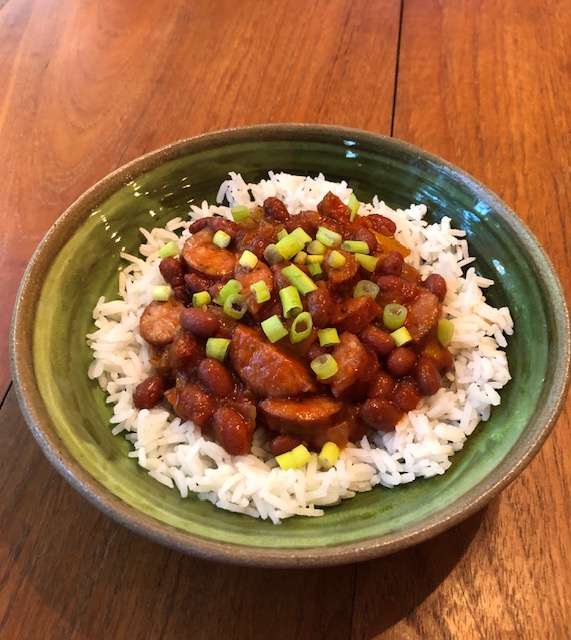
Louisiana Red Beans and Rice


A Louisiana Creole family favorite, Red Beans and Rice feeds a hungry crowd for Sunday dinner, with really tasty food and at a modest cost. The beans are generally not red kidney beans, but rather the smaller red beans, which are also used in some Caribbean countries as well as in Louisiana. The meat in this dish is typically Andouille sausage, made with pork and hot peppers and often smoked.


I’m making it more easily than the original, since I use canned red beans, rather than soaking and boiling dry beans from scratch, plus I’m using commercially available Cajun Seasoning – which contains salt. (I use Louisiana Brand, but Chacheré’s Creole is also good.) This blog has a number of readers in other countries and, unfortunately, this particular regional American dish may not be one you can easily get key ingredients for. But if you ever visit Louisiana, try it there!


The recipe serves six as a dinner dish on top of white rice, traditionally medium-grained rice from Louisiana or Arkansas. I like jasmine rice, which is more available and which we cook with a lot. Brown rice will also work. (See elsewhere in this blog – check the index – for rice cooking notes.) Offer a Louisiana-style hot sauce for diners to add to their food if they wish, like Crystal, Louisiana Brand, Tabasco, “Frank’s RedHot,” or Texas Pete,


1 medium-large green or red bell pepper, cut in 1/4-inch dice

1 large stick celery, split lengthwise several times, then cut crosswise 1/4-inch wide

1 medium-large, cut in 1/4-inch dice

2 tablespoons olive oil

1 (14-ounce) Andouille sausage, split lengthwise then cut in 1/4-inch lengths

1 large clove garlic, minced

1 (14-ounce) can diced or crushed tomatoes

1 tablespoon Cajun seasonings

2 (14-ounce) cans red beans (not red kidney beans), drained but not rinsed

Salt if needed

Green onion tops thinly sliced for garnish

Hot unsalted cooked white rice, either medium-grained or jasmine. for serving


In a heavy pot, gently fry the cut up bell pepper, celery, and onion in the oil, stirring frequently, until vegetables soften, about 10 minutes.


Add the cut Andouille sausage and garlic, and fry, stirring frequently, another 10 minutes.


Add the tomatoes, including any juice, plus the Cajun Seasoning. Simmer another 10 minutes. Finally add the drained red beans and simmer, stirring occasionally, another 15 minutes. Taste, and if the salt is not sufficient, add a little as needed.


Serve hot over hot unsalted white rice in shallow soup bowls. Top with a sprinkling of thinly sliced green onion tops. Pass the Louisiana-style hot sauce for diners to add to their taste.

,


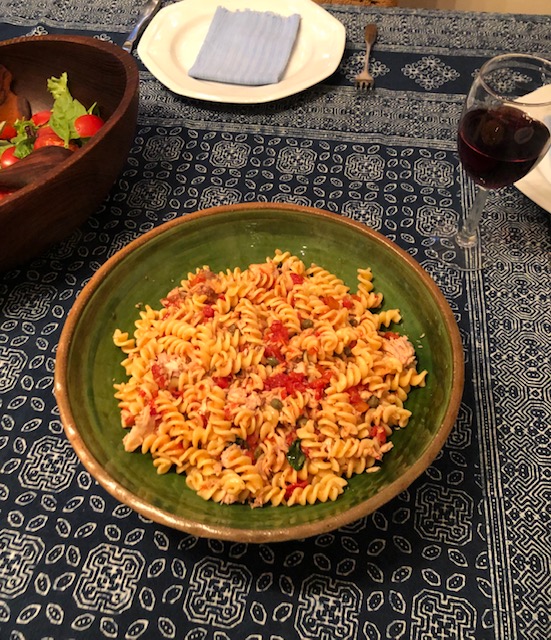
Pasta al Tonno, Pasta with Tuna and Tomato


In the United States, we are familiar with a limited number of pasta dishes. By contrast, in Italy, where pasta is ubiquitous, there are dozens if not hundreds of different, named, pasta dishes. Many of those are lighter, or simpler, than what we are used to. But in Italy, pasta typically serves as an early course in the dinner, or sometimes as a snack or light lunch, and not as the main dinner dish.


I first encountered pasta with tuna in Sicily, in Syracusa specifically. As I recall it was made with a “long” pasta, spaghetti or possibly linguine. But the dish can also be made with “short” pasta.


I’ve since learned that most of the tuna fishing by Italian fishermen is based out of coastal villages in Sicily. And while pasta with tuna and tomato is made elsewhere in Italy, it is a specialty in Sicily, particularly when made with fresh tuna. I’m pretty sure, though, that the pasta al tonno I first ate had canned tuna, as the dish typically does in Italy.


Here’s a delightful, fairly light, Pasta al Tonno, that can serve as part of a dinner, or as a light meal in its own right, accompanied by a simple salad. This dish is relatively quick and easy to make, but should be cooked shortly before eating.


In Italian cooking, pasta dishes that feature seafood, rather than meat or vegetables, rarely also contain cheese. Cheese makes a pasta dish heavy, and the point of seafood is lightness.


The best canned tuna for this dish is imported from Italy and is solid and packed in olive oil. At our local supermarket the closest I can get is Yellow Fin tuna canned in olive oil with the brand name “Genova.” which though not actually from Italy works satisfactorily for the dish.


The Italian trick of gently frying the garlic, somewhat crushed, in olive oil till golden then removing it keeps the floral essence of garlic without any of the bitterness or coarseness.


The recipe serves 6 people as the pasta course of a bigger dinner or as a light lunch or supper meal. In Italy, salad is served after the main course, but here we’d typically have the salad along with the pasta or dinner.


1 (4 to 5 ounce) can solid-meat tuna packed in oil, preferably olive oil

3 large cloves of garlic, peeled and partially crushed (with the bottom of a tumbler)

2 tablespoons capers, drained (optional)

1/4 teaspoon dry crushed red pepper flakes

1 (14-ounce) can petite diced tomatoes

1/2 teaspoon salt

6 medium-sized fresh basil leaves, or leaves from 4 sprigs flat (“Italian”) parsley

3 tablespoons olive oil

8 ounces (1/2 pound) spaghetti, or short pasta, such as Rotini or Ziti


Have all the ingredients ready, cans opened, etc. Keep the juices in the tuna can, since they are used in the recipe. Bring a large pot of water to a boil and add a teaspoon of salt, ready to boil the pasta.


Heat a heavy, shallow pan to medium-low, and gently fry the crushed garlic in the olive oil, stirring very frequently, until the garlic is golden colored. Lift garlic out of the pan, keeping the now-flavored oil in the pan. Add the drained capers, if used, and stir and fry about 10 seconds. Add the crushed dry pepper and stir and fry 5 seconds. Add the tomatoes and their juices to the pan. Press the lid of the tuna can gently into the tuna and add the juices to the pan. Stir and fry the tomatoes over medium heat a few minutes until the liquid is reduced somewhat. Stir in the salt and basil or parsley leaves and turn off the heat.


While the tomatoes are cooking, add the pasta to the boiling, salted water, and stir well for the first minute so the pasta doesn’t stick together. Then stir it less frequently. After 5 minutes or so, begin biting into a bit of the pasta to check for tenderness. When no crunch is present, and the pasta reaches the tenderness you want, drain it in a colander, catching some of the pasta water in a small bowl.


Put drained pasta into a bowl to mix, add the cooked tomato sauce. Using a fork, break up the tuna in its can and add it to the pasta. Toss this all together briefly. If the mixture is dry, add a little of the reserved pasta-boiling water to moisten it. Taste for salt, and if needed add a bit. Transfer mixed pasta to a serving bowl and serve immediately.


,


Spaghetti alla Putanesca: a Storied Dish


Spaghetti alla Putanesca, a deliciously savory dish of alleged ill repute, reportedly emerged from the war-ravaged brothels of Naples in the late 1940s. The name means spaghetti in the style of, well, ladies of negotiable virtue. The dish can be prepared quickly, for example in the short time between clients. It needs only non-refrigerated ingredients, as might have been found in your typical disorderly Neapolitan brothel kitchen’s pantry – spaghetti, canned tomatoes, garlic, olive oil, anchovies, olives, capers, dry hot pepper. The illicit-sounding dish became popular by the 1950s. Its catchy title inevitably brought out nudge-nudge, wink-wink attempts at wit: “fast,” “easy,” “hot.”


Unfortunately, food historians (and they exist!) have focused on a flamboyant cook and nightclub host on the nearby island of Ischia, not Naples working girls, as the likely creator. Yet, the lingering name suited the Italian sense of culinary humor.


To make Spaghetti alla Putanesca, the trick -- a risky word here -- is having the sauce ready before boiling the pasta. Cheese is not traditionally used. Dry to off-dry white wines, not red wines, are recommended for pairing because of the anchovies and hot peppers.


The recipe serves six as a starter course, Italian style, or four as the main course.

4 large cloves garlic, minced
1 (2-ounce) can anchovy fillets (save oil), coarsely chopped
24 Greek Kalamata olives, pitted and chopped
2 tablespoons capers, drained
2 tablespoons chopped parsley
6 tablespoons combined oil from anchovies plus olive oil as needed
1/2 teaspoon crushed red pepper flakes
1 (14-ounce) can diced tomatoes
Salt, if needed
3/4 pound (12 ounces) spaghetti

Boil large pot of water for the pasta, and prepare the ingredients.

In large frying pan gently fry garlic in the oil 10 seconds, stirring. Add anchovies and hot pepper. Fry 1/2 minute. Add tomatoes, olives, and capers. Raise heat and boil, stirring, 2 minutes. Taste, and add salt if needed. Remove from heat. Stir in parsley.

Add 1 tablespoon salt to the boiling water. Add pasta, stirring immediately so it doesn’t stick together. As pasta softens, bite a piece to test. When just tender, drain in colander, but do not rinse. In large serving bowl, toss pasta with 3/4 of the sauce. Spoon remainder of the sauce on top.

,


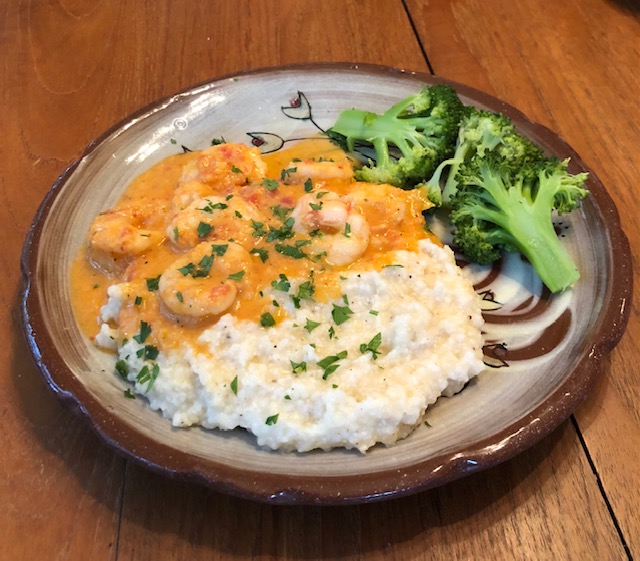
Dinner Grits made with Wine and Cheese


Dinner grits, as opposed to simple breakfast grits that go with eggs, are typically seasoned – lightly -- with herbs and spices, often contain cheese, and sometimes white wine, cream, or even chicken broth. They serve well as a side dish or base for the meal, such as in the Carolina Low Country specialty, “Shrimp and Grits.” They do very well along side, or under, grilled or roasted meats or fancy vegetable dishes. Grits have the added advantage of being gluten-free, unlike pasta or bread, and can be made vegan if desired.

Dinner grits as part of Shrimp and Grits

Serving local stone-ground grits for dinner became popular in upscale “farm-to-table” and “locavore” restaurants in the South over the past few decades. But in fact, Polenta, a very similar seasoned heavy porridge of ground corn has been used for centuries as a side dish and pasta substitute in northeastern Italy and adjacent countries. (Known as “Mamaliga,” cornmeal porridge, especially when chilled then cut and baked or grilled, is considered the national dish of Romania.) In turn, Polenta itself goes back to ancient Roman times when “Pulmentum,” as it was called in Latin, was a staple made from various grains, ground and boiled, well before corn was introduced to Europe from the Americas.


At our restaurant we serve “boats” of seasoned grits topped with the customer’s choice of sausage, bacon, fried green tomatoes, and the like, and finished with cheese, various sauces and garnishes. My recipe is slightly fancier than our restaurant version and is aimed for dinner use.


The recipe uses stone-ground or other grits that are simply ground corn. “Hominy” grits, which are the common variety used for breakfast, are ground from lye-treated corn, cook somewhat faster. Hominy grits, such as Aunt Jemima, Uncle Ben’s, or store brand, will work for this recipe, though I don’t find them as interesting.


For this dish, cook the grits and keep them warm while preparing the accompaniment. This is easily done by putting the pan, covered, in a larger pan of simmering water, or using a crock pot on warm setting -- or a chafing dish for fancy. The recipe serves four to six people.


2 cups milk or chicken broth

2 cups water

1/4 cup white wine

1/4 cup cream

1 cup stone-ground or other grits

1/2 teaspoon salt, plus more to taste

1/8 teaspoon black pepper

Large pinch ground celery (or 1/8 teaspoon celery salt)

Large pinch cayenne

Large pinch nutmeg

2 tablespoons cheddar or parmesan cheese


In a heavy pan, bring milk or broth, water, wine and cream to a boil, being careful the mixture doesn’t boil over. Meanwhile, measure out  the grits and dry seasonings into a bowl.


When the liquid boils, stirring constantly with wooden spoon or spatula, add grits mixture in a small stream. Continue to stir constantly for a minute, scraping the bottom of the pan well. Reduce heat to medium and stir frequently as grits begin to thicken, 3-4 minutes. Reduce heat to lowest setting and simmer the mixture, covered but stirring frequently, until grits are becoming tender, 20 minutes or more.


Stir in cheese. Taste, and add a little salt if necessary. Continue to simmer for a minute, then keep the mixture warm on the lowest stove setting (or place pot in a larger pan on the stove with an inch of boiling water to serve as a hot water bath, or use a crock pot on the “warm” setting) until ready to serve, stirring from time to time. The longer the grits simmer the better. If they become too thick or dry, add a little water.


To serve, spread grits in a thick puddle on a platter or individual plates. Spoon the topping partially over them. Garnish, if desired, with minced parsley.

,


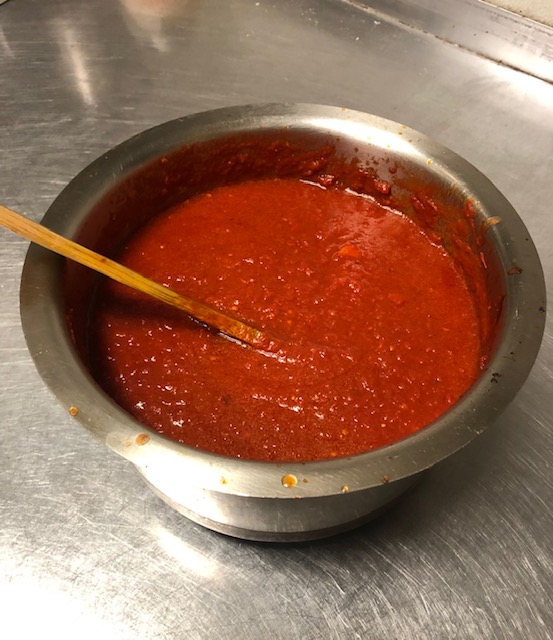
Tomato Sauce for Spaghetti, Lasagna, Pizza, and Baked Eggplant 

This is the simple red tomato sauce as I now make it after a long cooking career of experiment, trial and error. It still has elements of the way my mother made her spaghetti sauce.  Americans, but not Italians, often call this a “marinara” (sailor’s) sauce. Italians would call the vegetarian red tomato sauce simply “Sugo di Pomodoro” – tomato sauce. 

The sauce can be used on its own with pasta, topping it with grated Parmesan or Romano cheese. If you simmer meatballs in this sauce, rather than fry them, you have a nice spaghetti and meatball topping for pasta, Or, use the sauce in making lasagna; add vodka and cream for a vodka sauce; or top breaded, fried sliced eggplant or chicken along with mozzarella cheese for eggplant parmesan or chicken parmesan. The sauce also works well on homemade pizza. 

The most important part of a good sauce is the quality of the tomatoes. At the restaurant we have access to wonderful “ground” (crushed) tomatoes from a specialist company in central California. But their products are only available commercially in bulk. In my experience with supermarket canned tomatoes, Hunts brand works the best. Since American tomatoes are somewhat acidic, and a little citric acid is used for safety in the canning process, adding some sugar to the sauce is helpful.  

2 large cloves garlic, minced

3 tablespoons olive oil

1 large (28-ounce) can crushed unseasoned tomatoes (Hunts works well)

1 tablespoon sugar

1/2 teaspoon salt, plus more to taste

1/4 teaspoon paprika

1/4 teaspoon oregano

1/8 teaspoon crushed red pepper

Small pinch ground cloves

2 tablespoons water to rinse tomato can

Mince the garlic and place it in a pot (not cast iron) with the olive oil. Do not heat yet. Open the can of tomatoes and add the seasoning ingredients to the top of the tomatoes. 

Gently fry garlic in oil until softened but not golden. Stir in tomatoes and seasonings. Put two tablespoons water into the tomato can, swish it around and add it to the sauce ingredients. Bring to a simmer, stirring occasionally, and simmer for 3 minutes. Remove from heat. Taste and add a little salt, if needed.

,


Spiced Rice – a New (Old) Family Favorite

The other evening, we had some of our family who had just returned from their summer trip over for dinner, along with two additional grandchildren. The main dish was pork braised with peaches, which are currently in peak season here (see my blog posting for July 12, 2021 for a nectarine version of the dish). To accompany this, I made a spiced rice dish, actually a simple rice pilaf, something that is common in Eastern Mediterranean cuisines, and the sort of thing I made often as a side dish when our restaurant was doing delivery dinners for over a year at the beginning of the Covid period. The rice dish isn’t complex or really special, merely something savory to set off the meat dish. Or so I thought. 

To my amazement, four of the grandkids and a son-in-law found the rice amazingly different. And had their final helping of dinner as simply the rice. 

So, here it is, a new favorite in the family. It goes well with a seasoned meat dish that has a gravy or sauce. It worked very well with the braised pork. 

The recipe serves six. The rice, if necessary, reheats well in the microwave. 

1 1/2 cups basmati rice (or long-grained rice, such as Mahatma)

1 small onion, finely minced

3 tablespoons butter

1 tablespoon olive oil

2 1/4 cups water or unsalted chicken broth

1 1/4 teaspoon salt

3/4 teaspoon paprika

1/2 teaspoon dry oregano

1/4 teaspoon black pepper

3 whole cloves or a pinch of ground cloves

3 large bay leaves 

Rinse and drain the rice twice and set aside.

Mince the onion and fry it, uncovered, with the butter and olive oil over low heat in a heavy pot that has a tight-fitting lid. When onion is softened but not browned, stir in the drained rice and fry it with the onion 1 minute, stirring often. Add the water or unsalted chicken broth and seasonings and stir to mix. Do not stir again until the cooking is finished.   

Raise the heat and bring the mixture to a boil. Boil, uncovered, for 1 minute. Cover pot and reduce heat to lowest setting and set the timer for 20 minutes. Do not open the pot. When the time is up, keep the pot covered, turn off the heat and let rest for 10 minutes. 

Open the pot and remove the bay leaves and whole cloves. Fluff the rice with a fork or rice paddle. Keep warm until served.

,


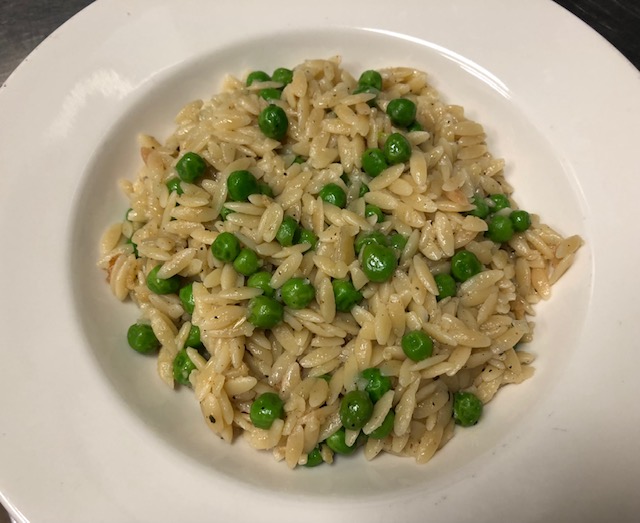
Orzo Risotto with Peas

Real risotto, the elegant Northern Italian creamy dish created from the special -- and expensive -- rice from Italy’s Po Valley, is difficult to make. And it is so fussy that you must finish cooking it then serve it almost immediately to maintain its tender structure. I have rarely had a good risotto at an American restaurant, even a restaurant with a fine chef.

On the other hand, the pasta shaped like rice, called “orzo,” is much easier – and certainly cheaper - to make into a risotto-like dish. And it will keep for a while after cooking, making it easier to serve. The Italian name “orzo” for the pasta shaped like rice grains actually means barley.

Here’s an orzo risotto with the typical sorts of ingredients in real risotto: peas, white wine, cream and Parmesan cheese. Other vegetables can be used in place of the peas, like short-cut asparagus, mushrooms, or diced zucchini. For those, cook them in at the end, like the peas, but just long enough to be crisp-tender.

The recipe serves six as a side dish or light lunch.


2 tablespoons butter, plus more if needed

2 tablespoons olive oil or chicken fat, plus more if needed

1 small onion, diced

1 small clove garlic

1 pound orzo pasta

1/2 cup white wine

1 1/2 cups unseasoned chicken broth or water, plus more water as needed

1 teaspoon salt

1/4 teaspoon oregano

1/4 teaspoon black pepper

2 bay leaves

Pinch of cayenne

1 cup frozen peas

1/2 cup heavy cream

1/4 cup freshly grated Parmesan cheese 

Heat butter and oil or chicken fat to pot and fry onion, stirring frequently, until softened. Stir in garlic for 15 seconds. Add orzo, and stir and fry 2 minutes. 

Add wine, chicken broth or water, salt and seasonings. Simmer, uncovered, stirring frequently, and add a little water as needed to keep the orzo quite moist. When orzo is tender, add the frozen peas and cream. Simmer, stirring frequently, several minutes. Add a little water if needed to keep the mixture quite moist. Taste and add salt, if needed. Remove from heat and keep warm.
 

Before serving, stir in the cheese.

,
Pasta Primavera Showcases 

Spring Vegetables With spring here and fresh local vegetables bountiful at farmers’ markets, a classic pasta dish celebrates the season. 

“Primavera” (“spring” in Italian), or correctly “alla primavera,” indicates that early vegetables dress the pasta, like asparagus, carrots, turnips, radishes, broccoli, spinach or peas. Heavier summer vegetable flavors –- tomato, pepper, eggplant, green beans -- are avoided. “Spring,” however, does not necessarily mean “lite.” Pasta Primavera can be substantial. 

The sauce is quick to cook, though it involves some prep. Almost any mixture of spring or early summer vegetables works. Firmer ones, cut evenly, start the cooking. Then less firm ones are added. Finally, young spinach and tender peas, if used, are added, along with cream, seasonings, and cheese. 

“Farfalle” pasta seems most appropriate. Literally “butterflies” in Italian (boringly, “bow-ties” in English), farfalle maintains the garden theme, and exudes the warm humor of Italian food names. Which cheese to use is an individual choice. In northern Italy, Parmesan, a cows’ milk cheese, is more likely. In southern Italy, it would be Pecorino Romano, tangier and made from sheep’s milk. Having grown up around Sicilians, I prefer Romano. Since the cheese is important to the dish, it is best grated fresh from a chunk. 

In Italy, small portions of pasta form a starter course for a dinner. In the American manner, a large serving of pasta is the main course. Accompany Pasta Primavera with crusty bread, olive oil to dip it in, and a simple green salad. Because of the cheese, I would choose a light to medium-bodied, fairly dry red wine, like a Chianti, or Pinot Noir. 

The recipe serves six. 

12 ounces “short” pasta, like bow-ties (“farfalle”) or penne 

Choose 4 of the following vegetables, 1-1/2 cups each except for spinach: 1/2-inch-diced young carrots, turnips (peeled); quartered radishes; asparagus in 1-inch lengths; 1/2-inch flowerets of broccoli; young (or frozen) peas; 4 cups washed, coarsely cut young spinach 
1 small young onion, finely chopped 
1 clove garlic, finely minced 
1/4 cup coarsely chopped parsley 
1/2 teaspoon of any mixture of fresh herbs, finely minced 
1 cup coarsely grated Romano or Parmesan cheese plus extra for serving 
1-1/2 teaspoons salt, split 
1/8 teaspoon nutmeg 
1/8 teaspoon black pepper 
Large pinch cayenne 
6 tablespoons olive oil 
1-1/4 cups half-and-half cream 

Boil a gallon of water for pasta in large pot. Add 2 teaspoons salt. Let simmer, covered, until needed. 

Prepare vegetables, onion, garlic, parsley, fresh herbs, and cheese. Mix 1 teaspoon salt plus the nutmeg. black pepper and cayenne in a cup. 

Heat olive oil in large pan and briefly fry onion plus carrot, if used, plus 1/2 teaspoon salt for 2 minutes, stirring very frequently. Add turnip and/or radish, if used, and stir and fry for another minute. Add 4 tablespoons water, cover, and steam, stirring occasionally, until vegetables become tender (test by piercing with a toothpick). Add broccoli and/or asparagus, if used, plus another tablespoon or two of water. Cook one minute, covered, stirring occasionally. 

Add half-and-half plus the salt and spice mixture. Bring to a boil. Add peas or spinach, if used, and return just to a boil, stirring. Remove from heat and stir in cheese and parsley. Keep warm and covered. 

As vegetables cook, bring the salted pasta water back to full boil. Add pasta and stir immediately so pasta does not stick together. Cook, stirring frequently, until tender to the bite. Drain in colander and transfer, hot, to large serving bowl. Add sauce plus cheese. Toss together. Taste and add salt if needed. 

Serve with additional cheese.
,


 Pesto with Pasta – The Classic Dish from Genoa

The region of Genoa, on the northwestern coast of Italy, is home to that great basil, garlic, cheese and pine nut sauce, “pesto,” called “pesto alla genovese” in Italian.

Fettuccini al Pesto alla genovese
Genoa was also home to the navigator Christopher Columbus, who sailed for the Spanish Crown. We don’t know his food preferences. Less auspiciously, Genoa is also the ancestral home of the Donderos, including my great-grandfather, Joseph Francis Dondero, who sailed from there to America in the mid-19th century. His pesto recipe – if he had one – was not handed down through the family.

The name “pesto” comes from the Latin for “pounded” or “crushed,” since the ingredients were originally pounded together in a marble mortar and pestle. The word “pestle” has the same linguistic origin.

Despite variations, including a delicious Sicilian red “pesto rosso,” made from dried tomatoes and almonds, and an arugula pesto, basil-based pesto remains the classic. A milder but still authentic version, which I prefer, replaces 1/4 of that herb with fresh parsley. There is also a relative of pesto, “pistou,” in Provence, on the French Mediterranean coast near to Genoa. French pistou does not use pine nuts and may or may not contain cheese.

Genovese Basil in our garden
Ideally the basil for pesto should be young and of the large-leaved “Genovese” variety. Now in early June in Georgia, that basil is at its peak. As pine nuts (“pignoli”) are expensive, walnuts are sometimes substituted. (I also get a reaction to at least some pine nuts, which I used to love, with my taste being distorted to bitter for a week or two afterwards.) The cheese for pesto is traditionally either Pecorino Romano, Pecorino Sardo, or Parmesan.

Though better when freshly made, pesto can be refrigerated for up to a week. An added layer of olive oil over the surface slows the color from browning. If freezing pesto for later use, omit the cheese and add it just before serving.

A traditional pasta for pesto is “trenette,” long flat noodles often made with eggs. Fettuccini is an available substitute. In the region of Genoa, potato and green beans are sometimes cooked in with the pasta. Pesto is also served with potato gnocchi, which are little fork-scored dumplings, and sometimes with that charmingly named pasta, “strozza preti” -- priest stranglers.

Traditionally, just before use, pesto is diluted with a little boiling water from the cooking pasta. The pasta is drained then tossed with the pesto in large serving bowl and topped with additional grated cheese.

The recipe makes enough dressed pasta for six people.


Pesto with Pasta

1-1/2 cups fresh basil leaves, lightly packed
1/2 cup parsley leaves, flat “Italian” type preferred, lightly packed
3 tablespoons pine nuts, or walnuts (lightly toasted – see below)
2 cloves garlic
1/2 cup extra virgin olive oil
1 teaspoon salt
5/8 cup grated Romano or Parmesan cheese, or a mixture, plus extra for garnish
Salt for boiling the pasta
2 medium potatoes, peeled and cut in 1/2-inch chunks
1/4 pound green beans (optional), cut in 1-inch lengths
1 pound fresh pasta, if available, or 12 ounces dry


Put basil, parsley, pine nuts or walnuts (toast walnuts about 3 minutes on a plate in the microwave), garlic, oil, and salt in a blender or food processor. Pulse it a number of times, scraping down the container with a spatula. Do not purée the herbs, but chop them until they are tiny specks. Remove the mixture to a bowl. Stir in the cheese.

Bring a large pot of water to a boil. Add 2 tablespoons salt. If using fresh pasta, which cooks more quickly, add potatoes and green beans if used, and bring water back to a boil. Add the fresh pasta and stir immediately so it does not stick together. If using dry pasta, add it, the potatoes and green beans, if used, together to the boiling water and stir immediately so pasta doesn’t stick together. Either way, let boil, stirring frequently. While pasta is cooking, remove 1/2 cup of the pasta-boiling water and stir it into the pesto.

When pasta is tender to the bite, drain it in a colander, shaking briefly, and transfer it to a large serving bowl. Toss pasta with the diluted pesto. Sprinkle with a little more cheese.


,


Greek-Style Orzo Pasta Salad

This dish grew out of a momentary thought a few years ago when a local hospital ordered a buffet catering meal from us that was for a public reception. One of the tricks for serving a crowd at modest cost is a huge bowl of pasta salad, which was among the dishes the hospital ordered.

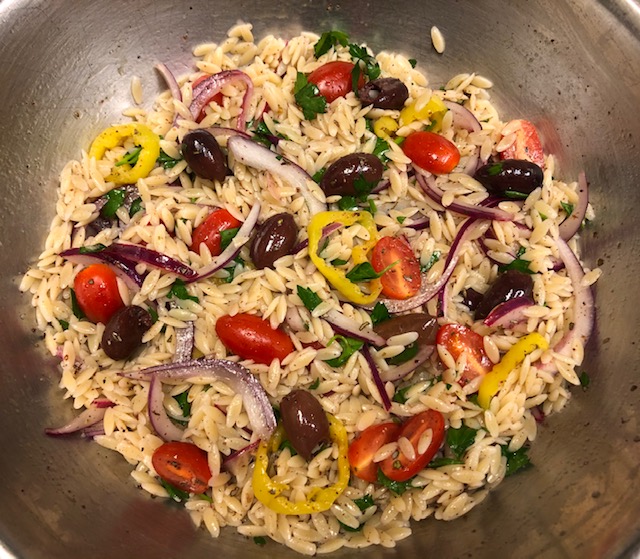
Greek Orzo Pasta Salad, without Feta Cheese
Instead of my standard sort of pesto-seasoned pasta salad I suddenly thought to use the ingredients around that I had just made a conventional Greek salad with for a different order, Kalamata olives, pickled peppers, tomatoes, red onions, wine vinegar, oregano, olive oil, feta cheese. Happily, the huge bowl of penne I dressed with all these ingredients tasted tangy and good. More important, the Administrator of the hospital loved the salad, and it was always requested as we catered more events for them. We added it as a standard item for our general catering, special orders, and the deli case.

Here is a version of the salad with an even shorter pasta than penne. Orzo, shaped like rice grains, actually means “barley” in Italian (though the pasta is sometimes called “risoni” in Italy, meaning large [grains of] rice). The result looks like a Mediterranean rice salad, at least if not covered with crumbled feta cheese.

I use the herb sumac in the dressing, which I first learned about when I cooked with Turkish chef friends in Decatur. But sumac actually originated in Greece and, reportedly, is used with meats there as well as throughout the Eastern Mediterranean. A little paprika can be substituted if sumac is not available. Feta cheese is optional, being a bit heavy for summer dining, but it enhances the nutritional value of the salad.


The recipe makes enough salad to serve 4-6 people.


1/2 pound orzo pasta (or penne pasta)

1 medium clove garlic put through a garlic press or finely minced

2 tablespoons red wine vinegar

1 1/2 tablespoons olive oil

1 1/2 teaspoons sugar

1 teaspoon sumac (or 1/2 teaspoon paprika)

3/4 teaspoon salt, plus more to taste

3/4 teaspoon dry oregano

1/4 teaspoon black pepper

1/2 of a small red onion, thinly sliced lengthwise (julienned)

1/2 cup small cherry tomatoes, halved lengthwise

6 tablespoons pitted Kalamata olives, drained

1/4 cup sliced pickled banana peppers

2 tablespoons coarsely chopped parsley leaves (flat “Italian” type preferred)

1/4 cup crumbled feta cheese, optional


Boil the pasta in plenty of lightly salted water, stirring well after adding the pasta to the water. When just tender to the bite, drain into a sieve and rinse well with cold running water. Set aside.

In a mixing bowl combine the rest of the ingredients except the feta. Mix in the drained pasta, and mix well. Let sit for ten to fifteen minutes, mix again, and taste, If desired, add vinegar or salt to taste (generally do not add salt if salty feta cheese will be added).

 
Serve mounded slightly on a platter. Sprinkle with crumbled feta, if used.


Follow Us @donderoskitchen