Showing posts with label Desserts & Baked Items. Show all posts
,


Swedish Apple Pie


Here’s a great apple dessert that’s shamelessly easy to make. “Swedish Apple Pie” has it all, including a misleading name. It is Swedish (called smulpaj, meaning “crumb pie”) and contains apples. But it’s more of a crustless torte than a traditional “pie.” I adapted this recipe from that of my non-Swedish sister-in-law Carol. Simple, inexpensive, and with everything basically thrown into the baking dish, it’s unbeatable. When served, it should be topped with either whipped cream or vanilla ice cream. The most elegant is heavy cream whipped with a little powdered sugar then a little rum or Bourbon folded in at the end.

5 cooking apples (like Gala or Granny Smith), peeled, cored, in 1/2-inch slices
1 tablespoon sugar for apples
1/2 teaspoon cinnamon
1/2 teaspoon grated lemon zest

2 tablespoons lemon juice
1 egg, lightly beaten

1/3 cup butter, unsalted preferred
1/4 cup oil (not olive)
1 cup flour
1 cup sugar for batter
1/2 teaspoon salt

1/4 cup walnuts or pecans, chopped

Whipped cream or vanilla ice cream for serving, optional

Preheat oven to 350 degrees. Butter an attractive 10-inch shallow casserole.


Place sliced apples in a bowl. Mix the tablespoon of sugar with cinnamon and lemon zest. Sprinkle evenly over apples. Sprinkle on the lemon juice. Toss to mix and spread out the apple slices in the baking dish. Then use the bowl to beat the egg.


In a different bowl, glass or ceramic, melt butter in microwave, about 1 minute. Add oil, flour, sugar, egg, salt, and nuts. Stir until combined. Spoon batter over apples and spread evenly.

Bake 45 to 55 minutes, or until golden brown. Serve warm. When serving, top, if desired, with whipped cream or vanilla ice cream.

,


Easy Berry Topping or Sauce


For an easy dessert, like store-bought ice cream or angel food cake, a raspberry, or strawberry or mixed berry sauce is a great topping. Using store-bought frozen, or fresh, berries, making the sauce takes just a few minutes, plus a few more minutes to cool.


The typical packages of frozen berries are 12 ounces, and the fresh berries are a pint. Both work with this recipe. I prefer organic berries, to avoid the pesticides that are often used on these crops.


12 ounces frozen or 1 pint fresh berries (raspberries, blackberries, strawberries, blueberries, or mixed berries), organic preferred

2 1/2 tablespoons brown sugar for 12 ounces of frozen fruit OR 1/2 tablespoons brown sugar for a pint of fresh berries

1/8 teaspoon salt


If using frozen berries, place them directly in a small enamel or stainless steel cooking pot. If using fresh berries, remove any leaves or stems and place the fruit in the pot. Add the brown sugar and salt.


Heat to a boil over medium heat, stirring frequently, and cook until fruit is becoming tender. Turn off the heat and break up the berries somewhat with a potato masher or fork. Let cool.


The sauce will keep, refrigerated, for a week or more.


Serve over your choice of ice cream, sherbet, cake, cheesecake, pudding, or even pancakes. An optional additional topping is whipped cream.

,


“Peach Marsala” is easy and delicious


The idea started with a chef friend’s experiment years ago in Atlanta. He toyed with a sweet, creamy bourbon-enhanced sauce for a peach cake. In the end he abandoned the effort, but not before I had tasted his sauce and saw possibilities. 


I stole the idea, frankly, but changed the flavor from Jack Daniels to aromatic Marsala wine. And I envisioned the sauce over broiled peaches. That was as the peach season was winding down that year.  The idea dwindled. But the following year, having received some luscious peaches from a traveler from South Carolina (I know, I know… but they grow them well up there, too), I revived the thought of a rich, Marsala-laced sauce on peaches. And in particular, peaches over good vanilla ice cream.


Marsala, a fragrant, fortified wine made for centuries in Sicily, draws its name from its town of origin. Produced from local grapes, the wine ages for years in a system of connected barrels from which a portion of older wine is drawn off from the bottom to sell and new wine is added to the top to replace it. Thus wines of different vintages mingle as their flavor and fragrance intensify. The barreling system is similar to the “solera” used for producing sherry and port wines.


California Marsala made by Cribari, a company best known for sacramental and altar wines, is inexpensive and quite decent for cooking. But Marsala varieties from Italy are not expensive, either. I prefer the non-sweet version (“secco” for Italian­­-made Marsala) since I also use it cooking chicken.


In this dessert fresh sliced peaches are placed over ice cream and the sauce is poured lightly over them.


The recipe makes sauce enough for six servings over peaches and ice cream .


1/3 cup Marsala wine

1/4 cup brown sugar

Large pinch of salt

2/3 cup sour cream

3-6 peaches, depending on size, peeled and sliced

Vanilla ice cream


In enamel or stainless steel pot, bring wine, sugar and salt to a rapid boil, stirring. Simmer for two minutes. Whisk in the sour cream until smooth, then remove from the heat. Let cool.


Serve from a small pitcher or serving bowl. Spoon sliced peaches over ice cream and drizzle with the sauce.

,


Mince Pie Filling for Pies and Tarts


I have no idea if anyone reading this will ever actually make homemade mince pie filling. But I wanted to record how over the years and through much trial and error I have learned to make it, just in case someone wishes to try. “Mincemeat,” as it used to be called (it began many centuries ago as a spiced mixture of meat and fruit for baking into pastries around Christmas) is now usually vegetarian. Mince pie is one of those traditional foods that some people love and some dislike. It should be clear that I love it.


Mince Pie Filling for Pies and Tarts

Even in the areas of the world where mince pies and tarts are traditional, like the British Isles, some British Commonwealth countries, and the New England of my childhood, people rarely actually made the filling from scratch. Usually they bought a commercial product. My mother preferred First National’s house brand “Finast” (both the venerable store chain and the Finast brand are gone), but Crosse and Blackwell was generally the most readily available mincemeat. The one my mother used came as a concentrate that she had to moisten and cook. She would add some chopped apple to stretch it -- and always stirred in some rum before baking the pies at Christmas.


The original mincemeat goes back to 13th century England, where Crusaders returning from the Holy Lands brought with them an acquired taste for richly flavored meat dishes cooked with fruit, spices and sweetened with honey. The earliest mincemeats for pie were based on actual chopped (“minced”) meat, particularly lamb, but vennison and beef were also used. Suet (beef fat) was also a component, even into the 20th century, well after the meat itself had largely disappeared from the mixture. In recent decades, the mixture has generally been purely vegetarian, combining apples or pears, raisins, currants (dried tiny grapes, “Raisins de Corinthe,” not true currants), orange peel, sugar, molasses, salt and spices. The traditional principal spices are cinnamon, cloves and nutmeg.


As I make mince pie filling, I think the flavor and general texture are like what I enjoyed in my childhood. But my memory may have evolved the way my method has. I leave out the suet that was there back then, and replace it with butter or oil. (If this were to be vegan, sunflower or canola oil could be used.) My spice mixture includes allspice as well as the original three. Allspice is the only true spice that originated in the New World, and would not have been available to English cooks until sometime after Columbus got to the Americas. One final adaptation is using green tomatoes, as thrifty New Englanders did in their mincemeat to make use of late produce from the garden, harvested unripe before the frost arrived. In past trials I’ve also used local pears when available, as one of the fruits. I still use dried apples, which give a good consistency. When I couldn’t find them in the past I used fresh apples, peeled and chopped, and reduced the water a little.


Here’s my recipe as it has evolved. I doubt that I will be modifying it further. It makes about four quarts, and keeps well in the refrigerator for several weeks. It also can easily be stored frozen until needed for holiday baking. If you make it, I hope your pies and tarts turn out well!


3/4 pound dried apple rings (about 3-4 cups after chopping)

5 medium-large firm green tomatoes

1 medium-large orange (preferably organic)

1 pound dried currants

1 pound dried green grape raisins or regular raisins

1 pound black raisins

1 1/2 cups molasses

1 cup cider vinegar

1 1/2 cups water

4 tablespoons butter (or vegetable oil)

1 cup brown sugar

1/2 cup white sugar

2 1/2 teaspoons salt

1 tablespoon ground cinnamon

1 1/2 teaspoons grated nutmeg

3/4 teaspoon ground cloves

3/4 teaspoon ground allspice


Using a food processor, chop the dried apples, part at a time, until the pieces are about 1/4-inch in size. Place in a heavy stainless steel or enamel pot. Cut out cores from the green tomatoes, cut the tomatoes in chunks and chop them coarsely in the food processor, part at a time. Add to the apples. Cut the orange, skin and all, into thick slices and remove any seeds. Chop the sliced orange finely in the food processor and add it to the pot.


Add the dried currants and raisins, molasses, vinegar, water, butter or oil, sugars, salt and spices. Bring to a boil, then over very low heat, cook slowly, stirring frequently and covering the pot between stirrings. If the mixture gets somewhat dry, add a little water. Cook the mixture for half an hour or more, until apple pieces are tender and moist.


Cool and store refrigerated, or frozen, for later baking. The flavors mellow and improve with aging, and are best after at least a few days storage.


Some cooks (like my mother did) stir in a little rum, bourbon, or (in the UK) whisky before baking their mince pie or tarts. The alcohol cooks off during baking, leaving behind only delightful flavor overtones.

,

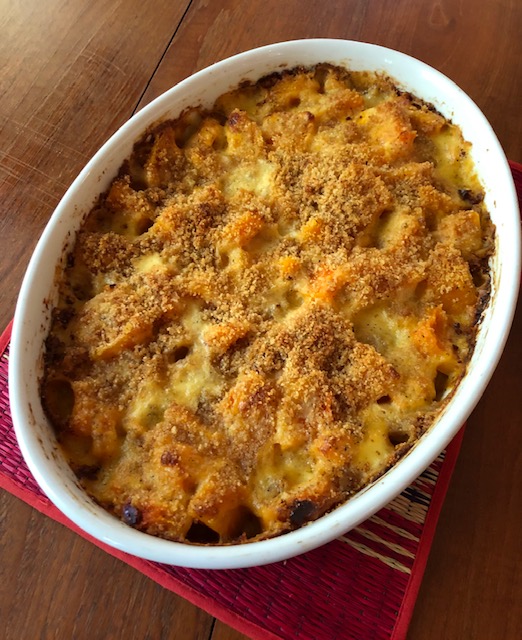
 Butternut, Pumpkin, or Kabocha Casserole – a French-Style Gratin


French cuisine, especially from the southeast of France, includes many wonderful and varied “au gratin” vegetable dishes. The common denominator seems to be baking with  cheese and/or oiled or buttered breadcrumbs.


This recipe is for a hearty, cold-weather gratin casserole of winter squash or the somewhat flat European-style pumpkin, French “courge” or Italian “zucca.” These are sometimes available here at farmer’s markets and called “heirloom” pumpkins. The Japanese “Kabocha squash” is fairly similar. In the US, the most readily available of these vegetables (though technically they are all “fruits”) is butternut squash. The dish can be the vegetable in a dinner, or a supper or lunch accompanied with warm baguette. The recipe serves six.


1 medium-large butternut squash or Kabocha (2 1/2 to 3 pounds)

3/4 teaspoon salt for vegetable plus 1/2 teaspoon for sauce

1 1/2 cups (loosely packed) coarsely grated Cheddar or Gruyère cheese

2 tablespoons grated Parmesan or Romano cheese

3 tablespoons butter

2 1/2 tablespoons flour

1 1/2 cups whole milk, or part cream

1/2 teaspoon ground black pepper

1/8 teaspoon grated nutmeg

A pinch of cayenne

4 tablespoons plain breadcrumbs moistened with 1 tablespoon olive oil or melted butter plus a sprinkle of salt


Cut off the stem and bottom ends of squash. Peel the squash. Cut it crosswise into 1/2-inch slices, scooping out the seeds with a spoon when you get to them. Cut the squash slices into 1-inch square pieces. Steam them over boiling water, stirring them once or twice, until tender (test with toothpick), about 15 minutes.


Cool the steamed vegetable, then transfer it into an attractive casserole dish. Sprinkle with about 3/4 teaspoon of salt, part at a time, and mix to season evenly. Top with the cheeses and mix them in gently.


Set the oven for 375 degrees.


Prepare béchamel sauce:  In heavy pan over medium heat melt butter with the flour. Cook mixture 2 minutes, stirring. With whisk, mix in milk or milk and cream and continue to whisk until the sauce comes to a boil. Let simmer, whisking frequently, until thickened,  2-3 minutes. Remove from heat and stir in 1/2 teaspoon salt, plus the pepper, nutmeg and cayenne.


Spoon sauce evenly over the vegetable in the dish and gently mix it in a little. Finish by sprinkling on the oiled or buttered breadcrumbs. With moistened paper towel, wipe off any sauce and vegetable stuck to the edges of the baking dish.


Bake in the middle of oven until the sauce is bubbling and the surface begins to brown, about 20-30 minutes. Serve hot. Or the baked dish can be cooled, refrigerated, and re-baked just long enough to he
,

 Tarte de Cambrai -- Easy French "Cake" with Fresh Fruit


Tarte de Cambrai, also known as Tarte Normande, is a easily made cake-like dessert with fresh fruit baked into the top. The original was made with apples, the major fruit of Normandy, in the northwest of France, where this dessert is a traditional specialty. Pears are also used, as are fresh plums, which are my favorite. Sometimes the apple version, reportedly, contains some Calvados, the apple brandy of Normandy. 


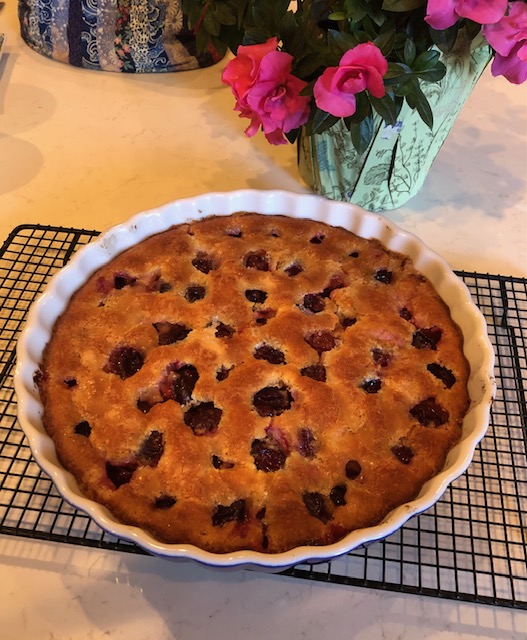
In our house, this tarte has become a standard dessert that my wife, Christina, makes. having found a recipe in a cooking magazine 40 years or more ago, possible "Cuisine." Depending on what fruit is in season, she makes the treat with any of the three typical fruits. Right now with prune plums in season she just used those, as pictured in this posting.


The traditional topping in France is Crème Fraiche, the French version of sour cream. Sour cream or whipped cream, or even a little vanilla ice cream can be used here when serving the tarte. 


The recipe makes a 10-inch round cake, enough to serve six to eight for dessert or tea snack. 


5 large ripe apples or pears, or 10-12 medium-small dark-colored plums

1 tablespoon lemon juice for the fruit 

Batter:

10 tablespoons (1/2 cup plus 2 tablespoons) flour

6 tablespoons sugar

1 teaspoon baking powder

1/4 teaspoon salt (the French use less)

1/4 cup vegetable oil

1/2 cup milk

2 eggs

1 teaspoon vanilla

Topping:

2 tablespoons sliced almonds (optional)

2 tablespoons sugar

1/4 cup (1/2 stick) butter


Set oven for 375 degrees.


Peel apples or pears, if used. Quarter them and cut out the cores. Cut the fruit lengthwise into 1/4-inch wide wedge-like slices. Toss them with the lemon juice. Or, if using plums, rinse them but do not peel. Cut them in half around the pit, twist them to free up the pit, or cut along it with a knife to remove it. Keep the plum halves intact if they are small, or cut them in half if large. Toss them with the lemon juice.


In a mixing bowl, place all the batter ingredients and mix them together well by hand using a whisk or large fork. 


Grease a 10-inch round baking dish that the tarte will be served from. Spread the batter evenly in the dish. Arrange the fruit attractively on top of the batter. If using sliced almonds, scatter them over the surface. Sprinkle the top evenly with the 2 tablespoons of sugar, then cut the butter into bits and scatter them evenly on top.  


Bake 40-50 minutes or until the tarte has risen and the top is golde
n brown. 


Eat warm with whipped cream, sour cream, or vanilla ice cream.


,


Eggplant Gratin – Provençal Gratin d’Aubergine


Late summer brings both eggplant and tomatoes. That’s when in the south of France Eggplant Gratin – “Gratin d’Aubergine” -- was was most common in the old days. Now with produce available year round, the dish can be enjoyed anytime.


Southeastern French cuisine includes many wonderful vegetable gratins. There are seafood and meat gratins as well. “Gratin” indicates topping with grated cheese and/or breadcrumbs and baking in a shallow dish till crispy on top. Gratins of potatoes, cauliflower and other winter vegetables typically lack tomatoes but contain milk, often in a creamy béchamel sauce. Two gratins that I’ve had in France are different, eggplant gratin and “Tomates Provençale,” which is a sort of gratin but not called that. Both contain cheese and breadcrumbs plus tomatoes, but no milk. They both taste very fresh, and are somewhat lighter than some of the winter gratin dishes.


Eggplant gratin has some similarities with  Eggplant Parmesan, or “Melanzane alla Parmigiana,” a dish from southwestern Italy, down the Mediterranean coast from French Provence. But in the heavier Italian dish the eggplant slices are coated with egg and flour or breadcrumbs and pre-fried or pre-baked before assembling the dish. Plus considerable mozzarella cheese is used in addition to the namesake Parmesan cheese. And there are no breadcrumbs in the topping. For French eggplant gratin, which similarly uses Parmesan cheese, the eggplant is merely salted to remove its bitterness, and mozzarella is not usual.


In this recipe, I use the traditional Parmesan cheese (domestic is good enough for this baking), but in addition for a creamier cheese inside the dish I use Gruyère, or for a more economical dish grated Jarlsberg or “Swiss” cheese works satisfactorily. The dried herb mix “Herbes de Provence” is an important seasoning for this dish. It’s available at the spice and herb section at most supermarkets. A substitute would be a mixture of thyme, marjoram and oregano.


The recipe serves six as a luncheon or principal dish, or will serve more as a side dish. The gratin can be made ahead and re-heated before the meal.


This dish pairs nicely with lighter-bodied red wines (chilled about 20 minutes in the fridge before drinking to take off the summer warmth). A red Beaujolais, Côtes du Rhône, or Pinot Noir will work and be geographically appropriate.


2 medium eggplants (about 1-1/2 pounds)

2 tablespoons salt for soaking the eggplant

3 tablespoons olive oil for the casserole dish

1/4 pound (about 3/4 cup) grated Gruyère or Swiss cheese (domestic)

1 (14-ounce) can crushed or “ground” tomatoes

1-1/2 teaspoons salt for the baking

2 teaspoons dry Herbes de Provence (or see notes above)

2 teaspoons chopped fresh basil leaves

1-1/2 cups grated Parmesan cheese (domestic wedge is OK)

5 tablespoons dry breadcrumbs mixed with 2 tablespoons olive oil for topping


Rinse off the eggplants. In a large bowl, combine two quarts of water with 2 tablespoons of salt. Cut stem tops off the eggplant and cut a thin piece off the bottom ends. With a vegetable peeler or sharp knife cut off three narrow strips of peel lengthwise equally separate from each other (so skin isn’t continuous when the eggplant is sliced). Slice the eggplants crosswise into 1/4-inch-thick circles. Soak these in the salted water, mixing them occasionally, at least 30 minutes.


Open the can of crushed/ground tomatoes and mix in the 1-1/2 teaspoons of salt plus the Herbes de Provence and chopped fresh basil. Set aside.


Set the oven for 350 degrees.


Using a shallow casserole dish from which the gratin will be served, pour in 3 tablespoons of olive oil and tip the dish to have the oil coat the bottom and part of the sides of the dish.


Drain the eggplant slices. Place half of them in the oiled casserole dish, slightly overlapping. Press them down lightly. Sprinkle evenly with half of the grated Gruyere or Swiss cheese. Then spoon half of the crushed/ground tomatoes (containing the seasonings) evenly over the top. Sprinkle with half the grated Parmesan. Then repeat these steps with the second half of the ingredients, finishing with the Parmesan.


Moisten the breadcrumbs with the olive oil. With your fingers crumble this evenly over the top of the casserole.


Bake in middle of oven until the juices are bubbling and the topping begins to brown, about 40-50 minutes.


Serve hot. Or the baked casserole can be cooled, refrigerated, and re-baked just long enough to heat through before serving.

,


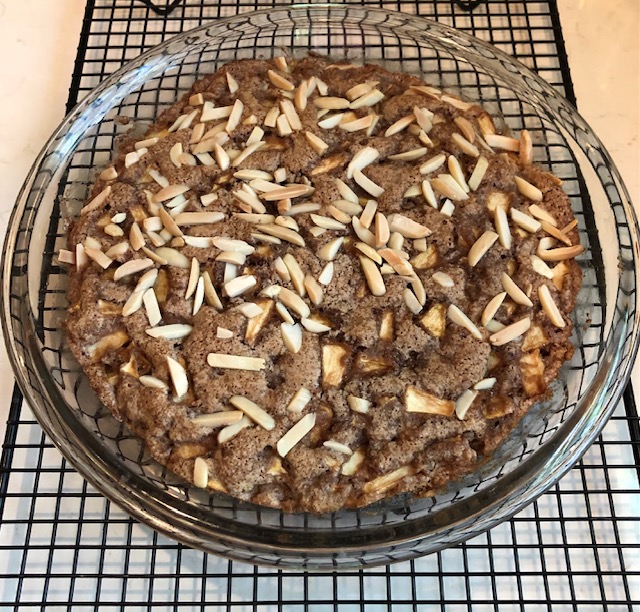
Easy-to-make Norwegian Apple Cake


Although incredibly simple and actually low in calories (no oil or shortening), this cake or, more accurately, torte, is a rich-tasting dessert. It is patterned after a recipe from my sister-in-law, Libbet, who learned it in Vermont. While the cake is satisfying alone, I include a recipe for honey-tinged whipped cream for a topping. Good vanilla ice cream also works well.
 

Made by Christina Dondero
The “cake” will serve six to eight.


With cooking spray or butter, grease a 9-inch pie dish (preferably glass or ceramic) or a spring-form pan. Heat oven to 350 degrees.

1/2 cup flour

1/2 cup sugar

1 teaspoon baking powder

1/2 teaspoon cinnamon

1/4 teaspoon nutmeg

1/8 teaspoon salt

3 medium-large apples, such as Golden Delicious, Rome, or Braeburn

1 egg

1 teaspoon vanilla extract

1/4 cup slivered or sliced almonds, or coarsely chopped pecans


Combine the dry ingredients. Peel and core apples. Cut them into 1/2-inch slices. Mix these into the dry ingredients. Lightly beat egg and vanilla together in a small bowl, and stir them into fruit just until moistened.

Spoon mixture into prepared baking dish and smooth top. Sprinkle with almonds or pecans.

Bake 40-45 minutes, or until the middle bounces back when you touch it. Serve warm or at room temperature. Top with a dollop of whipped cream, if desired.


Honeyed Whipped Cream 

1 cup (1/2 pint) heavy whipping cream

2 teaspoons honey (orange blossom is particularly good) 

Combine cream and honey in cold mixing bowl. Beat, scraping bottom of bowl frequently, to mix honey in well, until fluffy and slightly firm.

,


Cinnamon Flop: Great coffee cake, funny name

For years we’ve enjoyed a light fragrant breakfast cake called “cinnamon flop” from a recipe of my wife’s grandmother (“Nanny”), which was given to us by my mother-in-law. No one we’ve met had heard of this breakfast goodie outside of the family. The “flop” is white and airy, has a tender cinnamon topping and irregular deep pockets rich in spice and butter. It’s unique for having no egg and relatively little butter or shortening, and uses the old-fashioned hand mixing style of alternating dry and wet ingredients. An electric mixer makes the coffee cake tough, and adding egg (obviously we tried both) gives an uninteresting cakey texture that misses the delicate unique tenderness of real cinnamon flop. I had assumed that it came from the Great Depression and was an economical survivor of that time of deprivation, and wondered if it was limited to the family. Or was it maybe something from Boston, where my wife’s grandmother grew up.

But noooo. Some research turned up a number of other “cinnamon flops,” and they typically had the tell-tale no egg, the alternating mixing of wet and dry ingredients, and bits of butter pushed through the topping into the cake. Some recipes call for much more sugar than does “ours.” But most interesting were several attributions of cinnamon flop to the Amish and the “Pennsylvania Dutch”. In fact, my wife’s grandmother lived her married life in Bucks County, Pennsylvania. So that ethnic origin of the family’s spice-scented coffee cake is quite plausible (and certainly consistent with the cinnamon and brown sugar). The recipe was probably learned in Pennsylvania by Nanny. 
My grandson Jonah has become quite adept at making this coffee cake, as he has popovers. He increased the recipe's originally stingy amount of butter that is pushed into the batter just before baking, to good effect. I have converted to his method.

Cinnamon Flop Nanny
Cinnamon Flop made 
by my grandson Jonah


1/4 cup butter (originally “butter the size of an egg”)
1 cup sugar
2 cups flour plus 2 tablespoons for the topping
4 teaspoons baking powder
1/4 teaspoon salt
1 cup milk
1/4 cup brown sugar
3/4 teaspoon cinnamon (originally 1 teaspoon)
4 tablespoons cold butter (1/2 stick)

Set oven at 375 degrees. Butter a 9-inch square baking dish or pan. In a bowl, using a wooden spoon mix 1/4 cup butter with the sugar until creamy. In a separate bowl, combine the flour, baking powder, and salt. Add one-third of that to the butter-sugar mixture and stir it in. Then add 1/2 the milk and mix it in, just until evenly wet. Add and briefly mix in another third of the dry ingredients, then briefly the other half of the milk. Finish by briefly stirring in the last portion of the dry ingredients, just until moistened. Do not over mix it or the cake will be tough. Spread into the buttered dish. Mix together the 2 extra tablespoons flour, the brown sugar and cinnamon. Sprinkle this mixture evenly over the batter. Cut the cold butter into little slivers and stick them down here and there part way through the topping into the batter. Bake for 25 to 35 minutes, or until the center springs back when touched. Serve fresh and warm.
Jonah and his Cinnamon Flop on the porch

,


Popovers – Luscious easy treats my grandkids love


A very old-fashioned breakfast or snack food has been rediscovered by my grandkids, several of whom make them easily and often with minimal adult help. These golden puffed-up tender sorts of hot muffins or breads are basically crepe batter cooked in muffin tins. Popovers, which have been made in America for several centuries, are thought to have evolved from the earlier British Yorkshire pudding. They are perfect for a dab of butter, or honey or a fruit jam, and are best right out of the oven. 

Popovers made by my grandson Jonah
The batter is the same as for French crêpes – a cup of flour, a cup of milk, a couple of eggs, and optionally a pinch of salt. They are, in our experience, something the young kids can make, and certainly love to eat them. 

The recipe makes 12 popovers, enough for 4-6 people. 

2 eggs

1 cup flour

1 cup milk

1/4 teaspoon salt (optional)

12 small pieces butter 

In a bowl beat together the ingredients other than the butter with a small whisk or fork until well combined. 

Set oven for 400 degrees (380 convection). Place a small piece of butter in each cup of a 12-cup muffin tin. Place tin in the heated oven until the butter melts. 

Spoon batter evenly into the 12 muffin cups. Place in oven and bake for 20 minutes. Turn the pan around and bake for another 8-10 minutes, or until popovers are well puffed and golden on the tops. 

Serve hot, with a little butter and/or fruit jam or honey.


,


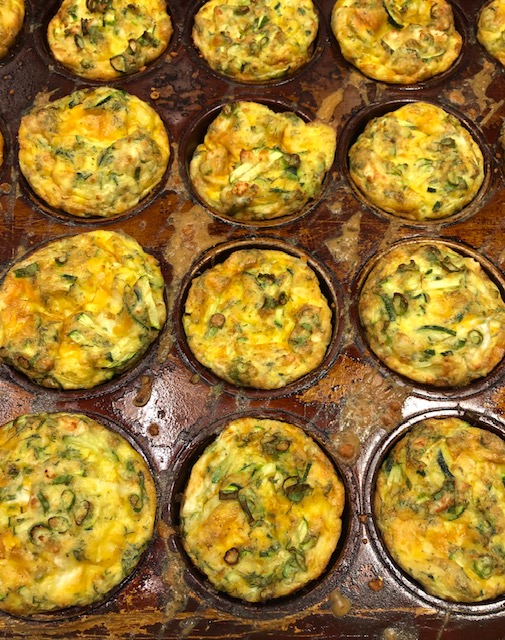
Egg Frittatas, crustless zucchini, cheese and fresh herb egg pies


At our restaurant, we are occasionally asked to make gluten-free quiche-like items for breakfast catering. Based on frittata, a crustless Italian vegetable and egg pie, here are individual savory treats baked in muffin pans. Shredded zucchini, feta cheese and dill make very Mediterranean, if not necessarily Italian, breakfast or supper frittatas. They are best right out of the oven, though can be eaten at room temperature or rewarmed in the microwave for a later snack.

The recipe makes about 12 small frittatas. Two to three per person is a hearty serving. 


2 cups eggs (crack eggs into a measuring cup until the volume is reached, 10-12 eggs)

1 cup shredded zucchini

2 tablespoons crumbled feta cheese for batter + 2 tablespoons for topping

1/4 cup shredded cheddar cheese

2 teaspoons snipped fresh dill

2 teaspoons chopped parsley, flat Italian style preferred

1/2 teaspoon salt

1/8 teaspoon black pepper

Large pinch ground celery seed (not celery salt)

Large pinch cayenne

3 green onions, green and part of white parts very thinly sliced


Set oven for 375 degrees. Spray oil or grease a 12-cupcake pan. 

In bowl, lightly beat the eggs with a whisk or fork until well broken up and smooth but not frothy. Add zucchini, 2 tablespoons feta, the cheddar, fresh herbs, salt, pepper, ground celery seed and cayenne. Mix well to combine. 

With ladle, partially fill all 12 cupcake cups to equal levels. Evenly distribute the remaining 2 tablespoons of crumbled feta plus the finely sliced green onion over the batter. Bake in heated oven 8 minutes. Turn pan and continue baking another 8 minutes or so until frittatas puff and a toothpick inserted near the center of one comes out clean.

Best served warm, with a little tomato sauce or salsa, or hot pepper sauce, if desired.


,


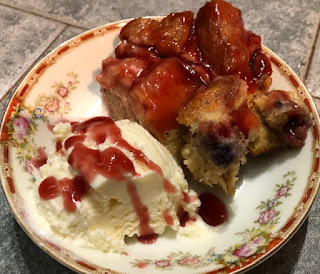
Blueberry Bread Pudding with Raspberry Sauce


Here’s a recipe for a fruited bread pudding that I developed for my pre-teen cooking class recently. The method is somewhat simplified in terms of the baking method, not using a pan of hot water in which the pudding pan sits.

Pudding:

10 cups, fairly packed, cubed (see below) baguette or sandwich bread (one large loaf)
4 eggs
3 1/2 cups whole milk
3/4 cup brown sugar
1 teaspoon vanilla
3/4 teaspoon salt
1/2 teaspoon cinnamon
1/4 teaspoon nutmeg
3 to 4 tablespoons melted butter (easiest in a cup in microwave)
1 cup blueberries, fresh or frozen
1/4 cup pecans (optional), coarsely chopped

Sauce:

1/2 cup raspberry preserves (can put through a sieve if you want to get rid of seeds)

3/4 cup water

Pinch of salt

2 teaspoons brown sugar

2 teaspoons lemon juice

1/2 teaspoon cornstarch

1 teaspoon butter


Heat oven to 375 degrees.

Do not cut off bread crusts, but slice bread if not already sliced, then stack up a few slices at a time and cut into 1-inch squares. Separately, in large bowl, whisk eggs lightly. Mix in milk, sugar, seasonings, and melted butter. Stir in bread. Let sit five minutes then stir again. Stir in blueberries, and pecans, if used.

Generously butter 10-inch round casserole or high-sided cake pan, or 9 by 13-inch pan. Fill with mixture and smooth top. Cover with waxed paper or parchment, then aluminum foil.

Bake 40 minutes. Uncover and bake 10 or more minutes to dry top, and until pudding tests done. (Edges pull away from pan; center should be slightly springy to the touch. A sharp knife inserted near the center comes out clean.) Remove from oven.

Whisk sauce ingredients, other than butter, in a small pan. Add butter. Simmer sauce ingredients 1 minute, stirring with a whisk. With 2-prong fork poke holes into still-hot pudding here and there and spoon sauce on so it soaks in.

The pudding can be eaten warm. Or cool, cover with plastic wrap. Serve cold, or slightly warmed (in microwave, for example). Nice topped with whipped cream or a small scoop of vanilla ice cream.

,


Fruitcake Bars – A Relatively Easy Family Favorite Treat


Here, after the holidays, as we eat the last of this season’s fruitcake bars, I realized I should get the recipe onto the blog so that family, and others who might be interested, can access it. I didn’t want to risk misplacing it, as happened for several years with our Lekerli recipe (see my blog post of December 6, 2020).

Although fruitcake is, or at least was, very common around the holidays, and I loved it, it was complex and tedious to make, wrap, and cure over weeks with rum or brandy or bourbon. Worse yet, it wasn’t very well liked by many people, such that it suffered from the joke about there being only one actual loaf of fruitcake in the world and it kept being re-gifted and passed around.

Many years ago on short notice just before Christmas I was asked to make a holiday food item for my wife’s church choir pot-luck brunch. Traditional fruitcake was out of the question because of the time needed to make and age it. The choir event was the next day. I worked with what we had in the kitchen and threw together a heavy, fruit and nut-packed batter and baked it in a sheet cake pan. I cut the cake into bars, sprinkled them with bourbon and arranged them on a platter, and off they went to church. The approach used several of the tricks of making classical fruitcake that I had learned from my mother as well as numerous shortcuts. Finally, and subversively, I used liquor in it for a church that then still frowned on drinking. The bars were a hit. Ever since, and with a few modifications to the recipe, my wife or I have made our Fruitcake Bars almost every year. There are extended family members and several friends who wait eagerly for this annual Christmas treat. 

In a pan on the stove, heat together to moisten the fruit, then set aside:
1 1/2 cups golden (“sultana”) raisins
1 1/2 cups black raisins (Monukka, Muscat or “large green” if available)
1/2 cup bourbon or rum
 
In a large bowl cream together by hand:
1/4 cup butter
1/2 cup light brown sugar
 
Beat in:
2 eggs
 
Add and mix in well:
1 1/2 cups flour
1 teaspoon baking soda
1 1/2 teaspoons cinnamon
1 teaspoon ground allspice
1/2 teaspoon nutmeg (fresh grated is best)
 
Add and mix in well, using a wooden spoon:
1 1/2 cups coarsely chopped or broken pecans
1/2 cup candied cherries, cut up
1/2 cup candied pineapple pieces
1/2 cup candied citron
1/2 cup candied orange rind
1/2 cup dried apricots, coarsely chopped
1/2 cup pitted prunes, coarsely chopped
The prepared raisins
 
Grease a 9x13 inch pan or 2 8-inch square pans. With wet hands, press the dough into the pan(s). Bang the pan(s) on a hard surface several times to force out bubbles.
 
Heat oven to 315 degrees and place a pan containing boiling water on the lower shelf. Bake the fruitcake for about 45 minutes, or until the center springs back when you push on it with your finger.
 
Cool cake in the pan overnight with a clean towel covering it. With a sharp knife, cut cake into 1-inch squares or 1/2 by 1 1/2 inch rectangles.
 
Store in tightly covered tins lined with bourbon or rum-soaked paper towels. Place more soaked paper towels between layers of bars and on top. Store at room temperature. After a few days, sprinkle with 1-2 tablespoons bourbon or rum, and repeat this several days apart until towel stays slightly moist. The fruitcake bars keep well for weeks.
 

Note, if avoiding the use of liquor to wrap the bars (that in the raisins will have cooked off during baking), store the container with the bars in the refrigerator.

,


Lekerli – German-Swiss Honey-Spice cookies from Basel

Basler Lekerli (or Läkerli) are glazed rectangular or diamond-shaped spice cookies that my family love around Christmas. The cookies are tedious and tricky to make, and thus are particularly special for the holiday. It has become a tradition with us, though not because of any Swiss background. The cookies keep for weeks, and improve in both flavor and texture with storage.

Lekerli are the German-Swiss counterpart, developed in Basel, to the originally Bavarian Nuremberg honey-spice cookie, Lebkuchen. Both date back about seven centuries. I found the recipe in a small Swiss cookie cookbook at the book store at World Health Organization in Geneva, where I was doing a work project in the mid-1980s. The book, fortunately, was the French translation, which I can read, of an originally German language regional cookbook, which I could not have read. With some adaptations that I made to the recipe for our local conditions and preferences, it became a favorite, which I baked nearly annually for decades.

When we moved to Athens from Atlanta, the recipe, typed on a single page of paper, disappeared in transit. My wife, Christina, tracked down a copy through a complex communication and locating an old friend of hers who, she recalled, had liked our cookies and photocopied the recipe. Our new copy is a printout of the pfg-transmitted copy of our original, which Sylvie had photocopied. Having just made the Lekerli as a project with several of my grandchildren, I’m now getting it on my recipe blog to keep it accessible.

Basler Lekerli

Mix together in a large bowl:

3 1/4 cups flour

1 1/2 tablespoons cinnamon

2 1/2 teaspoons nutmeg (fresh grated is best)

2 teaspoons ground cloves

3/4 teaspoon baking soda


In a separate bowl:

2 1/2 cups chopped almonds (with skins)

6 tablespoons candied orange rind, coarsely chopped

6 tablespoons candied lemon rind, coarsely chopped

Grated rind (zest) of 1 lemon

3 tablespoons orange juice


In a large pan, bring to a boil:

3/4 cup honey (strong flavored, such as wildflower honey)

3/4 cup sugar

Once the mixture has boiled, remove pan from the heat and stir in the almond mixture. Then transfer this all to the bowl with the flour mixture and combine using a strong wooden paddle. This can be difficult. The dry mixture can be kneaded with the hands once it is cool enough to touch.

Place one half of the dough (broken up and scattered) on the bottom side of a greased cookie sheet or greased parchment (not waxed paper) on the cookie sheet bottom. Roll the dough 1/4 inch or thinner, using a waxed paper sheet on top of the dough or lightly dusting dough with flour while rolling. Cut off ragged edges and fill in any gaps so as to get a large rectangle of dough. 

Repeat for the other half of the dough. 

Bake in a 315-degree oven until golden brown, 15-17 minutes. Remove from oven. While still hot, run the edge of a sharp knife underneath the edges of the dough to separate it from the parchment or the pan.

For each sheet of cookies, make the glaze (recipe below). This can be done separately for each sheet of dough, or together (glaze recipe doubled) once you’ve done this a time or two. When glaze is cooked, quickly paint the top of the still-hot baked dough (stick it back in the oven for a minute or so if needed) evenly with glaze using a pastry brush. The glaze will get cloudy and look like icy snow.

Using a sharp knife, cut the still-warm cookies into diamonds (1 1/2-inch wide lengthwise strips then 1-inch wide strips on a diagonal) or cut crosswise into rectangles 1 1/2 inches by 2 inches. Allow cookies to cool thoroughly. Lift them off the pan or parchment with a sharp spatula. Let them dry for a little while. Store in tightly covered tins,

Let ripen for at least a week for best flavor and texture. 

GLAZE for each half of the dough:

6 tablespoons sugar

3 tablespoons water

Boil in a pan without stirring (but gently swirl the pan occasionally) until the syrup first begins to spin a thread when a little is dripped from a spoon. Do not overcook. Brush quickly on a baked sheet of Lekerli.   


,

Fresh Fig Tart, Celebrating Local Figs

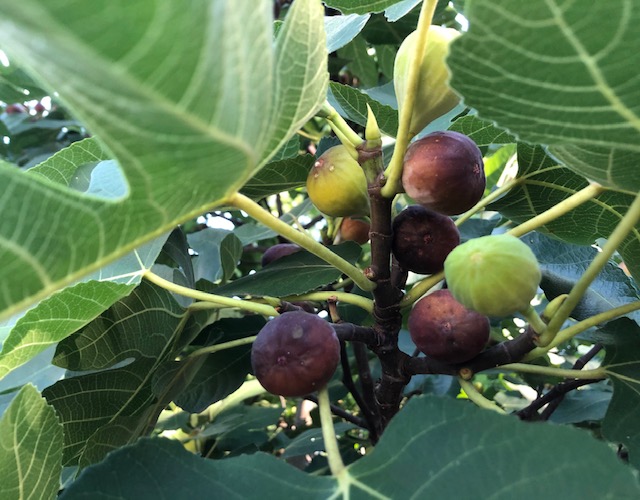
It’s been a remarkable season for figs. With no late frost to destroy the early buds, and enough rain to keep the trees from self-pruning, we – and the birds and even squirrels – have enjoyed many succulent fruits from the “Brown Turkey” and the even more fig-flavored “Celeste” fig trees planted near the restaurant and in our yard.

Not having a family recipe for fig tart, we turned to the recipe for the wonderful rhubarb tart my wife Christina makes from the unapologetically rich desert book, Rosie’s All-Butter Fresh Cream Sugar-Packed Baking Book, by Judy Rosenberg. “Rosie” originally began baking professionally in Harvard Square, Cambridge, MA, and probably kept the Massachusetts General Hospital’s Cardiology Department prosperous.

Figs are sweet and mildly flavored, unlike the assertive rhubarb, which I love and grew for years from plants my father started in my hometown up north. So Christina marinated the cut figs, harvested today, in lemon juice then cut back significantly on the sugar mixed into them.

Here’s the recipe for an 8-inch square or 9-inch tart, enough to feed six to eight a fantastic, rich seasonal dessert. (And while we haven’t tested it, this method should work also for the moist dried apricots that come from Turkey, and possibly even pitted dates.)

The Base (a shortbread crust):
1 cup flour
5 tablespoons confectioner’s sugar
8 tablespoons (1 stick) unsalted butter, room temperature, cut into 8 pieces
1 egg white for glazing (use the yolk in the topping)

Topping:
3 cups halved fresh figs
Juice of one large lemon
1 whole egg plus the reserved yolk from glazing the base
3/8 cup granulated sugar
3 tablespoons flour
1/4 teaspoon salt

Preheat oven to 350 degrees. Lightly grease an 8-inch square pan or a 9-inch pie pan.

Process the flour and confectioner’s sugar several seconds. Add butter and process until dough comes together, 20 to 30 seconds. (Or do all this in a bowl with a pastry knife.) Pat dough into the greased pan. Glaze the crust with egg white by pouring the white on the dough and tipping pan from side to side so the white coats the surface. Pour off the remainder of the egg white.

Bake the base until golden, about 25 minutes. Cool base completely (refrigerate to speed this up).

Prepare the topping. Mix the figs with lemon juice. In a bowl mix together the egg, egg yolk, sugar, flour and salt. Add the figs with their lemon juice.

Spread the fig mixture over the cooled, baked base. Bake the tart until set and slightly golden, about 50 minutes.

Cool completely before cutting into squares or wedges.

,

Quiche, a Versatile Wonder

The original “quiche,” a savory custard pie, appears to be French. But there are somewhat similar pies in both English and Italian culinary traditions. Probably the best-known classical version is Quiche Lorraine, from that northeastern region of France. It contains ham and leeks in the custard, with cheese as a more recent addition.

Basil, feta, sun-dried tomato and mushroom quiche
Nowadays, almost any meats, fish, vegetables, specialty cheeses, herbs, and even almonds or walnuts can go into quiche. Restaurants, unapologetically including ours, Donderos’ Kitchen in Athens, GA, vary the ingredients so as to feature a “different” specialty quiche each time.

Here’s my basic recipe, which was influenced by my culinary hero Craig Claiborne, the long-time food editor of the New York Times when I was younger. His recipe appeared in the book, “Craig Claiborne’s Herb and Spice Cookbook,” in the chapter on green onions.

The recipe makes several quiches, depending on size. Leftovers keep well and reheat easily in a toaster oven or oven (microwave makes the crust rubbery).

Pastry for 2 (9-inch) or 3 (8-inch) pies (homemade or purchased refrigerated)
6 medium-large scallions (green onions)
*1/2 pound thick sliced smoked turkey (or turkey salami, ham, pastrami, smoked salmon, or mixed meats, including a little thinly sliced pepperoni) and/or blanched, steamed, or lightly microwaved vegetables (broccoli, cauliflower) or thawed, squeezed out (but not further cooked) frozen spinach
2 cups coarsely grated Swiss cheese, or cheddar
6 eggs
2 1/4 cup whole milk (or part cream)
1/4 cup grated Romano cheese
2 teaspoons prepared horseradish
1 teaspoon salt (3/4 teaspoon if using a salty ingredient like feta, salami, etc)
1/2 teaspoon nutmeg
1/2 teaspoon ground black pepper
A pinch of cayenne
2 teaspoons Dijon or whole grain mustard for painting inside of pie crusts

Preheat the oven to 350 degrees.

Roll crusts lightly and line pie pans. Paint inside the bottom and sides of crusts with mustard.

Slice scallions into 1/8-inch lengths. Distribute them over the bottoms of the crust. Cut the meat(s) or salmon into small pieces, and distribute it over the scallions. Or if using vegetables, add them with or without meats over the scallions. Spread the Swiss and/or cheddar over these ingredients.In a bowl, lightly beat the eggs with a whisk. Add the milk, grated Romano, horseradish, salt, nutmeg, pepper and cayenne, and whisk briefly to combine. Pour it into the piecrusts. If using disposable aluminum pie pans, place them on cookie pans for security.

Bake at 350 degrees for 5 minutes, then turn the heat down to 310 and continue baking until the center doesn’t wiggle and a sharp knife inserted an inch from the center comes out clean (25 to 35 minutes). Serve warm or at room temperature.

A salad accompanies quiche well for a lunch or supper.

*Other possible quiche ingredients: bacon (fried and crumbled) plus blue cheese (along with the regular cheese); chopped canned artichoke hearts with chopped walnuts on top; sliced black olives, green olives, moistened and heated sun-dried tomatoes, roasted peppers, baked chicken; chorizo out of casing and pre-fried, jalapeño, and roasted red pepper; Italian sausage, out of casing and fried, roasted peppers plus olives.


Follow Us @donderoskitchen