Showing posts with label Condiments. Show all posts
,


Easy Berry Topping or Sauce


For an easy dessert, like store-bought ice cream or angel food cake, a raspberry, or strawberry or mixed berry sauce is a great topping. Using store-bought frozen, or fresh, berries, making the sauce takes just a few minutes, plus a few more minutes to cool.


The typical packages of frozen berries are 12 ounces, and the fresh berries are a pint. Both work with this recipe. I prefer organic berries, to avoid the pesticides that are often used on these crops.


12 ounces frozen or 1 pint fresh berries (raspberries, blackberries, strawberries, blueberries, or mixed berries), organic preferred

2 1/2 tablespoons brown sugar for 12 ounces of frozen fruit OR 1/2 tablespoons brown sugar for a pint of fresh berries

1/8 teaspoon salt


If using frozen berries, place them directly in a small enamel or stainless steel cooking pot. If using fresh berries, remove any leaves or stems and place the fruit in the pot. Add the brown sugar and salt.


Heat to a boil over medium heat, stirring frequently, and cook until fruit is becoming tender. Turn off the heat and break up the berries somewhat with a potato masher or fork. Let cool.


The sauce will keep, refrigerated, for a week or more.


Serve over your choice of ice cream, sherbet, cake, cheesecake, pudding, or even pancakes. An optional additional topping is whipped cream.

,


“Street Vendor Style” Corn Salsa – Salsa de Elote


The Mexican word “Elote” (aay-LO-tay) means fresh corn.  “Mais” (my-EECE), the general word  for corn elsewhere in the Spanish-speaking world is limited in Mexico to corn as crop or the dry grain. “Mais” came from the indigenous language of the Taino people in the Caribbean Islands where Spaniards first encountered corn, while “elote” is from the word for corn in Nahuatl, the language of the native Aztec people of central Mexico.


In Mexico you find fresh corn, elote, being sold by street vendors in the plazas and other gathering places. Corn kernels, freshly steamed, or sometimes grilled, are piled into a paper cone, topped with “crema” (Mexican sour cream), a slosh of hot pepper sauce (a favorite being “Valentina”), a squeeze of lime, and sprinkled with chopped cilantro. It’s a delightful snack.


Here’s an easy salsa based on street vendor Elote that I sometimes make for tacos and fajitas, favorite foods of my grandkids. You can’t have too many different kinds of condiments when serving tacos or fajitas. The salsa also goes well as a dip for tortilla chips.  


1 large ear of yellow corn, boiled (or grilled)

1/4 cup sour cream

Juice from 1 medium lime

1/2 teaspoon (or more) hot pepper sauce (like Valentina, Frank’s RedHot, Crystal, Tabasco)

1/2 teaspoon salt

2 teaspoons coarsely chopped cilantro plus a sprig for garnish


Cook the corn and let it cool. With a sharp knife, slice the kernels off into a mixing bowl. Break up the corn to separate the kernels. Stir in the remaining ingredients except for the sprig of cilantro.


Place in a serving bowl and garnish with the sprig of cilantro.


,


Horseradish Sauce for Sandwiches, Burgers, Roast Beef, Corned Beef and Beef Pie


Horseradish sauce, or in British slang, “Horsey” sauce, is a frequent condiment for roast beef, corned beef, and meat-containing sandwiches in the British Isles. It was, and possibly still is, a typical sauce for roast beef sandwiches at the Arby’s chain of restaurants. It can also serve on a hamburger. The sauce is easily made and keeps for a number of days in the refrigerator. 


Here’s my version, aimed for the British-inspired beef pot pie that I will be posting soon on this blog. But the sauce makes a good general spread on meat sandwiches, burgers, or ,if you can afford it, roast beef.. 


Horseradish is native to eastern Europe and western Asia, and has long been used for medicinal as well as culinary purposes. It figures prominently into the cuisines of central and northern Europe and the British Isles, particularly as a condiment for meat and fish. Prepared horseradish is horseradish root that was grated and mixed with vinegar.


For this sauce, as a seasoning ingredient I suggest prepared English mustard (like Coleman’s). That’s my first choice, but since English mustard is not commonly available, French-style Dijon mustard is the next best --  and is actually quite good.


The recipe makes enough sauce for sandwiches for six or more, hamburgers, or for sliced roast beef or corned beef. Extra keeps in the fridge for later use.


10 tablespoons (1/2 cup plus 2 tablespoons) sour cream

5 teaspoons prepared horseradish

1 teaspoon prepared English or Dijon mustard

1/4 teaspoon salt


Mix well. Store refrigerated until eaten. Serve in a small bowl with a serving spoon.

,


Easy Fresh Basil Sauce for Appetizers or Pasta Salad


While Pesto, the classic basil sauce from the Genoa region of Italy, is basically a sauce for pasta, it is also a convenient topping to add flavor and color to canapés, marinated cheese, sandwiches and pasta salad, and even pizza. Commercially made pesto is available in small jars the US, as it is in Italy. It tends to be expensive.

Easy Fresh Basil Sauce for Appetizers or Pasta Salad


Pesto is somewhat complicated to make, requiring in addition to fresh basil leaves, pine nuts and pecorino or Parmigiano cheese. Because I’ve been making appetizer dishes for our restaurant’s catering, I’ve often needed a basil-based condiment for highlights or marinade. So I make a much simplified basil sauce that serves our needs.


Here’s a recipe for this simple sauce. It makes a small quantity, since not much is needed for most things. But the recipe can easily be multiplied if needed. Use it for lightly topping sliced fresh mozzarella for a side dish, or put a little on thinly sliced Toscano or Asiago cheese on a cracker (and add a couple drops of honey!). Or marinate fresh mozzarella balls or chunks with it for Caprese skewer appetizers. It can be mixed, in limited quantities, into pasta salad or drizzled onto sandwiches or other dishes where fresh basil highlights would be exciting. Mix some of it into a little more olive oil for a wonderful dip for crusty bread.


12 medium-large fresh basil leaves

Easy Fresh Basil Sauce for Appetizers or Pasta Salad
Basil Sauce served with Fresh Mozzarella
3 tablespoons extra virgin olive oil

2 to 3 drops vinegar

A pinch of sea salt

A pinch of freshly ground black pepper


Rinse and drain the basil leaves. On a cutting board mince them very finely, almost to a paste, with a chef’s knife. Place basil in a small dish from which the sauce can be served. Gently stir in the remaining ingredients. Allow to season at least 10 minutes, then stir again.


The sauce tastes best when used within an hour or two of making it, but it will store for a day or two refrigerated.


,


Céleri (Celery Root) Rémoulade


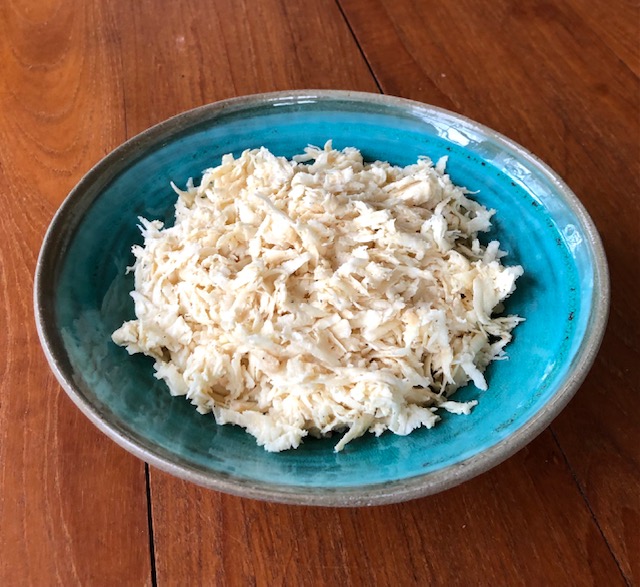
Celery Root (Celeriac), or in French, “Céleri Rave,” is the heavy, bulbous stem base of one variety of celery plants. Although botanically part of the stem rather than a true root, it is treated like a root vegetable. It has a delightful, subtle celery flavor, and is used extensively in colder parts of Europe where the “root” stores well in winter, when the more typical stalk celery was not available prior to modern transportation. Used in soups and stews, or boiled and mashed, it also makes a wonderful type of slaw, “Céleri Rémoulade,” that is somewhere between a salad and a condiment.

Céleri (Celery Root) Rémoulade


This special dish is most typical in French cuisine, showing up in appetizers and small side dishes. It is also popular in Louisiana Créole (French-descended) cooking. Fortunately it is simple to make, other than the grating by hand, which is made easier using the shredder blade in a food processor. Recently I got a celery root for another cooking purpose, and prepared a rémoulade with the generous amount I had left over.


The recipe makes enough for six or more people as a side salad and may more with appetizers. Leftovers keep well for several days in the refrigerator.


1 medium-large celery root, about 1 pound after peeling

4 tablespoons mayonnaise

1 tablespoon Dijon mustard

1 teaspoon olive oil

1 teaspoon vinegar

1 1/2 teaspoons salt, plus more to taste

1/4 teaspoon ground black pepper


Peel the celery root, cutting off the twisted smaller roots at the bottom (the peelings and small roots make excellent vegetable broth). With a sharp knife, cut out any crevices left between the bottom roots. Grate the celery root on the coarse side of a hand grater, or use the coarse grater blade of a food processor (first cutting the root into chunks small enough to fit down the feeder tube). Transfer the grated root to a mixing bowl.


Add the remaining ingredients and mix well. Let the mixture rest five or ten minutes and mix again. Do this once or twice more, as the salt draws a moisture from the grated root and the rémoulade becomes moister. Its best to make this at least a half hour before eating time. Taste the mixture and add salt, if needed, to taste.


If serving as part of a meal, place in an attractive serving dish.

,


Chili-Garlic Sauce, Malaysian Style


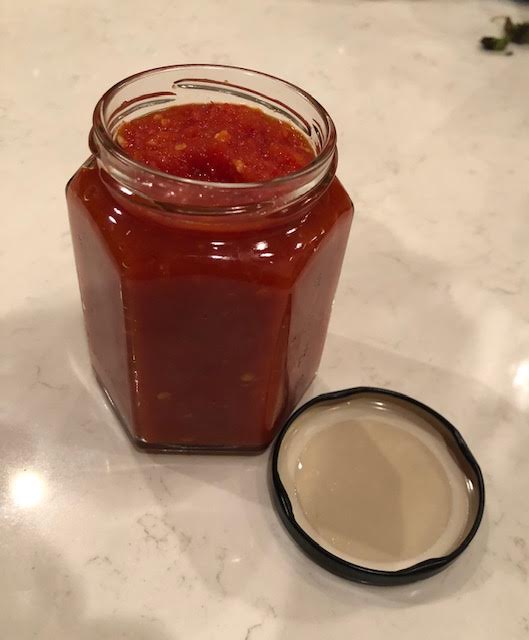
When we lived for those seven and a half years in Malaysia in the 1970s, we enjoyed many different styles of hot chili sauce, from Chinese, to Indian, to Malay (“sambal api”), to various commercial sauces that had flourished during British colonial period not many years before then. Many sauces represented fusions of the various culinary traditions that the immigrants and native people followed.


I do not remember what particular condiment I was trying to imitate when I started making this sauce, probably a Malay-influenced Chinese sauce. But I made it often while we were in Malaysia, then repeatedly in the US in the decades since. My chili sauce in jars is frequently given, and happily received, as Christmas gifts to family. There is always some in our refrigerator for highlighting stir-fry dishes, rice noodle dishes, and even scrambled eggs.


The Vietnamese-origin Huy Fong Siracha (“Rooster Brand”) sauce, which became wildly popular in the US, is not extremely different from what I started making before that sauce was launched here. That one was originally developed in the former Saigon, now Ho Chi Ming City, by David Tran, an ethnic Chinese business man from Vietnam, who made and sold it there. He started making it again when he and his family migrated as refugees to southern California, and the business went on to great success. His recipe is secret, obviously, but I do know that the chilies are entirely red jalapeños because they all used to be grown by my old college roommate, Craig Underwood, a 5th-generation farmer in Ventura County, CA.


Here’s the way I have been making this sauce for well over forty years, though I’m only now writing down the quantities of the various ingredients. Typically when red chilies are available, I make multiple quantities of the sauce and pack it in clean glass jars with non-corrosive lids, such as canning jars or used jelly jars or olive or pickle jars. That way I always have some for our use plus plenty to give away. The recipe is written for one pound of red chilies, though it is easily – and usually -- multiplied.


One recipe makes about a pint and a half. It stores for years in the refrigerator. Or if good canning procedures are used, the sauce can be stored on the shelf and only needs refrigeration after opening.


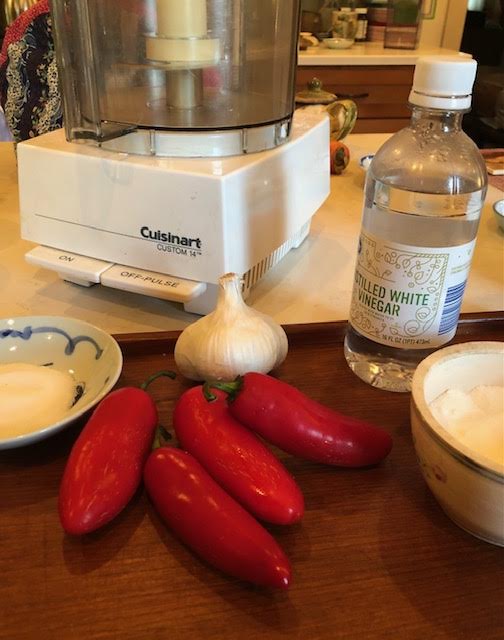
1 pound red jalapeño chilies or red Fresno chilies

2 medium-large cloves garlic, peeled

6 tablespoons distilled white vinegar

6 tablespoons sugar

1 1/2 teaspoons salt


Cut the green stems off the chilies, saving as much of the red flesh and seeds as possible. As you do this, cut the chilies across into halves and put them into a food processor or large blender. Add the garlic, vinegar, sugar and salt. Run the machine until the chilies are pureed, scraping down the inside of the container with a spatula several times.


Transfer the mixture to a stainless steel or enamel pan (not aluminum or cast iron). If doing multiples of the recipe, repeat the process with each batch. Bring the pan just to a boil, stirring frequently. Turn off the heat. With a large spoon, skim off any foam that has formed.


Spoon while hot into very clean jars, to a half inch below the rim. Wipe any sauce off the edge, and put the lid on the jar. Turn the jars over so the lid gets heated by the sauce.


Allow to cool overnight. Store in a cool place, or in the refrigerator.


The sauce needs a week or so for the flavors to emerge fully.


,


Rose Sauce, a Simple but Luscious Condiment


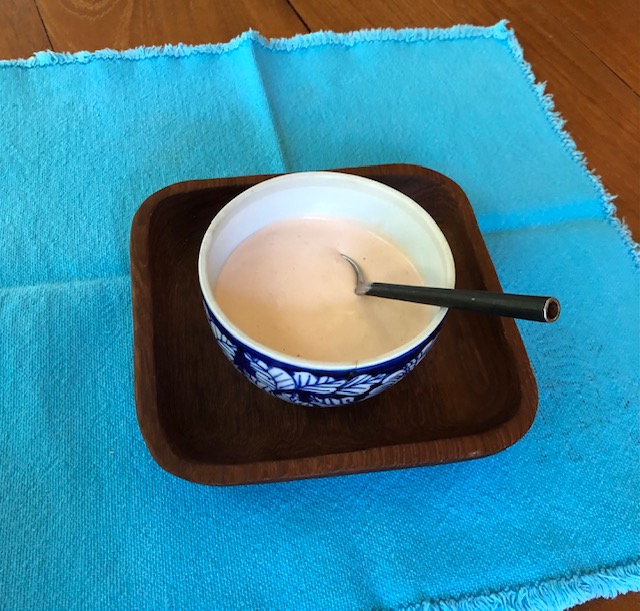
Rose (or Pink) Sauce is a sort of “rémoulade” that I developed based on several more traditional similar sauces. It works well as a condiment with vegetarian dishes, French fries, and crab cakes. (Elsewhere in this blog -- check the index -- the sauce is the topping for cauliflower-cheese rissoles.)


The sauce was influenced by “Salsa Rosa,” a Puerto Rican topping for fried ripe plantains. (That salsa couldn’t be easier to make: a mixture of mayonnaise and tomato ketchup.) Another influence was an originally French sauce we encountered in West Africa used both on cooked shrimp and on avocado. Finally, I couldn’t resist adding a little horseradish, which is a key flavor in the sauce used on American shrimp cocktail.


Here’s the recipe for a batch big enough to serve as the condiment for a meal for six. It will store, refrigerated, for a few days, but it’s quick enough to make fresh as needed.


3 tablespoons sour cream

2 tablespoons tomato ketchup

1 tablespoon mayonnaise

1 teaspoon prepared horseradish

A pinch of sea salt


In a small bowl, mix the five ingredients together well with a fork. Taste and add a tiny bit of salt if needed.


Place in a small dish to spoon onto whatever you’re serving it with.


,


Quick Pear Chutney, a Great Appetizer Topping for Brie Cheese


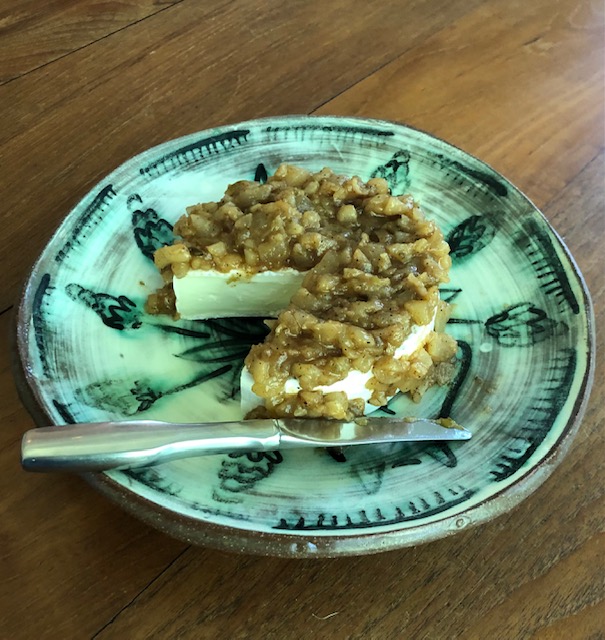
As autumn approaches, fresh pears are readily available. Here’s an easy and economical pear chutney that makes a delightful topping for Brie cheese or Mexican-style Queso Fresco (“fresh cheese”) for an appetizer. The chutney also goes well over goat cheese. Alternatively, it can be spread lightly as a condiment on meat or cheese sandwiches. Despite going well with cheese or meats, the chutney itself is completely plant-based.


“Chutney” comes from the Hindi word “chatni,” which in turns derives from a Hindi verb meaning “to eat with appetite.” Savory condiments have been part of the cuisines of the Indian Subcontinent for over two millennia. Chutneys, especially those made of spiced fruits, along with their name, came to Great Britain from India early in the colonial period.     


The recipe makes about one cup, enough for topping two 8-ounce round cheeses for appetizer use. The chutney will keep in the refrigerator for several weeks.


2 large or 3 medium pears, such as Bosc, Anjou or Bartlett

1 green onion, white and green parts, or a small piece of regular onion

4 teaspoons cider vinegar

1 tablespoon brown sugar

1/2 teaspoon vegetable oil

1/2 teaspoon salt

3/8 teaspoon paprika

1/8 teaspoon ground cinnamon

1/8 teaspoon ground black pepper

1 large pinch dry ground ginger, or 1/4 teaspoon grated fresh ginger

1 large pinch ground cloves

1 small pinch cayenne


Peel pears. On a cutting board, cut them lengthwise into quarters. Cut out their cores and seeds. Coarsely chop the pear flesh and place it in a small enamel or stainless steel (not aluminum or cast iron) pot. On the cutting board, cut off the roots and any dried tip ends of the green onion (or use a bit cut off from a regular onion). Chop the onion very finely. Add this to the pears, along with all the remaining ingredients.


Turn on heat to medium low, stir the ingredients, and cover the pot. Simmer the mixture, covered, in its own juices, stirring every minute or two, until pear is fairly tender, 10-15 minutes. Remove from the heat. Taste, to check the seasonings. Add a little salt, sugar, and/or vinegar, if necessary, to reach the desired taste.


Let the chutney rest at least several hours before use so that the flavors mingle. It can be served now or can be stored in a covered jar for several weeks in the refrigerator. 


Pear chutney compliments a variety of soft cheeses on the buffet or appetizer table, accompanied by low-salt crackers, like “water crackers,” or Melba toast. Let the cheese round or wedge come to room temperature before topping with chutney.

,


Spicy Barbecue Sauce for Pork or Chicken BBQ

 It’s summer, and in Georgia that’s barbecue time. Slowly smoked pork, either pork butt or whole hog, is the traditional favorite here, with chicken a secondary choice. Barbecued beef brisket, though sometimes available commercially here, is really more a feature of St. Louis, Kansas City and especially Texas cooking. My personal favorite is smoked pork butt, with the meat “pulled” with two forks into chunky shreds, and bone and any excess fat that survived the slow cooking discarded.

BBQ sauce with pulled pork sandwich
While many cooks and BBQ eaters have their own favorite commercial sauce, I like making my own when someone I know is barbecuing. A decade or so ago our restaurant actually barbecued pork, whole hogs or butts, for special occasions. In the course of that I worked out my favorite sauce. I made the version in the recipe below for adults, and a milder, sweeter version with more ketchup in it for kids and adults wanting it less hot.

This sauce is basically in the North Carolina style, featuring cider vinegar, black pepper and  Worcestershire sauce. But I do use some tomato, in the form of ketchup. The wonderful hot pepper sauce from Jalisco in Mexico, “Valentina” Salsa Picante, is readily available and inexpensive here. It’s easy to find at Mexican grocery shops and even at many supermarkets. To me it’s more delicious in BBQ sauce than the Louisiana hot sauces or Frank’s “RedHot” or Texas Pete, but those would work, too.

 The recipe makes about a pint and a half, enough for a good barbecue gathering, but any leftover stores well in the refrigerator for later use. The sauce does not need refrigeration for a number of hours, making it convenient to take to the countryside or wherever the pig roast is happening.

 A technical note: because of the Worcestershire sauce, which contains anchovy, and soy sauce, which has some wheat, the BBQ sauce is neither completely vegetarian nor gluten-free. Non anchovy-containing Worcestershire sauce or gluten-free soy sauce or Tamari can be used if need be.


1/4 cup ketchup

1/4 cup cider vinegar

1/4 cup Valentina hot sauce (from Mexican grocery shops and some supermarkets)

3 tablespoons soy sauce

2 tablespoons Worcestershire sauce

3/4 cup + 2 tablespoons water

1 tablespoon brown sugar

3/8 teaspoon black pepper

1/8 teaspoon salt

1 teaspoon canola oil


Mix together using a fork or whisk. Refrigerate if held for more than a day.


,


Fresh Tomato Chutney (Tamatar Chatni)
 

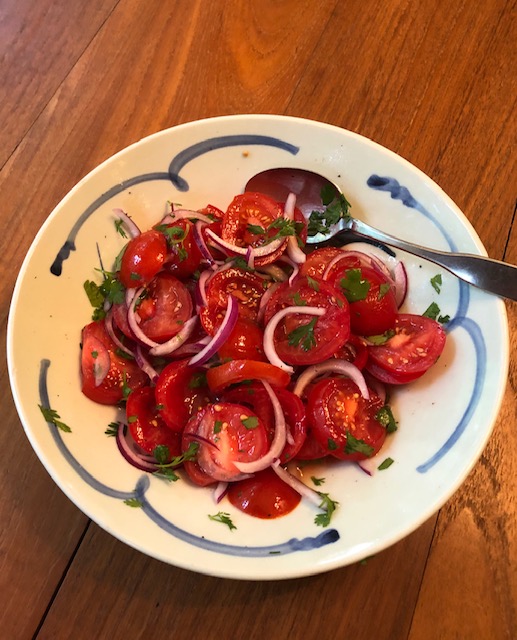
Here is a simple but wonderful chutney to serve with a curry dinner or other savory meal. I learned this delightful condiment from a lady from Karachi, Pakistan, who was doing graduate studies in the US. She served it with Lamb and Rice Biryani, Pakistan’s national dish. 

The secret is the freshest, ripest, sweetest tomatoes available at the time, whether locally grown regular ones, good Roma tomatoes or cherry, grape, or “Campari” tomatoes. 

The recipe serves six to eight as a condiment. 

1 pound fresh, ripe tomatoes

1/2 small red onion

1/2 of a medium-sized bunch of cilantro

1/2 teaspoon salt

A generous sprinkle of freshly ground black pepper

A generous sprinkle of cayenne

Juice of 2 medium limes 

For regular or Roma tomatoes, cut out the cores, then cut lengthwise into 1/2-inch wide wedges For smaller tomatoes, halve the lengthwise or slice 1/4-inch thick. Place tomatoes in a bowl. 

Place cut side of peeled, halved red onion on a board. Slice lengthwise into very fine julienne, and add to the tomatoes. Cut leaves off cilantro, chop the very coarsely, and add it to the bowl. Half an hour before serving, add salt, seasonings and lime juice. 

Stir carefully but thoroughly. Let sit ten minutes. Mix again, then taste. Add salt and/or lime juice to taste. Let sit at least a few more minutes. Stir again just before serving.

,


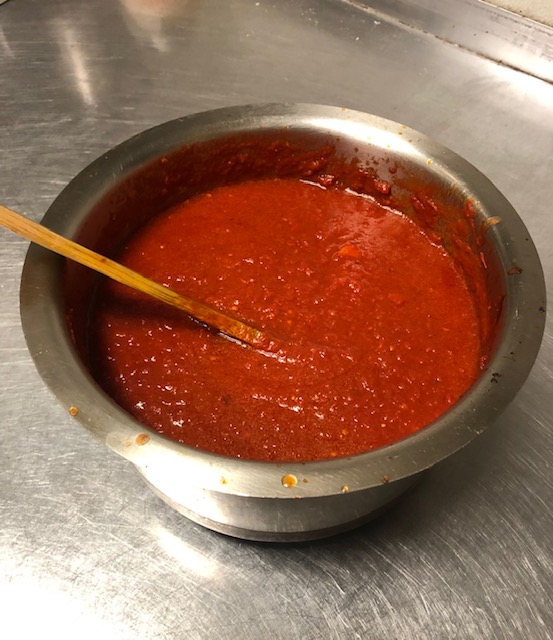
Tomato Sauce for Spaghetti, Lasagna, Pizza, and Baked Eggplant 

This is the simple red tomato sauce as I now make it after a long cooking career of experiment, trial and error. It still has elements of the way my mother made her spaghetti sauce.  Americans, but not Italians, often call this a “marinara” (sailor’s) sauce. Italians would call the vegetarian red tomato sauce simply “Sugo di Pomodoro” – tomato sauce. 

The sauce can be used on its own with pasta, topping it with grated Parmesan or Romano cheese. If you simmer meatballs in this sauce, rather than fry them, you have a nice spaghetti and meatball topping for pasta, Or, use the sauce in making lasagna; add vodka and cream for a vodka sauce; or top breaded, fried sliced eggplant or chicken along with mozzarella cheese for eggplant parmesan or chicken parmesan. The sauce also works well on homemade pizza. 

The most important part of a good sauce is the quality of the tomatoes. At the restaurant we have access to wonderful “ground” (crushed) tomatoes from a specialist company in central California. But their products are only available commercially in bulk. In my experience with supermarket canned tomatoes, Hunts brand works the best. Since American tomatoes are somewhat acidic, and a little citric acid is used for safety in the canning process, adding some sugar to the sauce is helpful.  

2 large cloves garlic, minced

3 tablespoons olive oil

1 large (28-ounce) can crushed unseasoned tomatoes (Hunts works well)

1 tablespoon sugar

1/2 teaspoon salt, plus more to taste

1/4 teaspoon paprika

1/4 teaspoon oregano

1/8 teaspoon crushed red pepper

Small pinch ground cloves

2 tablespoons water to rinse tomato can

Mince the garlic and place it in a pot (not cast iron) with the olive oil. Do not heat yet. Open the can of tomatoes and add the seasoning ingredients to the top of the tomatoes. 

Gently fry garlic in oil until softened but not golden. Stir in tomatoes and seasonings. Put two tablespoons water into the tomato can, swish it around and add it to the sauce ingredients. Bring to a simmer, stirring occasionally, and simmer for 3 minutes. Remove from heat. Taste and add a little salt, if needed.

,


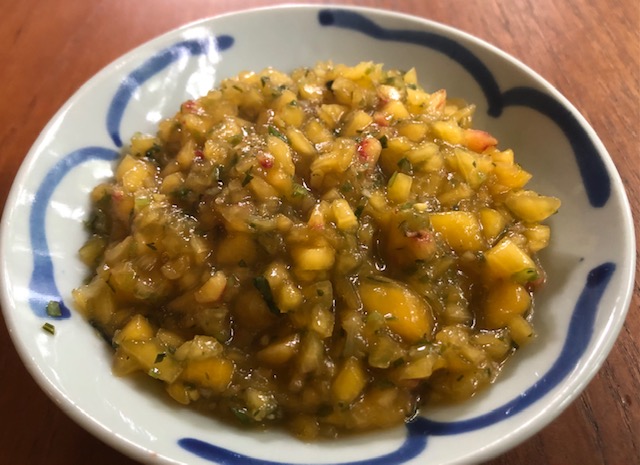
Fresh Peach Salsa


Working with a young colleague who produces short videos on cooking, I prepared for the upcoming filming in mid-summer in Athens Georgia – read peak peach season -- by developing a fresh peach salsa. We will use it for the video over pan-seared chicken thigh. But if I could get good salmon right now we’d serve the peach salsa over grilled salmon. 

This fresh peach condiment is a different, and fairly easy, use for our major Georgia fruit, and a change from the typical fruit snack and desserts that are all about. 

Use the salsa over grilled meat, chicken or fish, or over cheese such as goat cheese or Brie, or just scoop it up with tortilla chips. 

The recipe makes sufficient salsa for 4-6 people. But the recipe is easily doubled. The salsa will keep in the refrigerator for up to a week.


1 medium-large peach

1 small green onion, green part only

1-inch length piece of jalapeño pepper, membrane and seeds removed

1/8-inch slice of fresh ginger, peeled

2 sprigs cilantro or 3 mint leaves

1/2 teaspoon salt, plus more to taste

3 teaspoons brown sugar

5 teaspoons freshly squeezed lime juice


Peel peach and remove the pit. On a cutting board, using a chef’s knife, slice then finely mince the peach flesh. Transfer to a bowl. On the same cutting board, very finely mince the green part of the onion, the jalapeno, the ginger and the fresh herb leaves. Add the mixture to the minced peaches. Stir in the salt, sugar and lime juice. 

Let the salsa rest for 10-15 minutes, Stir well and taste. If needed, add a little salt, sugar or lime juice to taste. Store, refrigerated, for an hour or more
before serving to let the flavors mingle.

,


Candied Jalapeños -- Easily made Cowboy Candy 

These delightful condiments, which we make at our restaurant, Donderos’ Kitchen in Athens Georgia, go well with breakfast skillets, into breakfast burritos, on garnished grits, or even on burgers and sandwiches. They can also be chopped finely and sprinkled on goat cheese, or cream cheese, for an easy appetizer to spread on crackers. The leftover liquid once the jalapeños are finished can be used creatively as a seasoning or dip – think chicken wings -- also. 

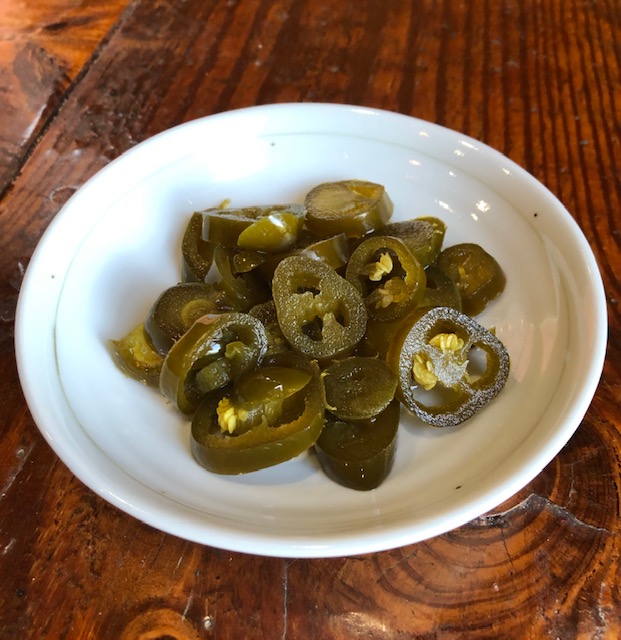
Nicknamed “Cowboy Candy” in Texas, the treat is traditionally made from scratch by slicing fresh jalapeños then heating them in a sweetened spiced vinegar broth like classic bread and butter pickles. I make them much more easily, starting with already pickled sliced jalapeños (sometimes called “nachos,” the dish on which they are often served). These are inexpensive and readily available in the supermarket, both in the pickle section and in the “Latin American” section near the salsas. They’re also available at Mexican grocery stores. 

Purchased at local supermarket

Starting with commercially pickled jalapeños, I drain away the pickling brine, keeping the pepper slices in the jar. I make an easy syrup of sugar and water simmered briefly with a few whole spices. Cooled, the syrup is poured into the jar containing the drained jalapeños. After several days in the refrigerator, we have lovely candied jalapeños!


For each pint (16 fluid ounces) of commercial pickled sliced jalapeños: 

3/4 cup white sugar

7/8 cup water 

4 whole cloves

4 whole allspice 

Drain jalapeños well, but keep them in their glass jar (or if in a can, transfer to a glass jar). 

In a pot, bring sugar, water and whole spices to a boil. Simmer 5 minutes. Cool to no hotter than warm. Remove whole spices. 

Add the liquid to jar containing the drained jalapeño slices. Cover and tip and gently shake jar to mix well. Let sit for a while. Tip and shake well again. Store refrigerated. Shake to mix occasionally.

Store at least several days for best flavor. Candied jalapeños can be kept, covered, in the refrigerator indefinitely.          

,


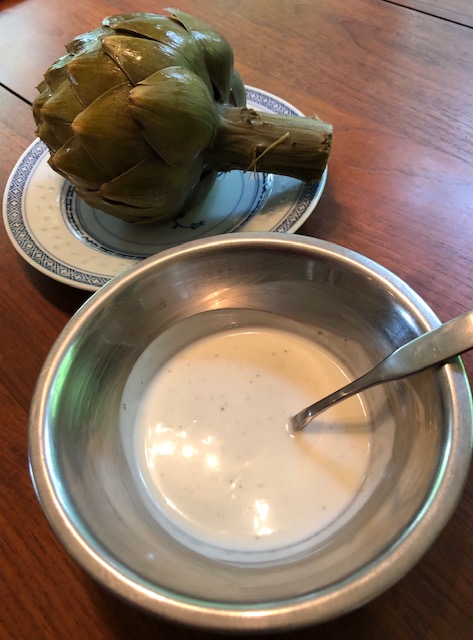
Super Easy Rémoulade Sauce

Rémoulade, that traditional French and subsequently Louisiana Créole dipping sauce (think New Orleans Shrimp Rémoulade), was originally a garlic-scented mayonnaise with a little extra vinegar or lemon juice. But it can have almost anything savory added, from minced green onion, parsley, pickled relish, roasted peppers, to minced tomato or even horseradish or Dijon mustard.

I use various rémoulades for catering to accompany crab cakes, potato cutlets, and herb-roasted potatoes and sweet potatoes. At home, we serve it as a dip for artichoke leaves and hearts, and with grilled or fried asparagus. At family Easter dinner this year I made a rémoulade to dress the roasted root vegetables. But people topped their cold herb-roasted pork tenderloin slices with it too, and my daughter Anna asked me to make more of the “pork sauce” for a catering client. Ah well! It’s a useful sauce. And easy!!!

Here’s a particularly easy version, requiring maybe a minute to make.


The recipe provides sufficient sauce for the condiment for four to six people.

 1 clove garlic

4 tablespoons whole-milk yogurt (or 3 tbsp. fat-free yogurt + 1 tbsp. sour cream)

2 tablespoons mayonnaise

2 tablespoons water

1 teaspoon white wine vinegar or white vinegar

1/4 teaspoon salt

1/8 teaspoon ground black pepper

Rub the inside of a mixing bowl well with a halved clove of garlic to season the bowl and the sauce that will be mixed in it. Add the remaining ingredients to the bowl and mix them well until smooth.

Taste, and add a little salt if you wish or vinegar. Let sit for at least ten minutes before serving. Mix again. 

Place in a suitable serving bowl for the sauce’s intended use. It can, optionally, be garnished with a little minced parsley or green onion dusted on top.

,


 Chimichurri Sauce and Choripán

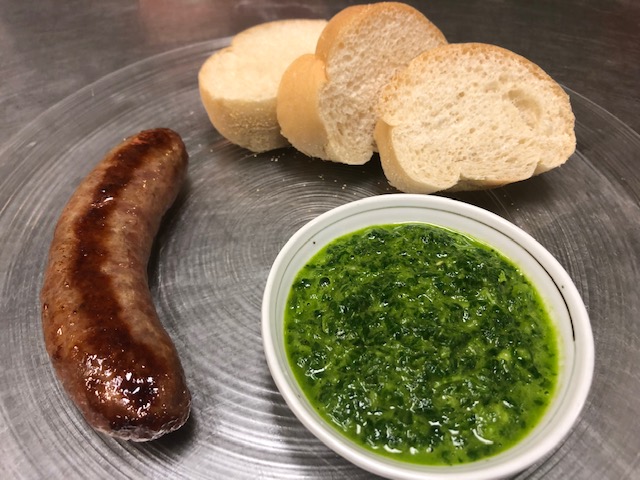
This fresh green herb sauce from Argentina and Uruguay is served on beef, sausage, grilled meat, or fish, and is special as the topping for “Choripán,” street vendor grilled sausage with crusty bread. The principal herb is parsley (flat Italian type). My version has basil and cilantro as secondary herbs, though fresh (or even dried) oregano is typically used.

Choripán

Having never been to Argentina, I first learned about this wonderful sauce when a young American couple whose wedding we catered asked for “Choripan” as an appetizer for their wedding celebration. They had met in the Peace Corps in South America, and while on a trip together to Buenas Aires decided to get married, while they were in a plaza enjoying this street vendor specialty.

The word comes from “chorizo” (sausage) and “pan” (bread), though the distinctive part of the dish is actually the green parsley and herb sauce “Chimichurri.” While a bit like Pesto, chimichurri, apparently, was created independent of that Italian basil sauce from Genoa.

The recipe makes enough sauce to serve 4-6 people.

Chimichurri

1 large shallot or 1 very small onion, peeled

1 large clove garlic, peeled

1 medium-sized bunch parsley, flat type preferred, including part of stems

1/2 cup cilantro including stems, packed

6 small fresh basil leaves

2 tablespoons olive oil

5 teaspoons lemon juice, plus to taste

Large pinch black pepper

1/2 teaspoon salt, plus to taste

Place all ingredients in food processor. Pulse to chop well. Mixture should be fine but not puréed. Transfer to bowl.

Allow sauce to rest 10 minutes. Stir and taste. Add salt and/or lemon juice to taste. Allow to marinate at least an hour. Stir and taste for salt before use. The sauce is best the first day, but can be stored refrigerated for 2-3 days.

 For Choripán

Grill mild sausage such as bratwurst, or Argentinean sausage if available, and serve it with crusty bread and some chimichurri sauce.

,

Minted Cream Sauce for Salmon or Lamb

This easy sauce, based on Irish cooking, is a delightful accompaniment to a roast of salmon or lamb or grilled lamb meatballs. I served it with our roasted salmon (blog post of 12/28/2019) for Christmas dinner for family this year.

The recipe makes enough for eight to ten people

1 cup heavy cream
Juice of 1 lemon, plus more as needed
1/4 teaspoon salt, plus more if needed
1/2 cup mint leaves pulled off the stems, lightly packed
A few tops of sprigs of mint for garnish

In small mixing bowl, stir lemon juice into the cream, until it thickens well. If more lemon juice is needed, add it a little at a time until cream is thick. Stir in the salt.

Mince mint finely with a chef’s knife on a cutting board. Stir it into the thickened cream. Taste and add a little salt or more mint, to taste.

Serve in a small, decorative bowl. Place one or more small mint sprigs on top of sauce for garnish.


,
Apricot or Nectarine Chutney

Dried fruit is easily made into chutneys, which can be served as a condiment to a meat dish or meat sandwich. Even more usefully, especially around the holidays, top a log of goat cheese, Brie, or even a Mexican-style cheese like Queso Fresco or Cotija, for an easy appetizer for a buffet or party. Chutneys are best made ahead and stored refrigerated in order for the flavors to develop.

The recipe serves six to eight as a condiment.
1 cup dried apricots or nectarines (packed) or a combination, chopped
1/2 small onion, finely chopped
1 clove garlic, minced
1 teaspoon fresh ginger, grated (or 1 tablespoon candied/crystalized ginger, minced)
1/2 cup water, plus more as needed
1/4 cup wine vinegar or cider vinegar
1/4 cup brown sugar
3/4 teaspoon salt
1/2 teaspoon Dijon mustard (optional)
A generous sprinkle of freshly ground black pepper
A generous pinch of cayenne

Place all ingredients in an enamel or stainless steel pan. Stir and heat, and let simmer 15-20 minutes, stirring from time to time. If the mixture is too dry (it should be moist) add a little water as needed.

Taste, to check tenderness of the fruit and the seasonings. Add a little salt, sugar, and/or vinegar to reach the desired taste.
 
Store in covered jar in refrigerator, ideally at least overnight up to several days before serving.

This chutney compliments a variety of cheeses on the buffet or appetizer table, accompanied by low-salt crackers, like “water crackers,” or sliced baguette.

,


Spiced Applesauce for Potato Pancakes or to accompany Roasted Pork

This sauce serves as a condiment, particularly for potato pancakes, or Hanukkah latkes. A variation on the applesauce theme is to add chopped dried cranberries. I taught the cranberry version to accompany Latkes in a recent cooking class on holiday foods, that featured Hanukkah, Christmas and New Year dishes.

The recipe makes sufficient condiment for a group of diners.
3 large (1-1/2 to 2 pounds) Fuji or Gala apples
2 tablespoons dried cranberries (optional)
2 tablespoons butter or olive oil
4 tablespoons water
2 teaspoon lemon juice
2 teaspoons sugar
1/2 teaspoon salt
1/8 teaspoon cinnamon
1/8 teaspoon nutmeg

Peel and quarter apples. Cut out cores. Slice apple quarters crosswise 1/2-inch thick. If using dry cranberries, chop them finely on a board with a chef’s knife.

In stainless steel or enamel pot, combine apples, cranberries if used, butter or olive oil, water, lemon juice, sugar, salt, cinnamon and nutmeg. Simmer, covered, stirring frequently, about 10 minutes. Uncover pot, and simmer, stirring occasionally until apples are very tender and liquid is reduced. If mixture becomes dry, add a small amount of water.

When apples are very tender, remove from heat. Break apples up with a wooden spoon or potato masher. Taste and add a little sugar or salt, if desired.

Serve warm or at room temperature in a bowl, to accompany potato pancakes or roasted pork.

,

Hungarian Cottage Cheese (“Pot Cheese”) Appetizer Spread

I’ve been cooking a lot of Eastern European food recently, Russian “Tefteli” meatballs (see my blog posting of 10/2/2019), cheese-potato Pirozhki, radish salad with sour cream (see my blog posting of 10/2/2019), Transylvanian goulash. Maybe it’s fantasizing for cooler weather as this dry heat wave continues in Georgia.

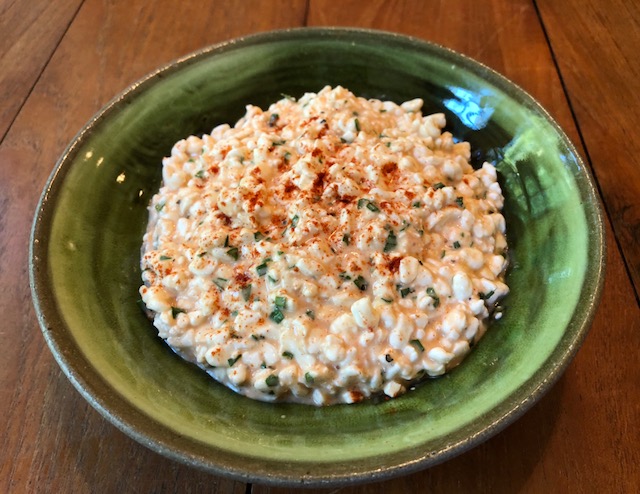
Bowl by Maria Dondero, Marmalade Pottery, Athens GA
Here’s a common appetizer from Hungarian cooking, which I encountered repeatedly at an authentic Hungarian restaurant I frequented when I was in school. It’s easy and satisfying.

Pot cheese, the homemade fresh cheese in Central Europe, is relatively close to the old fashioned dry-curd cottage cheese that used to be sold in the US. What seems available now is wetter “creamed” cottage cheese. It can be turned back into the drier version by letting sit in a sieve for an hour or so to drain.

The recipe will serve 8 to 12 as an appetizer with bread or crackers.

1 pint of fine curd cottage cheese
1 tablespoon minced chives or green onion tops
1/2 teaspoon paprika, Hungarian “sweet” (not hot) preferred
1/2 teaspoon sea salt (herb-seasoned can be good), plus more to taste
1/4 teaspoon ground black pepper
Pinch of cayenne

Place cottage cheese in a strainer or cheese cloth over a bowl and let it drain for an hour.

Mix cheese well with remaining ingredients. Let rest a few minutes, then stir again.

Taste for salt, and add a little if needed. More paprika can be added if slightly pinker color is desired.

Let mixture sit for a while, refrigerated, to let flavors mellow.

Serve with bread or crackers to spread the mixture on.


Follow Us @donderoskitchen