,


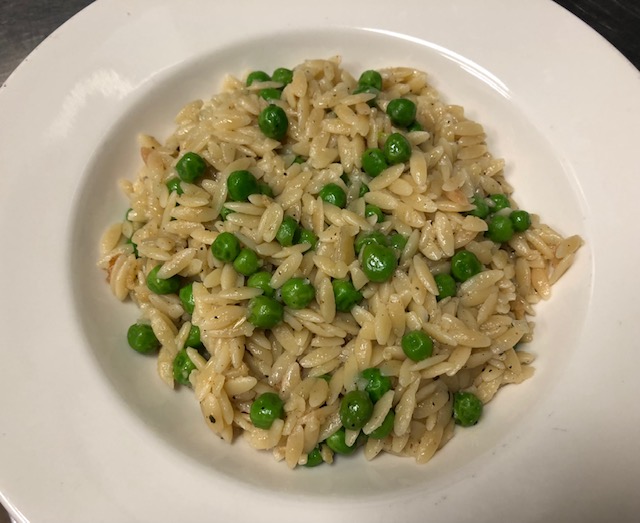
Orzo Risotto with Peas

Real risotto, the elegant Northern Italian creamy dish created from the special -- and expensive -- rice from Italy’s Po Valley, is difficult to make. And it is so fussy that you must finish cooking it then serve it almost immediately to maintain its tender structure. I have rarely had a good risotto at an American restaurant, even a restaurant with a fine chef.

On the other hand, the pasta shaped like rice, called “orzo,” is much easier – and certainly cheaper - to make into a risotto-like dish. And it will keep for a while after cooking, making it easier to serve. The Italian name “orzo” for the pasta shaped like rice grains actually means barley.

Here’s an orzo risotto with the typical sorts of ingredients in real risotto: peas, white wine, cream and Parmesan cheese. Other vegetables can be used in place of the peas, like short-cut asparagus, mushrooms, or diced zucchini. For those, cook them in at the end, like the peas, but just long enough to be crisp-tender.

The recipe serves six as a side dish or light lunch.


2 tablespoons butter, plus more if needed

2 tablespoons olive oil or chicken fat, plus more if needed

1 small onion, diced

1 small clove garlic

1 pound orzo pasta

1/2 cup white wine

1 1/2 cups unseasoned chicken broth or water, plus more water as needed

1 teaspoon salt

1/4 teaspoon oregano

1/4 teaspoon black pepper

2 bay leaves

Pinch of cayenne

1 cup frozen peas

1/2 cup heavy cream

1/4 cup freshly grated Parmesan cheese 

Heat butter and oil or chicken fat to pot and fry onion, stirring frequently, until softened. Stir in garlic for 15 seconds. Add orzo, and stir and fry 2 minutes. 

Add wine, chicken broth or water, salt and seasonings. Simmer, uncovered, stirring frequently, and add a little water as needed to keep the orzo quite moist. When orzo is tender, add the frozen peas and cream. Simmer, stirring frequently, several minutes. Add a little water if needed to keep the mixture quite moist. Taste and add salt, if needed. Remove from heat and keep warm.
 

Before serving, stir in the cheese.

,


Super Easy Rémoulade Sauce

Rémoulade, that traditional French and subsequently Louisiana Créole dipping sauce (think New Orleans Shrimp Rémoulade), was originally a garlic-scented mayonnaise with a little extra vinegar or lemon juice. But it can have almost anything savory added, from minced green onion, parsley, pickled relish, roasted peppers, to minced tomato or even horseradish or Dijon mustard.

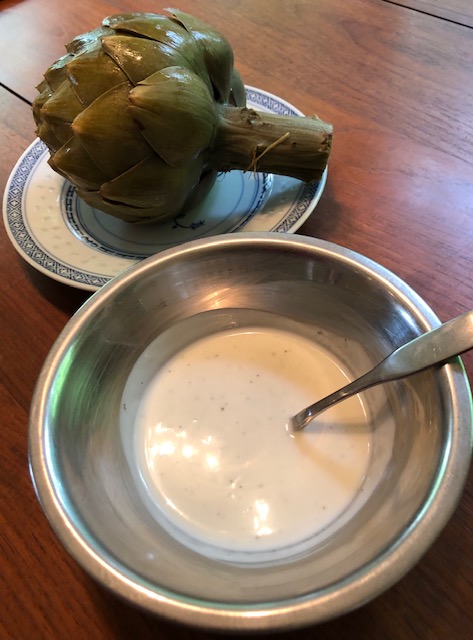
I use various rémoulades for catering to accompany crab cakes, potato cutlets, and herb-roasted potatoes and sweet potatoes. At home, we serve it as a dip for artichoke leaves and hearts, and with grilled or fried asparagus. At family Easter dinner this year I made a rémoulade to dress the roasted root vegetables. But people topped their cold herb-roasted pork tenderloin slices with it too, and my daughter Anna asked me to make more of the “pork sauce” for a catering client. Ah well! It’s a useful sauce. And easy!!!

Here’s a particularly easy version, requiring maybe a minute to make.


The recipe provides sufficient sauce for the condiment for four to six people.

 1 clove garlic

4 tablespoons whole-milk yogurt (or 3 tbsp. fat-free yogurt + 1 tbsp. sour cream)

2 tablespoons mayonnaise

2 tablespoons water

1 teaspoon white wine vinegar or white vinegar

1/4 teaspoon salt

1/8 teaspoon ground black pepper

Rub the inside of a mixing bowl well with a halved clove of garlic to season the bowl and the sauce that will be mixed in it. Add the remaining ingredients to the bowl and mix them well until smooth.

Taste, and add a little salt if you wish or vinegar. Let sit for at least ten minutes before serving. Mix again. 

Place in a suitable serving bowl for the sauce’s intended use. It can, optionally, be garnished with a little minced parsley or green onion dusted on top.

,
Braised Lamb and Turnip or Brussels Sprouts: Easy, Easy, Easy 


I guess this rich, slightly heavy dish doesn’t really fit with the early summer heat we’re experiencing recently in North Georgia. But its easiness, at least, suits cooking in the prematurely hot weather. Having been food shopping for the restaurant and household in Atlanta yesterday, I had a half pound of ground lamb and some fresh purple-topped turnips on hand. So here is one of the simplest dishes I cook that can qualify as dinner.

Ground lamb is one of my favorite meats. Middle eastern meatballs are the preferred use, but a modest amount of lamb braised with hearty vegetables to season them works very well. Okra, chickpeas, turnip, or Brussels sprouts are all enhanced by some lamb cooked with them, and the result is economical, savory and hearty. Fresh ground lamb is sometimes hard to find. It’s always available in Atlanta in shops where the Muslim community shops, like Dekalb Farmers Market and Buford Highway Farmers Market. But it’s also at stores elsewhere, including here in Athens, that carry good and especially local meats. It’s a little pricey, but you don’t need a lot. Ground pork or even good ground beef can substitute. 

I got spring turnips this time, but heartier brassicas like rutabaga turnip or Brussels sprouts (or even kohlrabi) also work. With the dominating flavors of lamb and turnip I used only mild enhancements from black pepper and a little onion The starch to accompany this was toasted split English muffins or whole-grain toast, and the side dish was a fresh green salad with lettuce from my garden. The meal took about 25 minutes from start to eating. 

The recipe serves 2-3 for a small dinner. A dollop of sour cream can be put on top of the mixture when eating. 

1 medium-large or 2 medium turnips, or 1 small rutabaga (or 1/2 pound Brussels sprouts) 
1/2 small onion, finely minced 
1/2-pound ground lamb, or pork or beef 
3/8 teaspoon ground black pepper 
3/4 teaspoon salt, plus more to taste 
2 tablespoons white wine 
Water as needed 
2 toasted English muffins split in halves halves or 2 slices whole grain bread for serving 
Sour cream for topping, optional 

Peel the turnip(s) and cut in 1/4-inch dice, or cut stem off Brussels sprouts and quarter them. 

In pot, fry the ground meat with the minced onion until well cooked. Add turnip or Brussels sprouts plus pepper and salt, wine and a few tablespoons water. Cover pot and cook over low-medium heat, stirring every few minutes, until vegetable becomes tender (15 minutes for turnip, 20 plus minutes for rutabaga, 10 minutes for Brussels sprouts). Add a little water if needed to keep a little liquid in the pot. 

Taste a piece of vegetable for tenderness and salt. Add salt as needed. Cook until tender, and remove from the heat. 

Serve on buttered, toasted English muffin halves or slices of toast. Put a dollop of sour cream on the braised meat and vegetable if desired. Accompany with a green salad.
,


Popovers – Luscious easy treats my grandkids love


A very old-fashioned breakfast or snack food has been rediscovered by my grandkids, several of whom make them easily and often with minimal adult help. These golden puffed-up tender sorts of hot muffins or breads are basically crepe batter cooked in muffin tins. Popovers, which have been made in America for several centuries, are thought to have evolved from the earlier British Yorkshire pudding. They are perfect for a dab of butter, or honey or a fruit jam, and are best right out of the oven. 

Popovers made by my grandson Jonah
The batter is the same as for French crêpes – a cup of flour, a cup of milk, a couple of eggs, and optionally a pinch of salt. They are, in our experience, something the young kids can make, and certainly love to eat them. 

The recipe makes 12 popovers, enough for 4-6 people. 

2 eggs

1 cup flour

1 cup milk

1/4 teaspoon salt (optional)

12 small pieces butter 

In a bowl beat together the ingredients other than the butter with a small whisk or fork until well combined. 

Set oven for 400 degrees (380 convection). Place a small piece of butter in each cup of a 12-cup muffin tin. Place tin in the heated oven until the butter melts. 

Spoon batter evenly into the 12 muffin cups. Place in oven and bake for 20 minutes. Turn the pan around and bake for another 8-10 minutes, or until popovers are well puffed and golden on the tops. 

Serve hot, with a little butter and/or fruit jam or honey.


,


Egg Frittatas, crustless zucchini, cheese and fresh herb egg pies


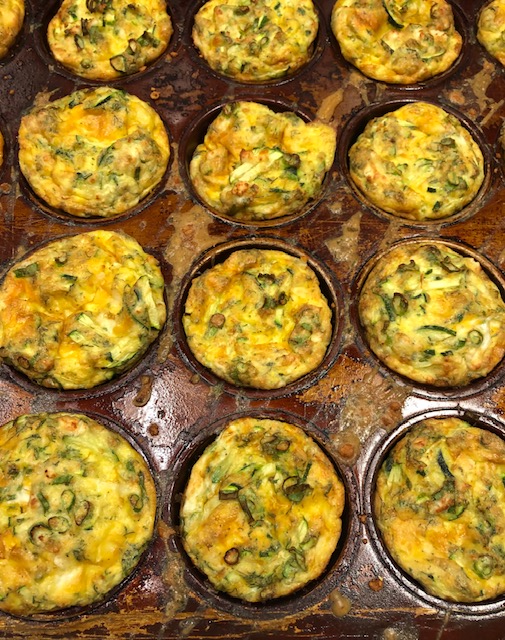
At our restaurant, we are occasionally asked to make gluten-free quiche-like items for breakfast catering. Based on frittata, a crustless Italian vegetable and egg pie, here are individual savory treats baked in muffin pans. Shredded zucchini, feta cheese and dill make very Mediterranean, if not necessarily Italian, breakfast or supper frittatas. They are best right out of the oven, though can be eaten at room temperature or rewarmed in the microwave for a later snack.

The recipe makes about 12 small frittatas. Two to three per person is a hearty serving. 


2 cups eggs (crack eggs into a measuring cup until the volume is reached, 10-12 eggs)

1 cup shredded zucchini

2 tablespoons crumbled feta cheese for batter + 2 tablespoons for topping

1/4 cup shredded cheddar cheese

2 teaspoons snipped fresh dill

2 teaspoons chopped parsley, flat Italian style preferred

1/2 teaspoon salt

1/8 teaspoon black pepper

Large pinch ground celery seed (not celery salt)

Large pinch cayenne

3 green onions, green and part of white parts very thinly sliced


Set oven for 375 degrees. Spray oil or grease a 12-cupcake pan. 

In bowl, lightly beat the eggs with a whisk or fork until well broken up and smooth but not frothy. Add zucchini, 2 tablespoons feta, the cheddar, fresh herbs, salt, pepper, ground celery seed and cayenne. Mix well to combine. 

With ladle, partially fill all 12 cupcake cups to equal levels. Evenly distribute the remaining 2 tablespoons of crumbled feta plus the finely sliced green onion over the batter. Bake in heated oven 8 minutes. Turn pan and continue baking another 8 minutes or so until frittatas puff and a toothpick inserted near the center of one comes out clean.

Best served warm, with a little tomato sauce or salsa, or hot pepper sauce, if desired.


,
Pasta Primavera Showcases 

Spring Vegetables With spring here and fresh local vegetables bountiful at farmers’ markets, a classic pasta dish celebrates the season. 

“Primavera” (“spring” in Italian), or correctly “alla primavera,” indicates that early vegetables dress the pasta, like asparagus, carrots, turnips, radishes, broccoli, spinach or peas. Heavier summer vegetable flavors –- tomato, pepper, eggplant, green beans -- are avoided. “Spring,” however, does not necessarily mean “lite.” Pasta Primavera can be substantial. 

The sauce is quick to cook, though it involves some prep. Almost any mixture of spring or early summer vegetables works. Firmer ones, cut evenly, start the cooking. Then less firm ones are added. Finally, young spinach and tender peas, if used, are added, along with cream, seasonings, and cheese. 

“Farfalle” pasta seems most appropriate. Literally “butterflies” in Italian (boringly, “bow-ties” in English), farfalle maintains the garden theme, and exudes the warm humor of Italian food names. Which cheese to use is an individual choice. In northern Italy, Parmesan, a cows’ milk cheese, is more likely. In southern Italy, it would be Pecorino Romano, tangier and made from sheep’s milk. Having grown up around Sicilians, I prefer Romano. Since the cheese is important to the dish, it is best grated fresh from a chunk. 

In Italy, small portions of pasta form a starter course for a dinner. In the American manner, a large serving of pasta is the main course. Accompany Pasta Primavera with crusty bread, olive oil to dip it in, and a simple green salad. Because of the cheese, I would choose a light to medium-bodied, fairly dry red wine, like a Chianti, or Pinot Noir. 

The recipe serves six. 

12 ounces “short” pasta, like bow-ties (“farfalle”) or penne 

Choose 4 of the following vegetables, 1-1/2 cups each except for spinach: 1/2-inch-diced young carrots, turnips (peeled); quartered radishes; asparagus in 1-inch lengths; 1/2-inch flowerets of broccoli; young (or frozen) peas; 4 cups washed, coarsely cut young spinach 
1 small young onion, finely chopped 
1 clove garlic, finely minced 
1/4 cup coarsely chopped parsley 
1/2 teaspoon of any mixture of fresh herbs, finely minced 
1 cup coarsely grated Romano or Parmesan cheese plus extra for serving 
1-1/2 teaspoons salt, split 
1/8 teaspoon nutmeg 
1/8 teaspoon black pepper 
Large pinch cayenne 
6 tablespoons olive oil 
1-1/4 cups half-and-half cream 

Boil a gallon of water for pasta in large pot. Add 2 teaspoons salt. Let simmer, covered, until needed. 

Prepare vegetables, onion, garlic, parsley, fresh herbs, and cheese. Mix 1 teaspoon salt plus the nutmeg. black pepper and cayenne in a cup. 

Heat olive oil in large pan and briefly fry onion plus carrot, if used, plus 1/2 teaspoon salt for 2 minutes, stirring very frequently. Add turnip and/or radish, if used, and stir and fry for another minute. Add 4 tablespoons water, cover, and steam, stirring occasionally, until vegetables become tender (test by piercing with a toothpick). Add broccoli and/or asparagus, if used, plus another tablespoon or two of water. Cook one minute, covered, stirring occasionally. 

Add half-and-half plus the salt and spice mixture. Bring to a boil. Add peas or spinach, if used, and return just to a boil, stirring. Remove from heat and stir in cheese and parsley. Keep warm and covered. 

As vegetables cook, bring the salted pasta water back to full boil. Add pasta and stir immediately so pasta does not stick together. Cook, stirring frequently, until tender to the bite. Drain in colander and transfer, hot, to large serving bowl. Add sauce plus cheese. Toss together. Taste and add salt if needed. 

Serve with additional cheese.
,


Beef Stroganoff


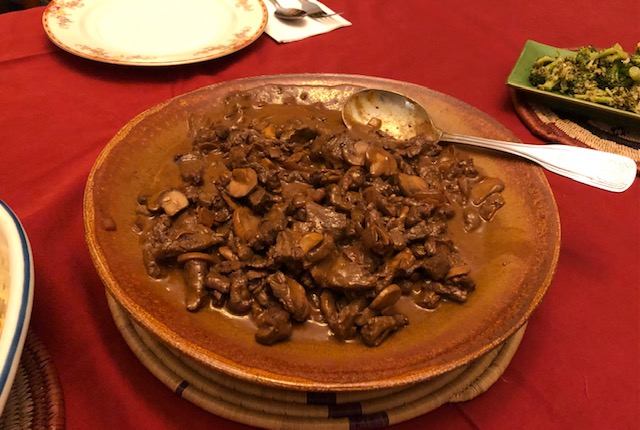
Created in the early 19th century and named for Count Pavel Alexandrovich Stroganov, the last male scion of a rich and aristocratic Russian family for whom the creator, a French chef, worked, this dish became an international haute cuisine classic. The Franco-Russian treat combines the seared steak and Dijon mustard of French cuisine with the sour cream of Russia. And although the name of the Stroganov family’s chef is now lost, naming the creation for his patron was probably a wise career move. 

Made by my grandson August Pearson
The alternate spelling “Stroganoff” (the original name is spelled in the Cyrillic, not Roman, alphabet) is used internationally for the dish. Some recipes use mushrooms and ketchup, others do not. But beef, onions, Dijon mustard and sour cream are essential. The other essential is that the strips of beef are fried quickly, part at a time, so they brown lightly, rather than stew. I use beef “flatiron” steak, but fancier cuts of tender lean beef can be used, up to and including tenderloin. 

The traditional accompaniment for the dish is “French” fried strips of potato. But rice and noodle dishes also go well. The recipe serves six. 


1-1/2 pounds “flatiron” (blade of chuck) steak

Butter and sunflower or other vegetable oil (not olive)

1 large onion, very thinly sliced lengthwise

1 tablespoon flour

2 cups beef broth

2 tablespoons red wine

1/2 pound small mushrooms, end of tips removed, mushrooms halved lengthwise

2 tablespoons tomato ketchup or 1 tablespoon tomato paste

1 teaspoon Dijon mustard

1 bay leaf

1 1/4 teaspoons salt, plus more to taste

1/4 teaspoon black pepper

1/2 cup sour cream

2 tablespoons snipped fresh dill for topping (optional) 

Trim tough parts off surface of beef. Cut away any fat. Slice steak across the grain into 1/4-inch slices. Cut any pieces longer than 3 inches into halves. Set aside. 

In large frying pan (one you can serve in) fry sliced onions in 1 tablespoon butter plus 1 tablespoon oil until quite limp. Sprinkle with flour and stir well and gently fry 2 minutes. Add broth and wine, and stir well. Let mixture come to a boil. Add mushrooms, ketchup or paste, mustard, bay leaf, salt and pepper. Let simmer gently, covered, 10 minutes. Turn off heat. 

Heat a griddle or another large frying pan. Add some butter and oil and fry part of the beef, such that it all rests without overlap on the pan and fries. Stir to turn the pieces frequently, until they are gently browned in parts and the pink color has just left. Transfer beef to the sauce mixture, using slotted spoon.

Add more butter plus oil to frying pan as needed, continue to fry part of the beef at a time until finished.

Reheat the pan that contains the sauce, mushrooms, and beef, and simmer 3 to 4 minutes. Stir in sour cream and remove from heat as soon as the mixture bubbles. Taste and add salt, if necessary. 

Sprinkle beef mixture with snipped dill, if used,. Serve with noodles, rice or French fries.

Follow Us @donderoskitchen