,


Popovers – Luscious easy treats my grandkids love


A very old-fashioned breakfast or snack food has been rediscovered by my grandkids, several of whom make them easily and often with minimal adult help. These golden puffed-up tender sorts of hot muffins or breads are basically crepe batter cooked in muffin tins. Popovers, which have been made in America for several centuries, are thought to have evolved from the earlier British Yorkshire pudding. They are perfect for a dab of butter, or honey or a fruit jam, and are best right out of the oven. 

Popovers made by my grandson Jonah
The batter is the same as for French crêpes – a cup of flour, a cup of milk, a couple of eggs, and optionally a pinch of salt. They are, in our experience, something the young kids can make, and certainly love to eat them. 

The recipe makes 12 popovers, enough for 4-6 people. 

2 eggs

1 cup flour

1 cup milk

1/4 teaspoon salt (optional)

12 small pieces butter 

In a bowl beat together the ingredients other than the butter with a small whisk or fork until well combined. 

Set oven for 400 degrees (380 convection). Place a small piece of butter in each cup of a 12-cup muffin tin. Place tin in the heated oven until the butter melts. 

Spoon batter evenly into the 12 muffin cups. Place in oven and bake for 20 minutes. Turn the pan around and bake for another 8-10 minutes, or until popovers are well puffed and golden on the tops. 

Serve hot, with a little butter and/or fruit jam or honey.


,


Egg Frittatas, crustless zucchini, cheese and fresh herb egg pies


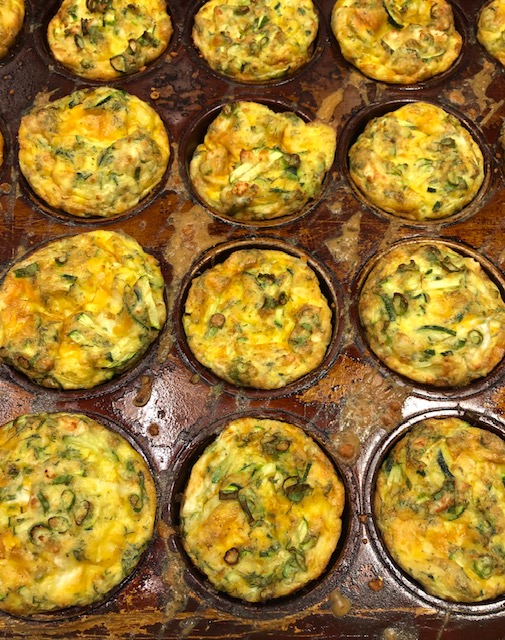
At our restaurant, we are occasionally asked to make gluten-free quiche-like items for breakfast catering. Based on frittata, a crustless Italian vegetable and egg pie, here are individual savory treats baked in muffin pans. Shredded zucchini, feta cheese and dill make very Mediterranean, if not necessarily Italian, breakfast or supper frittatas. They are best right out of the oven, though can be eaten at room temperature or rewarmed in the microwave for a later snack.

The recipe makes about 12 small frittatas. Two to three per person is a hearty serving. 


2 cups eggs (crack eggs into a measuring cup until the volume is reached, 10-12 eggs)

1 cup shredded zucchini

2 tablespoons crumbled feta cheese for batter + 2 tablespoons for topping

1/4 cup shredded cheddar cheese

2 teaspoons snipped fresh dill

2 teaspoons chopped parsley, flat Italian style preferred

1/2 teaspoon salt

1/8 teaspoon black pepper

Large pinch ground celery seed (not celery salt)

Large pinch cayenne

3 green onions, green and part of white parts very thinly sliced


Set oven for 375 degrees. Spray oil or grease a 12-cupcake pan. 

In bowl, lightly beat the eggs with a whisk or fork until well broken up and smooth but not frothy. Add zucchini, 2 tablespoons feta, the cheddar, fresh herbs, salt, pepper, ground celery seed and cayenne. Mix well to combine. 

With ladle, partially fill all 12 cupcake cups to equal levels. Evenly distribute the remaining 2 tablespoons of crumbled feta plus the finely sliced green onion over the batter. Bake in heated oven 8 minutes. Turn pan and continue baking another 8 minutes or so until frittatas puff and a toothpick inserted near the center of one comes out clean.

Best served warm, with a little tomato sauce or salsa, or hot pepper sauce, if desired.


,
Pasta Primavera Showcases 

Spring Vegetables With spring here and fresh local vegetables bountiful at farmers’ markets, a classic pasta dish celebrates the season. 

“Primavera” (“spring” in Italian), or correctly “alla primavera,” indicates that early vegetables dress the pasta, like asparagus, carrots, turnips, radishes, broccoli, spinach or peas. Heavier summer vegetable flavors –- tomato, pepper, eggplant, green beans -- are avoided. “Spring,” however, does not necessarily mean “lite.” Pasta Primavera can be substantial. 

The sauce is quick to cook, though it involves some prep. Almost any mixture of spring or early summer vegetables works. Firmer ones, cut evenly, start the cooking. Then less firm ones are added. Finally, young spinach and tender peas, if used, are added, along with cream, seasonings, and cheese. 

“Farfalle” pasta seems most appropriate. Literally “butterflies” in Italian (boringly, “bow-ties” in English), farfalle maintains the garden theme, and exudes the warm humor of Italian food names. Which cheese to use is an individual choice. In northern Italy, Parmesan, a cows’ milk cheese, is more likely. In southern Italy, it would be Pecorino Romano, tangier and made from sheep’s milk. Having grown up around Sicilians, I prefer Romano. Since the cheese is important to the dish, it is best grated fresh from a chunk. 

In Italy, small portions of pasta form a starter course for a dinner. In the American manner, a large serving of pasta is the main course. Accompany Pasta Primavera with crusty bread, olive oil to dip it in, and a simple green salad. Because of the cheese, I would choose a light to medium-bodied, fairly dry red wine, like a Chianti, or Pinot Noir. 

The recipe serves six. 

12 ounces “short” pasta, like bow-ties (“farfalle”) or penne 

Choose 4 of the following vegetables, 1-1/2 cups each except for spinach: 1/2-inch-diced young carrots, turnips (peeled); quartered radishes; asparagus in 1-inch lengths; 1/2-inch flowerets of broccoli; young (or frozen) peas; 4 cups washed, coarsely cut young spinach 
1 small young onion, finely chopped 
1 clove garlic, finely minced 
1/4 cup coarsely chopped parsley 
1/2 teaspoon of any mixture of fresh herbs, finely minced 
1 cup coarsely grated Romano or Parmesan cheese plus extra for serving 
1-1/2 teaspoons salt, split 
1/8 teaspoon nutmeg 
1/8 teaspoon black pepper 
Large pinch cayenne 
6 tablespoons olive oil 
1-1/4 cups half-and-half cream 

Boil a gallon of water for pasta in large pot. Add 2 teaspoons salt. Let simmer, covered, until needed. 

Prepare vegetables, onion, garlic, parsley, fresh herbs, and cheese. Mix 1 teaspoon salt plus the nutmeg. black pepper and cayenne in a cup. 

Heat olive oil in large pan and briefly fry onion plus carrot, if used, plus 1/2 teaspoon salt for 2 minutes, stirring very frequently. Add turnip and/or radish, if used, and stir and fry for another minute. Add 4 tablespoons water, cover, and steam, stirring occasionally, until vegetables become tender (test by piercing with a toothpick). Add broccoli and/or asparagus, if used, plus another tablespoon or two of water. Cook one minute, covered, stirring occasionally. 

Add half-and-half plus the salt and spice mixture. Bring to a boil. Add peas or spinach, if used, and return just to a boil, stirring. Remove from heat and stir in cheese and parsley. Keep warm and covered. 

As vegetables cook, bring the salted pasta water back to full boil. Add pasta and stir immediately so pasta does not stick together. Cook, stirring frequently, until tender to the bite. Drain in colander and transfer, hot, to large serving bowl. Add sauce plus cheese. Toss together. Taste and add salt if needed. 

Serve with additional cheese.
,


Beef Stroganoff


Created in the early 19th century and named for Count Pavel Alexandrovich Stroganov, the last male scion of a rich and aristocratic Russian family for whom the creator, a French chef, worked, this dish became an international haute cuisine classic. The Franco-Russian treat combines the seared steak and Dijon mustard of French cuisine with the sour cream of Russia. And although the name of the Stroganov family’s chef is now lost, naming the creation for his patron was probably a wise career move. 

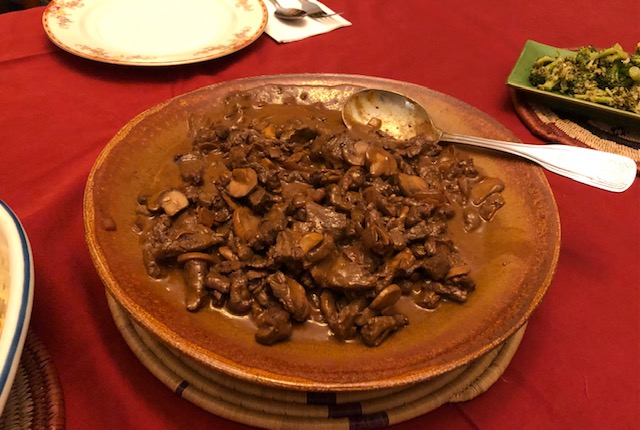
Made by my grandson August Pearson
The alternate spelling “Stroganoff” (the original name is spelled in the Cyrillic, not Roman, alphabet) is used internationally for the dish. Some recipes use mushrooms and ketchup, others do not. But beef, onions, Dijon mustard and sour cream are essential. The other essential is that the strips of beef are fried quickly, part at a time, so they brown lightly, rather than stew. I use beef “flatiron” steak, but fancier cuts of tender lean beef can be used, up to and including tenderloin. 

The traditional accompaniment for the dish is “French” fried strips of potato. But rice and noodle dishes also go well. The recipe serves six. 


1-1/2 pounds “flatiron” (blade of chuck) steak

Butter and sunflower or other vegetable oil (not olive)

1 large onion, very thinly sliced lengthwise

1 tablespoon flour

2 cups beef broth

2 tablespoons red wine

1/2 pound small mushrooms, end of tips removed, mushrooms halved lengthwise

2 tablespoons tomato ketchup or 1 tablespoon tomato paste

1 teaspoon Dijon mustard

1 bay leaf

1 1/4 teaspoons salt, plus more to taste

1/4 teaspoon black pepper

1/2 cup sour cream

2 tablespoons snipped fresh dill for topping (optional) 

Trim tough parts off surface of beef. Cut away any fat. Slice steak across the grain into 1/4-inch slices. Cut any pieces longer than 3 inches into halves. Set aside. 

In large frying pan (one you can serve in) fry sliced onions in 1 tablespoon butter plus 1 tablespoon oil until quite limp. Sprinkle with flour and stir well and gently fry 2 minutes. Add broth and wine, and stir well. Let mixture come to a boil. Add mushrooms, ketchup or paste, mustard, bay leaf, salt and pepper. Let simmer gently, covered, 10 minutes. Turn off heat. 

Heat a griddle or another large frying pan. Add some butter and oil and fry part of the beef, such that it all rests without overlap on the pan and fries. Stir to turn the pieces frequently, until they are gently browned in parts and the pink color has just left. Transfer beef to the sauce mixture, using slotted spoon.

Add more butter plus oil to frying pan as needed, continue to fry part of the beef at a time until finished.

Reheat the pan that contains the sauce, mushrooms, and beef, and simmer 3 to 4 minutes. Stir in sour cream and remove from heat as soon as the mixture bubbles. Taste and add salt, if necessary. 

Sprinkle beef mixture with snipped dill, if used,. Serve with noodles, rice or French fries.

,


Sweet and Sour Red Cabbage with Apple


I’ve been making this dish for many years, typically to accompany a roast of pork or turkey. For the last fifteen years or so we have sold it by the quart at the restaurant as a side dish with roasted turkeys and other Thanksgiving items that many of our customers order for the holiday. 

I first encountered this bright and beautiful treat in college at the classy demonstration cafeteria run by the School of Home Economics, where they called it “Belgian Red Cabbage.” I’ve since learned that sweet and sour red cabbage, often with apple, is prepared in northern Germany, Denmark, and Czech Republic, and elsewhere in central and northern Europe. I actually had it at a Czech restaurant in East Berlin, where it came with roasted goose and potato dumplings.

Here’s how I make it.

1 medium red cabbage

1 large apple

10 whole allspice berries

4-inch strip of orange zest, peeled preferably from an organic or well-scrubbed orange

1/2 cup water

1/2 teaspoon salt, plus more to taste

1/4 teaspoon black pepper

5 tablespoons cider vinegar

4 tablespoons sugar

Quarter the cabbage, cut out and discard the core. Shred cabbage finely (this can be done with a 2-milometer blade in a food processor or mandolin). Peel, quarter, and core the apple and chop the quarters into small pieces. The orange zest and allspice berries can be tied in a small cheesecloth bag for easy removal later.

In a stainless steel or enamel (not aluminum or cast iron) pot bring the cabbage, apples, allspice, orange peel, pepper, salt, and 1/2 cup water to a boil. Simmer, covered, stirring from time to time and adding a little water to keep some liquid on the bottom of the pan. Cook until cabbage is tender and the apple has broken up (about 20 min). 

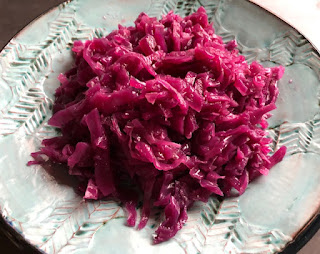
Remove the cheesecloth bag or if it wasn’t used remove the orange peel and allspice berries as you see them. Add the vinegar and sugar plus salt to taste. Simmer about 5 minutes. The color will become a bright crimson red. Taste and add more sugar, vinegar, and/or salt to your taste. The flavor should be delicately sweet-sour.

The dish is best if made ahead and reheated to serve. Re-check the salt before serving.


,


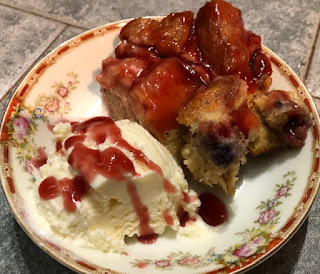
Blueberry Bread Pudding with Raspberry Sauce


Here’s a recipe for a fruited bread pudding that I developed for my pre-teen cooking class recently. The method is somewhat simplified in terms of the baking method, not using a pan of hot water in which the pudding pan sits.

Pudding:

10 cups, fairly packed, cubed (see below) baguette or sandwich bread (one large loaf)
4 eggs
3 1/2 cups whole milk
3/4 cup brown sugar
1 teaspoon vanilla
3/4 teaspoon salt
1/2 teaspoon cinnamon
1/4 teaspoon nutmeg
3 to 4 tablespoons melted butter (easiest in a cup in microwave)
1 cup blueberries, fresh or frozen
1/4 cup pecans (optional), coarsely chopped

Sauce:

1/2 cup raspberry preserves (can put through a sieve if you want to get rid of seeds)

3/4 cup water

Pinch of salt

2 teaspoons brown sugar

2 teaspoons lemon juice

1/2 teaspoon cornstarch

1 teaspoon butter


Heat oven to 375 degrees.

Do not cut off bread crusts, but slice bread if not already sliced, then stack up a few slices at a time and cut into 1-inch squares. Separately, in large bowl, whisk eggs lightly. Mix in milk, sugar, seasonings, and melted butter. Stir in bread. Let sit five minutes then stir again. Stir in blueberries, and pecans, if used.

Generously butter 10-inch round casserole or high-sided cake pan, or 9 by 13-inch pan. Fill with mixture and smooth top. Cover with waxed paper or parchment, then aluminum foil.

Bake 40 minutes. Uncover and bake 10 or more minutes to dry top, and until pudding tests done. (Edges pull away from pan; center should be slightly springy to the touch. A sharp knife inserted near the center comes out clean.) Remove from oven.

Whisk sauce ingredients, other than butter, in a small pan. Add butter. Simmer sauce ingredients 1 minute, stirring with a whisk. With 2-prong fork poke holes into still-hot pudding here and there and spoon sauce on so it soaks in.

The pudding can be eaten warm. Or cool, cover with plastic wrap. Serve cold, or slightly warmed (in microwave, for example). Nice topped with whipped cream or a small scoop of vanilla ice cream.

,


“Wild” Mushrooms sautéed with Goat Cheese (and optional Ham) on a “Planche”
 

Suddenly, some people, including our son-in-law Jason, are growing shiitake mushrooms at home. Locally grown ones are also often available in Georgia in fancier supermarkets, produce markets, as well as Asian grocery shops. Here’s a way of serving them like the French prepare seasonal wild mushrooms, typically as a starter course.

The dish is patterned after a specialty of Louisiana-born and French-restaurant experienced Chef Joe Truex, formerly with Watershed, in Decatur, Georgia. It serves as a starter or a light lunch or supper. 

The “Planche” is a long, diagonally cut slice of French baguette buttered on both sides and fried until golden. English muffins split in half are a readily available substitute. The “wild” mushrooms are either fresh shiitake or a combination of shiitake and oyster mushrooms. But locally collected chanterelles, “Hen of the Forest,” or morels would be more authentic. The ham is optional, but makes the dish richer in flavor. Country ham was Joe Truex’s choice, but smoked ham from the deli counter works well. The ham is easily chopped finely, or minced, on a cutting board with a chef’s knife. 

The recipe serves 4 to 6, depending on how the dish is used in the meal. 

Mushrooms

1 pound shiitake mushrooms or a mixture of small fresh shiitake and oyster mushrooms

2 tablespoons minced country ham or smoked ham (1-2 slices from deli counter) -- optional

1 tablespoon minced shallot or green onion

2 tablespoons olive oil

3 tablespoons white wine

3 tablespoons water, plus more as needed

4-6 ounces soft goat cheese

Salt, if needed (may not be needed if using salty ham)

Juice of 1/2 of a small-medium lemon

Minced parsley for garnish 

Planches

4-6 slices baguette cut 1/2-inch thick on a long, flat bias to make oval slices 4 to 6 inches long (or split English muffins)

Butter for the bread

Prepare ingredients for mushrooms. Rinse mushrooms, and for shiitakes, cut off stems. Slice mushrooms about 1/2-inch wide. Mince the ham, if used. Mince shallot or green onion. Have other ingredients ready. 

Slice the bread into the number of
planches needed, or use one English muffin, split, per person. Lightly butter both sides. Fry them gently in a wide frying pan on both sides until golden. Set on serving plates. 

Reheat frying pan. Gently fry minced ham, if used, and shallot or green onion in olive oil until shallot is softened. Add mushrooms and stir and fry until looking slightly softened. Add wine and water, and simmer, stirring frequently, until liquid is reduced to half. 

Stir in goat cheese, until melted. If sauce is thick add a little water. Remove from heat. Taste for salt, and add a little if needed. Squeeze in lemon juice. Mix briefly. 

Spoon mixture onto the fried planches. Dust lightly with minced parsley. 

Follow Us @donderoskitchen