,


Caprese Skewers, a Summertime Appetizer


Recently at the restaurant we’ve been catering a number of events serving “finger-foods,” small appetizers and baked goods. Such events are typically receptions with light, but colorful, nibbling foods to accompany drinks. A very frequent dish right now, in addition to the inevitable mini-sandwiches, is skewered fresh mozzarella, tomato and basil kebabs based on Caprese “salad.”  That’s the Italian classic appetizer or starter course that’s usually served on a platter rather than bamboo skewers.

Caprese Skewers, a Summertime Appetizer
 

As I am generally the one who prepares this particular appetizer, I’ve developed a fairly simple method and refined it with practice. The fresh mozzarella is easiest to work with if it’s the small balls called “ciliegine,” meaning “cherries.” But blocks can be cut into half-inch cubes, as well. And small “grape” tomatoes are easiest too. But sometimes they are large enough to need cutting in half. Short (4-5-inch) bamboo skewers work well, and do not need soaking before using.


For the basil I generally mince up fresh leaves very finely on a cutting board and mix them with a little salt, pepper and olive oil for marinating the mozzarella. Depending on the amount of basil, the specks on the mozzarella will be lighter or greener, but the basil flavor penetrates the mozzarella, even if the surface doesn’t look really green. I used to use small pieces of basil leaf skewered between the tomato and cheese, but I think the basil-marinated cheese works best.


Several of our recent catering customers, when returning the platters, have told me how much the guests liked our Caprese skewers.


Here’s a recipe based on 8-ounces of fresh mozzarella, that will make enough appetizer skewers for 6-8 people. For bigger groups, multiply the recipe. Allow 2 skewers, or more, for each diner. The skewers can be assembled up to several hours before they’re served. Store them refrigerated and covered with plastic wrap until needed.


10-12 fresh basil leaves, medium-large

1/4 teaspoon salt

1/8 teaspoon black pepper

3 tablespoons extra virgin olive oil

8 ounces  “cherry” sized (“ciliegne”) fresh mozzarella balls, or 8 ounces of a block

8 ounces small grape tomatoes

4-5 inch bamboo skewers


On a cutting board and using a large knife, very finely mince the basil leaves. Transfer to a bowl and add the salt, pepper and olive oil. Drain the mozzarella balls or cut the block or log into 1/2-inch pieces. Mix these carefully into the basil mix to coat well.


Rinse the tomatoes. If small (grape-sized), use whole. If they’re longer, cut them in half, Thread about three pieces of mozzarella alternating with two pieces of tomato.. Arrange the skewers on a serving platter. Cover with plastic wrap and store refrigerated until served. 

,


Irish Colcannon for St. Patrick’s Day


Thinking about Irish food for St. Paddy’s Day required sipping some Jameson, neat. It’s silky and elegant, more like cognac than whiskey. It shimmers across your palate. Now where was I? Oh yes, a dish for St. Patrick’s Day.


I propose colcannon, the savory combination of lightly caramelized cabbage, or braised kale, with mashed potatoes.


While not specifically a St. Patrick’s Day treat, it’s solid winter fare and will pair nicely with salmon and watercress-cream sauce or with lamb chops and mint. It’s also ideal with boiled ham or corned beef for a classic Irish dinner.


The name derives from the Gaelic words for white-headed cabbage. “Cál” is the Irish version of “cole,” an Old-English and Germanic word, though of Latin origin, for cabbage (think coleslaw, kohlrabi, cauliflower). Either cabbage or kale combines heartily with potatoes – and plenty of butter, of course -- to make an amazing dish.


Irish fare is infrequently considered a gourmet offering. But in fact, some dishes are extremely tasty. Well-seasoned mashed potatoes, which my New England-Irish mother served nearly every day of my childhood, is one of those, as chefs at classy restaurants now recognize. The greens in colcannon makes mashed potatoes even richer.


Since this is a side dish, I’m not recommending specific accompanying drinks. Those would depend on the meat or fish in the dinner. But if having beer, please not Guinness stout, as good as it is, especially if serving salmon. A low-hop lager beer would be preferable.


Actually, as my Irish informants inform me, wine or beer is uncommon with dinner there. Men are more likely to drink stout or porter after dinner, while the ladies take sherry.


My recommendation is sipping neat Jameson while you’re cooking. 


Irish Colcannon

1 small cabbage or large bunch kale, cut in 1-inch pieces

1 very small onion, diced

6 tablespoons butter, split

3 tablespoons canola oil

Salt

2 pounds potatoes, baking type or Yukon Gold type

1 clove garlic, peeled

1/4 teaspoon ground black pepper

Large pinch cayenne or 1/4 teaspoon hot sauce

1 tablespoon prepared horseradish (optional)

1/2 cup half-and-half or whole milk

About 1/2 cup water reserved from boiling the potatoes

Gently fry onion and cabbage or kale in 3 tablespoons butter, the oil plus 1/2 teaspoon salt in covered pan, stirring frequently. Add a tablespoon of water from time to time to keep vegetables from sticking. Fry until tender and color is becoming pale golden in places. Taste and add salt, if necessary.


Meanwhile, peel potatoes (or keep skins if not too thick or spotted: if not peeling, scrub potatoes and remove any bad spots). Cut into 2-inch chunks. Place in cold water to prevent browning.


In a pot boil potatoes in just enough water to cover them, adding garlic and 1/2 teaspoon salt. Boil until quite tender and beginning to flake on the edges (10 -12 minutes). Test for doneness with a tooth pick.


Drain potatoes, saving part of the water in a bowl. Return potatoes to pot. Add 1/2 teaspoon salt, the pepper, cayenne or hot sauce, horseradish, if used, and 3 tablespoons butter. Mash well to break up lumps. Add half-and-half or milk and continue to mash and mix. With the masher, beat in enough reserved boiling water to obtain a soft fluffy consistency. Taste and add salt if necessary.


Add cooked cabbage or kale. Mix thoroughly with spoon. Taste again and adjust any seasonings necessary. Cover and keep warm until served.

,


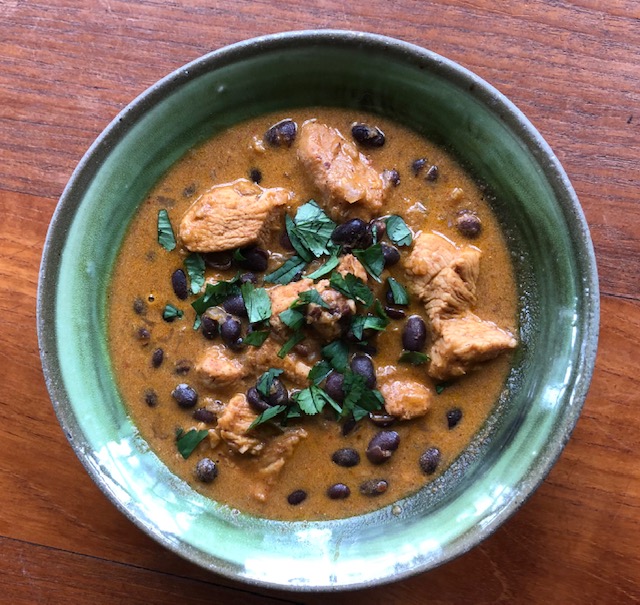
Chicken Braised with Black Beans “Veracruz”


All right, this richly flavored dish is something I created, not a specialty of Veracruz, that Mexican city and state bordering the Caribbean. But it employs a number of ingredients used in Veracruzana cooking, and highlights their favorite black bean.


Chicken Braised with Black Beans “Veracruz”

The dish is a sort of stew, and is designed to be accompanied by rice. I make it a little on the hot side in terms of peppers, but the people I’m making if for, including my grandchildren, like their food peppery.


The recipe serves 6-8 people, but leftovers are very enjoyable. Serve with rice on the side.


The Chicken:

2 pounds boneless, skinless chicken breast

1 teaspoon salt

1 teaspoon cornstarch

1 teaspoon ground cumin

1/2 teaspoon ground black pepper

1/2 teaspoon cayenne


The sauce:

2 medium-large onions, finely diced (or chopped in a food processor)

6 tablespoons olive oil

4 cloves garlic, minced

1 teaspoon salt, plus more to taste

1 teaspoon ground cumin

1 teaspoon (or less if preferred) dry crushed red pepper or cayenne

1 teaspoon ground allspice

1 teaspoon ground annato (sold in Mexican groceries as “Achiote Molido”)

1/2 teaspoon dry oregano

1 1/4 cups chicken broth (low salt)

2 (14-ounce) cans black beans, drained and rinsed well

1/2 cup sour cream or crema

Chopped cilantro for garnish, optional


Prepare and marinate the chicken: Trim off tough or fatty parts from the chicken breasts. Cut flesh into 1-inch cubes. Mix well with the salt, cornstarch, and next three spices. Set aside to marinate.


Prepare the onions, and fry them over medium-low heat in the olive oil in a wide pot, covered when not stirring. Every several minutes, open the pot and stir, scraping the bottom of the pot well, until onions are very soft and starting to turn pale golden.


While the onions are frying, prepare the garlic, measure out the seasonings into a small bowl, and drain and rinse the beans.


When onions are done, stir in the garlic, and fry them in for several minutes. Add the chicken broth plus the seasonings. Stir well, then simmer, covered, five minutes, stirring occasionally. Add the marinated chicken, raise the heat under the pot, and cook, stirring frequently until the raw color of the chicken is gone. Then cover the pot and simmer 5 more minutes, stirring occasionally.


Stir in the drained black beans, and simmer 4-5 minutes, stirring occasionally. Taste the sauce, and add a little salt to taste. Stir in the sour cream, and bring back just to a boil, then remove from the heat. Taste one last time and if under-salted to your taste, stir in a little more salt.


The dish can be served now, or reheated later. When serving, sprinkle the top with coarsely chopped cilantro, if desired. Accompany with rice.

,


Louisiana-Style “Dirty Rice” made with Mushrooms


 “Dirty Rice” is a Louisiana-Cajun sort of rice pilaf in which the rice was traditionally cooked with finely chopped chicken livers, ground meat or sausage, plus seasonings. I prefer it made with chopped dark mushrooms rather than chicken giblets. That idea came from having the wonderful Riz Djon-Djon in Haiti, a specialty rice dish enriched as well as colored a rich brown by local hill-side black
mushrooms. I use Basmati or other long-grained rice, but in Louisiana cooking medium-grained rice, from Louisiana or Arkansas, is more typical.

Louisiana-Style “Dirty Rice” made with Mushrooms
 

Dirty Rice in Louisiana is frequently served with stewed red beans. It makes a good side for a number of savory braised or stewed dishes.


The recipe serves six to eight as part of dinner.


1 1/2 cups Basmati or other long-grained rice

1 medium-small onion

1/4 large green bell pepper

1/2 stick celery

1/4 pound (4 ounces) baby Bella or Portobello mushrooms

3 tablespoons olive oil

1 tablespoon tomato ketchup

1 1/2 teaspoons Cajun Seasoning (or 1/2 tsp salt, 1/2 tsp paprika, 1/4 tsp black pepper, 1/4 tsp celery salt, 1/4 tsp garlic salt, 1/4 tsp cayenne)

1/8 teaspoon black pepper

2 bay leaves

2 1/4 cups low sodium chicken broth or vegetable broth

Coarsely chopped parsley or thinly cross-cut green onion tops for garnish


Rinse and drain rice twice to remove excess starch, and set aside to dry. Finely chop together in a food processor the onion, bell pepper, celery and mushrooms, or finely mince them on a cutting board with a chef’s knife.


In heavy cooking pot in which the rice will be cooked, fry together the minced vegetables and olive oil. Stir frequently, scraping the bottom of the pot. When the mixture is becoming softer and darker, add the ketchup, dry seasonings, and bay leaves. Add the drained rice and stir well. Add broth and stir briefly. Then do not stir again until cooking is done. Bring pot to the boil, uncovered. When boiling, without stirring, cover tightly and turn heat to lowest setting. Set timer for 20 minutes. After 20 minutes, turn off heat and allow to rest without opening the pot for 10 more minutes.


Open pot, remove bay leaves, and fluff gently with a fork. Cover and keep warm until served. When serving, sprinkle lightly with chopped parsley or sliced green onion tops.


An alternative cooking method can be used with a rice cooker. Put drained rice in rice cooker. Fry vegetables and the olive oil in a pan until color has changed. Add this mixture to the rice in the rice cooker. Add the ketchup, dry seasonings, bay leaves and broth. Stir briefly. Cover and cook as usual without opening the cover. When heat goes off, again without uncovering, let rest 10 more minutes. Then remove bay leaves, and fluff the rice with a fork. Keep warm until served. Sprinkle with the parsley or green onion garnish when serving.

,


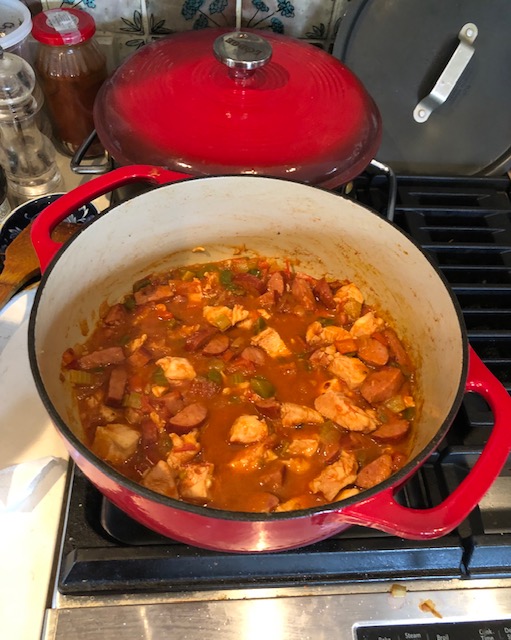
Créole-Style Chicken Stewed with Andouille Sausage


This dish has some elements of Louisiana Créole cooking, and some overlaps specifically with Gumbo. But it contains no okra, which is not liked by one of our recent dinner guests when I made this, and no roux and therefore no gluten (or tedious roux preparation).

Créole-Style Chicken Stewed with Andouille Sausage
 

I ran the idea for this past a friend from Louisiana who was formerly a chef, and she approved. So, here is my stewed dish inspired by my somewhat limited knowledge, though high appreciation, of Créole cooking. I served it with “Dirty Rice” and Céleri Rémoulade. It went well with a nice Sauvignon Blanc. My friend, the former Louisiana chef, might have chosen a Grüner Veltliner.


The recipe serves six. Accompany it with a rice or grits dish, and perhaps a salad.


1 pound boneless, skinless chicken breast

1 teaspoon cornstarch

1/2 teaspoon salt for the chicken

1 (14-ounce) smoked Andouille or Cajun sausage

1 medium onion, coarsely diced (1/4-inch)

1 small green bell pepper, cored then coarsely diced (1/4-inch)

1 small red bell pepper, cored then coarsely diced (1/4-inch)

1 large stalk of celery, split lengthwise then cut in 1/4-inch lengths

2 cloves garlic, minced

3 medium-large tomatoes, cored then coarsely diced (1/4-inch)

3 tablespoons olive oil

2 teaspoons Cajun Seasoning (or 1 teaspoon paprika, 1/4 tsp garlic salt, 1/4 teaspoon celery salt + 1/4 teaspoon cayenne)

1 teaspoon paprika

1/2 teaspoon ground black pepper

1/4 teaspoon cayenne

Salt to taste for the sauce, starting with 1/4 teaspoon

2 green onions, green parts cut in 1/4-in lengths, for serving


Trim off any tough or fatty parts of the chicken and cut the flesh into 3/4-inch cubes. Mix in a bowl with the salt and cornstarch. Set aside.


With a chef’s knife, split the sausage lengthwise into halves. Slice the halved sausage into 1/4-inch lengths. Prepare the onion, peppers, celery, garlic and tomatoes, setting them out in separate piles on a platter.


In a heavy pot, fry the onion, peppers, and celery in the olive oil, stirring frequently, until vegetables are softening. Add minced garlic, stir and fry half a minute. Add diced tomatoes, and stir as the mixture begins to cook. Add the dry spices, other than salt.


When vegetable mixture is becoming more moist and the tomato begins to soften, stir in the sausage. Cook, stirring frequently, until the vegetables are becoming like a sauce, about 10 minutes. Stir in the prepared chicken. Cook, stirring very frequently and scraping the bottom of the pan, until the raw color has gone from the surface of the chicken. Stir in the salt. Cover the pot and simmer 6 minutes, stirring frequently. Taste the sauce, and add salt if needed. Test a piece of chicken for doneness by cutting in half. If the raw color is gone from the center, bite into one of the halves to see if it’s done to your taste.


Cool, then reheat to serve. Sprinkle with the sliced green onion. Accompany with a rice dish or a seasoned grits dish.

,


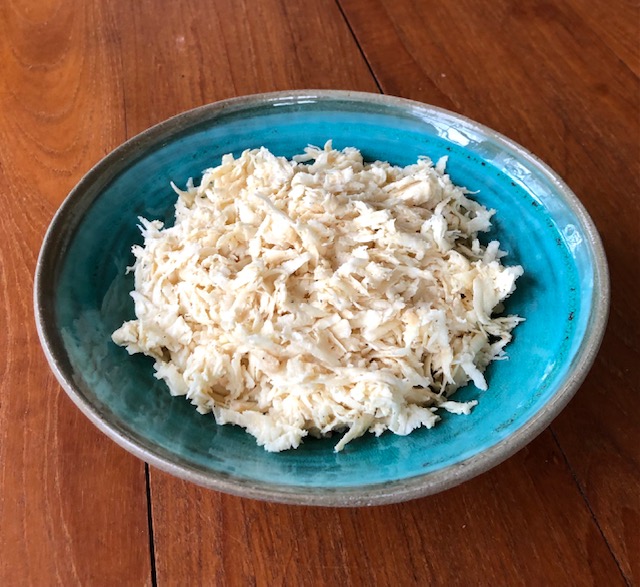
Céleri (Celery Root) Rémoulade


Celery Root (Celeriac), or in French, “Céleri Rave,” is the heavy, bulbous stem base of one variety of celery plants. Although botanically part of the stem rather than a true root, it is treated like a root vegetable. It has a delightful, subtle celery flavor, and is used extensively in colder parts of Europe where the “root” stores well in winter, when the more typical stalk celery was not available prior to modern transportation. Used in soups and stews, or boiled and mashed, it also makes a wonderful type of slaw, “Céleri Rémoulade,” that is somewhere between a salad and a condiment.

Céleri (Celery Root) Rémoulade


This special dish is most typical in French cuisine, showing up in appetizers and small side dishes. It is also popular in Louisiana Créole (French-descended) cooking. Fortunately it is simple to make, other than the grating by hand, which is made easier using the shredder blade in a food processor. Recently I got a celery root for another cooking purpose, and prepared a rémoulade with the generous amount I had left over.


The recipe makes enough for six or more people as a side salad and may more with appetizers. Leftovers keep well for several days in the refrigerator.


1 medium-large celery root, about 1 pound after peeling

4 tablespoons mayonnaise

1 tablespoon Dijon mustard

1 teaspoon olive oil

1 teaspoon vinegar

1 1/2 teaspoons salt, plus more to taste

1/4 teaspoon ground black pepper


Peel the celery root, cutting off the twisted smaller roots at the bottom (the peelings and small roots make excellent vegetable broth). With a sharp knife, cut out any crevices left between the bottom roots. Grate the celery root on the coarse side of a hand grater, or use the coarse grater blade of a food processor (first cutting the root into chunks small enough to fit down the feeder tube). Transfer the grated root to a mixing bowl.


Add the remaining ingredients and mix well. Let the mixture rest five or ten minutes and mix again. Do this once or twice more, as the salt draws a moisture from the grated root and the rémoulade becomes moister. Its best to make this at least a half hour before eating time. Taste the mixture and add salt, if needed, to taste.


If serving as part of a meal, place in an attractive serving dish.

,

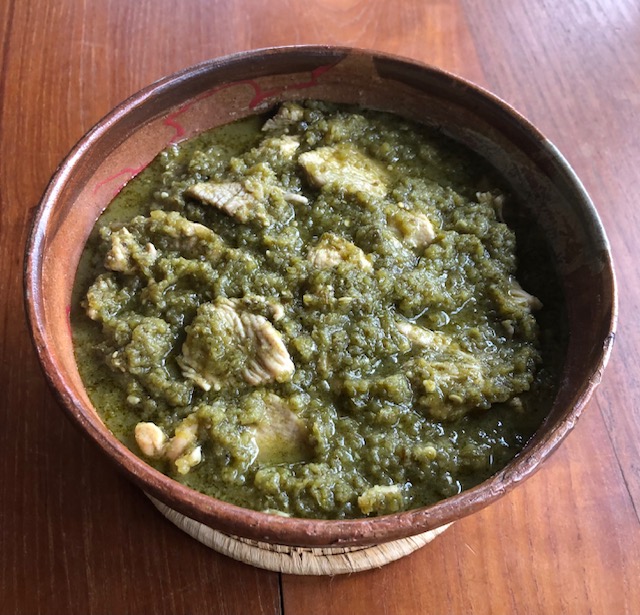
Green Chile with Chicken


I’ve loved green chile since I first encountered it many years ago in New Mexico. A meat, like pork or chicken, is cooked in a sauce rich in roasted medium-hot green peppers. And no beans are included in the chile, as they typically would be in Tex-Mex chili, though beans are often be served as a side dish.


Green Chile with Chicken
Not having easy access to the wonderful New Mexico green “Hatch” chilies (they can be bought roasted and ground, frozen, on the Internet), I’ve made green chile both at the restaurant and at home using a mixture of Poblano, Jalapeño and ordinary green bell peppers, along with tomatillos, onion and garlic for the sauce. And most recently I’ve tried not roasting these vegetables before grinding them for the sauce, rather grinding them raw in the food processor then “frying” the mixture with olive oil before adding the meat. It’s not like being in Santa Fe, but it still tastes good!


Here’s my current, much easier, recipe for green chile with chicken. It makes enough to serve six. It can be accompanied by a bean dish, rice, and/or cheese biscuits.


2 large poblano peppers

1 small green bell pepper

2 whole jalapeño peppers

3 medium-large tomatillos

1 medium-small onion

3 large cloves garlic

1/2 cup olive oil

2 pounds boneless, skinless chicken breast

1 teaspoon cornstarch

2 teaspoons salt, part for chicken part for sauce

1 teaspoon ground cumin

1/2 teaspoon ground black pepper

1/2 teaspoon ground allspice

1/2 teaspoon dry oregano

1/8 teaspoon ground cloves


Remove the stems, cores and seeds from the poblano and bell peppers. Cut the flesh into large chunks and place them in a food processor. Cut the stems off the jalapeños, but keep the seeds. Cut the jalapeños in half and add them to the food processor. Thoroughly puree the peppers, scraping down the inside of the processor several times. Transfer the pureed peppers to a heavy cooking pot.


Remove the outer husks from the tomatillos and twist out or cut out the small tough stems. Cut tomatillos in half and place in the food processor. Peel the onion and cut it into large chunks and add it to the processor. Peel the garlic cloves and add them to the processor. Thoroughly puree these vegetables. Add the mixture to the pot, scraping out the processor container well.


Add olive oil to the pot and cook the mixture over medium-high heat for 10 minutes, scraping the bottom of the pot frequently.


Meanwhile, trim away any tough or fatty parts from the chicken breasts. Cut the meat into medallion-type pieces, 1-1/2 by 1 by 1/2 inch. Mix the chicken with cornstarch plus 1 teaspoon of the salt. Allow chicken to marinate until ready to add to the vegetable sauce.


Add the other 1 teaspoon of the salt plus the dry spices and herbs to the vegetable mix, reduce the heat, and simmer for 5 minutes.


Bring the mixture back up to a boil and stir in the marinated chicken. Stir frequently until the raw color has fully left the chicken. Reduce the heat again, cover the pot and simmer for 5 minutes, stirring occasionally. Taste the sauce and a bit of chicken and add salt to taste, if needed.


It’s best to let the chile cool, then reheat it to serve. Do a final taste-test on the salt at this time, and add a little if needed.


Follow Us @donderoskitchen