,


                                     Coleslaw, Delicatessen-Style

 
Good-old American coleslaw hails from … (wait for it!) … Holland. “Koolsla” in Dutch is pronounced exactly like coleslaw (double “o” in Dutch sounds like the long O in “rose”). Koolsla is the shortened form of “koolsalade” -- cabbage salad.

 I make coleslaw the New York German deli way, with little mayonnaise, but tangy sweet and sour.

Any smooth-leaved green variety of cabbage seems to produce good coleslaw. Sweetness in the cabbage gets lost with all the seasonings added to it by the time the dish is completed. Savoy cabbage, though I love it for other things, in my experience doesn’t make particularly good coleslaw. Red cabbage produces a spectacular, if unorthodox, coleslaw. It serves well on a holiday buffet table. Specialty slaws for fancy and restaurant fare include slaw made from shredded Brussels sprouts.

 The recipe serves six as a side dish, with easily stored left-overs.

1 medium head of green (or red) cabbage or 3/4 of a medium-large head
1 medium-large carrot
2 tablespoons mayonnaise (“real” preferred)
1 tablespoon Dijon-style mustard
6 tablespoons white vinegar
4 tablespoons sugar
1-1/2 teaspoons salt, plus more to taste

1/4 teaspoon ground black pepper


Discard any tough outer cabbage leaves. Cut off cabbage’s bottom inch. Cut the head in half through the stem and cut it again into quarters. Set a quarter on a board and cut away the core and any big ribs on the exterior.

 Shred cabbage finely crosswise, either with a sharp knife on a cutting board, with a mandolin slicer, or in a food processor fitted with a 2-millimeter slicer blade. As you shred it, place cabbage in a very large bowl for mixing.

 Peel carrot and shred it, using the coarse side of a grater or the food processor fitted with a grater blade. Add it to the cabbage.

 Add mayonnaise, mustard, vinegar, sugar, salt and pepper. Mix well. It will be dry at first. Let it sit 15 or 20 minutes, mixing from time to time, until the cabbage softens and the juices increase. Taste and adjust salt, vinegar or sugar as desired.

 Coleslaw is best if allowed to chill for an hour or more, or even up to several days, covered. Mix well and taste before serving and adjust salt, vinegar or sugar if needed. 

,


Pad Thai Noodles


I’ve been slow on getting recipes onto my blog during the Covid pandemic, since I’ve been cooking virtually every day at the family restaurant, Donderos’ Kitchen here in Athens. Casual cooking for family and friends, as well as teaching cooking, which often lead to blog posts, have been off for over a year. But I’ll try to get back into the habit, especially now that the hits on the blog have increased appreciably. I’ll start back up with a family favorite, pad thai noodles.


Pad Thai noodles,, without shrimp
Pad Thai noodles, non-shrimp version
This exciting concoction of rice noodles fried sweet and sour with shrimp, tofu, pork (I sometimes substitute chicken), bean sprouts and toasted peanuts, is thought by some Westerners to be a Thai national dish. In fact, pad thai, meaning fried in the Thai manner, is street vendor food that is whipped up fresh and served for lunch or snack. And it is only forty or fifty years old and not part of traditional Thai cuisine. My wife, Christina, grew up in Bangkok, and did not even see this dish until she was an adult. Because pad thai is typically a light meal in itself, it, like most noodle dishes, is not usually included in a Thai dinner.


The recipe serves six.

 1/2 pound Thai dry flat rice noodles, 1/8-inch wide

2 eggs, beaten

12 fresh shrimp, peeled, deveined, tail shells left on (optional, increasing the meat if not using)

1/2 pound raw chicken breast or pork, thinly sliced

1/2 of a (1-pound) cake of tofu, firm style, in 1/2-inch cubes

3 large cloves garlic, finely chopped

3 scallions, including most of the green part, diagonally sliced 1/2 inch long

5 tablespoons peanuts (dry roasted), crushed or chopped slightly

2 cups fresh bean sprouts, rinsed

3 tablespoons coarsely chopped fresh cilantro (coriander) leaves

4 tablespoons freshly squeezed lime juice

4 tablespoons Asian fish sauce (available in Asian groceries)

4 tablespoons palm or brown sugar

1/2 teaspoon ground red toasted pepper or 1/4 teaspoon cayenne plus 1/4 teaspoon paprika

3-4 tablespoons vegetable oil (not olive oil)

1 red chili pepper, seeds removed, shredded or 1/2 teaspoon roasted Thai pepper flakes)

Lime wedges plus several sprigs of cilantro (coriander) leaves for garnish


Break noodles into 4-inch lengths. Soak in warm water at least 20 minutes, until softened. Drain. Beat eggs in a small bowl. Prepare the other ingredients from shrimp through cilantro leaves and set out in separate piles on a platter before cooking. Mix lime juice, fish sauce, sugar, and toasted red pepper, or cayenne plus paprika, in a small bowl.


Heat oil in a wok or large frying pan and gently stir-fry the garlic until pale golden. Add chicken or pork and increase heat and stir-fry until color is almost changed. Add shrimp, if used, and continue to stir-fry just until shrimp turn bright pink. Add the tofu. Stir and fry 15 seconds. Add lime juice mixture, stirring briefly to dissolve.


Add drained noodles and stir through the mixture 20-30 seconds (the noodles should start to become tender). Push noodles to one side in the wok. Add a little oil to the emptied part of the pan, and pour in beaten eggs. As they set, gently scramble them, keeping them separate from the noodles. Place most of the bean sprouts and scallions plus half the peanuts and chopped cilantro on the noodles. Stir these and the scrambled eggs throughout the noodles. Taste a noodle, and add fish sauce or salt if needed.


Serve immediately on a large plate or platter, sprinkling on the remaining bean sprouts, peanuts, scallions, chopped cilantro leaf, and red pepper or pepper flakes. Garnish with lime wedges plus several sprigs of cilantro. Diners should squeeze a little lime juice on their noodles.

,


Fruitcake Bars – A Relatively Easy Family Favorite Treat


Here, after the holidays, as we eat the last of this season’s fruitcake bars, I realized I should get the recipe onto the blog so that family, and others who might be interested, can access it. I didn’t want to risk misplacing it, as happened for several years with our Lekerli recipe (see my blog post of December 6, 2020).

Although fruitcake is, or at least was, very common around the holidays, and I loved it, it was complex and tedious to make, wrap, and cure over weeks with rum or brandy or bourbon. Worse yet, it wasn’t very well liked by many people, such that it suffered from the joke about there being only one actual loaf of fruitcake in the world and it kept being re-gifted and passed around.

Many years ago on short notice just before Christmas I was asked to make a holiday food item for my wife’s church choir pot-luck brunch. Traditional fruitcake was out of the question because of the time needed to make and age it. The choir event was the next day. I worked with what we had in the kitchen and threw together a heavy, fruit and nut-packed batter and baked it in a sheet cake pan. I cut the cake into bars, sprinkled them with bourbon and arranged them on a platter, and off they went to church. The approach used several of the tricks of making classical fruitcake that I had learned from my mother as well as numerous shortcuts. Finally, and subversively, I used liquor in it for a church that then still frowned on drinking. The bars were a hit. Ever since, and with a few modifications to the recipe, my wife or I have made our Fruitcake Bars almost every year. There are extended family members and several friends who wait eagerly for this annual Christmas treat. 

In a pan on the stove, heat together to moisten the fruit, then set aside:
1 1/2 cups golden (“sultana”) raisins
1 1/2 cups black raisins (Monukka, Muscat or “large green” if available)
1/2 cup bourbon or rum
 
In a large bowl cream together by hand:
1/4 cup butter
1/2 cup light brown sugar
 
Beat in:
2 eggs
 
Add and mix in well:
1 1/2 cups flour
1 teaspoon baking soda
1 1/2 teaspoons cinnamon
1 teaspoon ground allspice
1/2 teaspoon nutmeg (fresh grated is best)
 
Add and mix in well, using a wooden spoon:
1 1/2 cups coarsely chopped or broken pecans
1/2 cup candied cherries, cut up
1/2 cup candied pineapple pieces
1/2 cup candied citron
1/2 cup candied orange rind
1/2 cup dried apricots, coarsely chopped
1/2 cup pitted prunes, coarsely chopped
The prepared raisins
 
Grease a 9x13 inch pan or 2 8-inch square pans. With wet hands, press the dough into the pan(s). Bang the pan(s) on a hard surface several times to force out bubbles.
 
Heat oven to 315 degrees and place a pan containing boiling water on the lower shelf. Bake the fruitcake for about 45 minutes, or until the center springs back when you push on it with your finger.
 
Cool cake in the pan overnight with a clean towel covering it. With a sharp knife, cut cake into 1-inch squares or 1/2 by 1 1/2 inch rectangles.
 
Store in tightly covered tins lined with bourbon or rum-soaked paper towels. Place more soaked paper towels between layers of bars and on top. Store at room temperature. After a few days, sprinkle with 1-2 tablespoons bourbon or rum, and repeat this several days apart until towel stays slightly moist. The fruitcake bars keep well for weeks.
 

Note, if avoiding the use of liquor to wrap the bars (that in the raisins will have cooked off during baking), store the container with the bars in the refrigerator.

,


Lekerli – German-Swiss Honey-Spice cookies from Basel

Basler Lekerli (or Läkerli) are glazed rectangular or diamond-shaped spice cookies that my family love around Christmas. The cookies are tedious and tricky to make, and thus are particularly special for the holiday. It has become a tradition with us, though not because of any Swiss background. The cookies keep for weeks, and improve in both flavor and texture with storage.

Lekerli are the German-Swiss counterpart, developed in Basel, to the originally Bavarian Nuremberg honey-spice cookie, Lebkuchen. Both date back about seven centuries. I found the recipe in a small Swiss cookie cookbook at the book store at World Health Organization in Geneva, where I was doing a work project in the mid-1980s. The book, fortunately, was the French translation, which I can read, of an originally German language regional cookbook, which I could not have read. With some adaptations that I made to the recipe for our local conditions and preferences, it became a favorite, which I baked nearly annually for decades.

When we moved to Athens from Atlanta, the recipe, typed on a single page of paper, disappeared in transit. My wife, Christina, tracked down a copy through a complex communication and locating an old friend of hers who, she recalled, had liked our cookies and photocopied the recipe. Our new copy is a printout of the pfg-transmitted copy of our original, which Sylvie had photocopied. Having just made the Lekerli as a project with several of my grandchildren, I’m now getting it on my recipe blog to keep it accessible.

Basler Lekerli

Mix together in a large bowl:

3 1/4 cups flour

1 1/2 tablespoons cinnamon

2 1/2 teaspoons nutmeg (fresh grated is best)

2 teaspoons ground cloves

3/4 teaspoon baking soda


In a separate bowl:

2 1/2 cups chopped almonds (with skins)

6 tablespoons candied orange rind, coarsely chopped

6 tablespoons candied lemon rind, coarsely chopped

Grated rind (zest) of 1 lemon

3 tablespoons orange juice


In a large pan, bring to a boil:

3/4 cup honey (strong flavored, such as wildflower honey)

3/4 cup sugar

Once the mixture has boiled, remove pan from the heat and stir in the almond mixture. Then transfer this all to the bowl with the flour mixture and combine using a strong wooden paddle. This can be difficult. The dry mixture can be kneaded with the hands once it is cool enough to touch.

Place one half of the dough (broken up and scattered) on the bottom side of a greased cookie sheet or greased parchment (not waxed paper) on the cookie sheet bottom. Roll the dough 1/4 inch or thinner, using a waxed paper sheet on top of the dough or lightly dusting dough with flour while rolling. Cut off ragged edges and fill in any gaps so as to get a large rectangle of dough. 

Repeat for the other half of the dough. 

Bake in a 315-degree oven until golden brown, 15-17 minutes. Remove from oven. While still hot, run the edge of a sharp knife underneath the edges of the dough to separate it from the parchment or the pan.

For each sheet of cookies, make the glaze (recipe below). This can be done separately for each sheet of dough, or together (glaze recipe doubled) once you’ve done this a time or two. When glaze is cooked, quickly paint the top of the still-hot baked dough (stick it back in the oven for a minute or so if needed) evenly with glaze using a pastry brush. The glaze will get cloudy and look like icy snow.

Using a sharp knife, cut the still-warm cookies into diamonds (1 1/2-inch wide lengthwise strips then 1-inch wide strips on a diagonal) or cut crosswise into rectangles 1 1/2 inches by 2 inches. Allow cookies to cool thoroughly. Lift them off the pan or parchment with a sharp spatula. Let them dry for a little while. Store in tightly covered tins,

Let ripen for at least a week for best flavor and texture. 

GLAZE for each half of the dough:

6 tablespoons sugar

3 tablespoons water

Boil in a pan without stirring (but gently swirl the pan occasionally) until the syrup first begins to spin a thread when a little is dripped from a spoon. Do not overcook. Brush quickly on a baked sheet of Lekerli.   


,

Sweet Peppers Sautéed with Chopped Meat: Easy farm-style late summer supper

Gardens in Athens are full right now with late summer produce, and days are still warm and lazy, and our movement is still restricted by Covid. Hunkered down and cooking a lot is one of the activities available.

Our son-in-law, Jason, gave us a bunch of sweet long peppers, both red and green, plus sweet potatoes from his garden. I was not inclined to long or fancy cooking at home. I do plenty of that at the restaurant.

The peppers, cored, sliced and fried with a little onion, garlic, chopped meat (pork in this case, but lamb would be my preference if it were available) and simple seasoning sautéed up into a very bright and satisfying dish served with the roasted sweet potatoes plus some sliced fresh local tomatoes. No exotic seasonings, much as I love them, seemed appropriate to this farmhouse super. It was a bit like what my mother made decades ago when I was a kid.

The recipe will serve 4-6, depending on the amount of starchy side dish. Roasted sweet potatoes worked well, but so should baked potatoes, or a rice dish or a noodle dish – or quinoa?

6 large long sweet peppers, half green and half red (or 2 each red and green bell peppers)
1/2 small onion
1 large clove garlic
1 pound ground pork or lamb, not too fatty
1/2 teaspoon freshly ground pepper
1 teaspoon salt, plus more to taste
1/2 teaspoon lemon juice or vinegar

De-stem and remove cores and seeds from peppers. Cut into thin (1/8-inch) strips and cut to no longer than 1-inch long. Dice onion. Mince garlic.

Combine vegetables with ground meat in a frying pan and cook, stirring often and scraping the bottom of the pan, until meat changes color. Add pepper, salt and lemon juice or vinegar. Stir and fry for several more minutes. Taste and add a little salt, if needed, to taste.

If desired, spoon meat mixture off with a slotted spoon so as to leave excess grease behind. The dish can be served now or refrigerated and reheated for serving later.

Serve hot with roasted sweet potato or potato (quickest cooked in the microwave), or a rice dish or noodles. Accompany with a fresh salad for a summertime supper treat.

,

Lentil Soup with Vegetables, a hearty meatless treat

A satisfying dish, originally from the Middle East, lentil soup is made from one of the earliest cultivated plants in the world. Such a dish shows up in Genesis, the first book of the Bible, and allowed Jacob to wrest away the patrimony of his father, Isaac and his grandfather, Abraham, from his hungry older brother Esau. The recipe here is less auspicious, but very tasty nonetheless.

The recipe serves six with leftovers.

1 pound dry tan or green lentils
1 large bay leaf
1 large onion, diced
1 large carrot, peeled and diced
1 stalk celery, diced
1/4 of a red bell pepper, diced (optional)
2 cloves garlic, minced
2 medium tomatoes, diced (or 1/4 cup canned crushed tomato)
3 tablespoons olive oil, plus more for garnish
1 (2-inch) sprig fresh rosemary (or 1 teaspoon dry oregano)
3/8 teaspoon black pepper
1/4 teaspoon cinnamon
1/8 teaspoon cayenne
1 1/2 teaspoon salt, plus more to taste
1/2 teaspoon lemon juice or vinegar for serving
A little minced parsley for serving, optional

Pick over and rinse lentils. In an uncovered pot bring them to a boil in water above the level of the lentils, then immediately drain (this eliminates the “muddy” flavor of American lentils and does not appreciably reduce the protein value of the soup).

Add water to cover the lentils by about 3 inches. Bring them back to a boil. Skim off any foam. Add bay leaf and simmer until lentils are tender, about 25-30 minutes.

Meanwhile, finely dice onion, carrots, celery, and bell pepper if used, and mince garlic. Separately dice the tomatoes if using fresh, and set aside. Fry all except the tomato gently in olive oil until onion becomes limp and translucent. Then stir in the diced or crushed tomato and fry for one more minute. Add fried vegetables to the simmering lentils, along with the rosemary or oregano, cinnamon, pepper, and cayenne. Stir from time to time until lentils are very tender and start to break up (10-20 minutes), skimming off any foam that collects. Add a little water if necessary to keep mixture from becoming thick. Add salt, then more as necessary. Remove from heat. Check salt again 5-10 minutes after finishing cooking.

The soup is best if made ahead and stored before serving. To serve: reheat, taste and add salt if needed. Just before serving, stir in lemon juice or vinegar. When serving, drizzle the soup with some olive oil and if desired sprinkle on a little minced parsley.

,

Fresh Fig Tart, Celebrating Local Figs

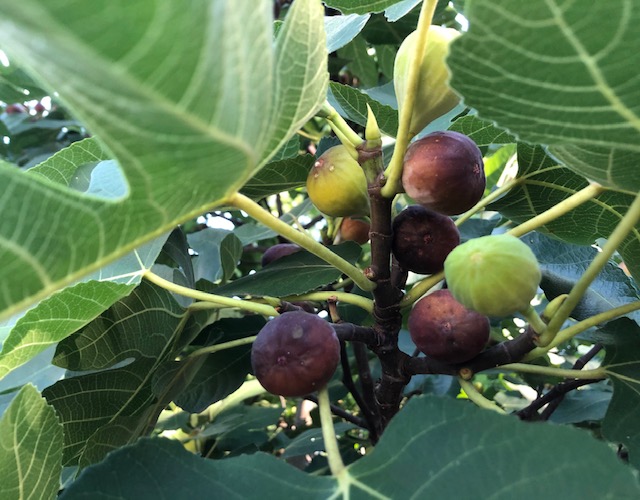
It’s been a remarkable season for figs. With no late frost to destroy the early buds, and enough rain to keep the trees from self-pruning, we – and the birds and even squirrels – have enjoyed many succulent fruits from the “Brown Turkey” and the even more fig-flavored “Celeste” fig trees planted near the restaurant and in our yard.

Not having a family recipe for fig tart, we turned to the recipe for the wonderful rhubarb tart my wife Christina makes from the unapologetically rich desert book, Rosie’s All-Butter Fresh Cream Sugar-Packed Baking Book, by Judy Rosenberg. “Rosie” originally began baking professionally in Harvard Square, Cambridge, MA, and probably kept the Massachusetts General Hospital’s Cardiology Department prosperous.

Figs are sweet and mildly flavored, unlike the assertive rhubarb, which I love and grew for years from plants my father started in my hometown up north. So Christina marinated the cut figs, harvested today, in lemon juice then cut back significantly on the sugar mixed into them.

Here’s the recipe for an 8-inch square or 9-inch tart, enough to feed six to eight a fantastic, rich seasonal dessert. (And while we haven’t tested it, this method should work also for the moist dried apricots that come from Turkey, and possibly even pitted dates.)

The Base (a shortbread crust):
1 cup flour
5 tablespoons confectioner’s sugar
8 tablespoons (1 stick) unsalted butter, room temperature, cut into 8 pieces
1 egg white for glazing (use the yolk in the topping)

Topping:
3 cups halved fresh figs
Juice of one large lemon
1 whole egg plus the reserved yolk from glazing the base
3/8 cup granulated sugar
3 tablespoons flour
1/4 teaspoon salt

Preheat oven to 350 degrees. Lightly grease an 8-inch square pan or a 9-inch pie pan.

Process the flour and confectioner’s sugar several seconds. Add butter and process until dough comes together, 20 to 30 seconds. (Or do all this in a bowl with a pastry knife.) Pat dough into the greased pan. Glaze the crust with egg white by pouring the white on the dough and tipping pan from side to side so the white coats the surface. Pour off the remainder of the egg white.

Bake the base until golden, about 25 minutes. Cool base completely (refrigerate to speed this up).

Prepare the topping. Mix the figs with lemon juice. In a bowl mix together the egg, egg yolk, sugar, flour and salt. Add the figs with their lemon juice.

Spread the fig mixture over the cooled, baked base. Bake the tart until set and slightly golden, about 50 minutes.

Cool completely before cutting into squares or wedges.

Follow Us @donderoskitchen